




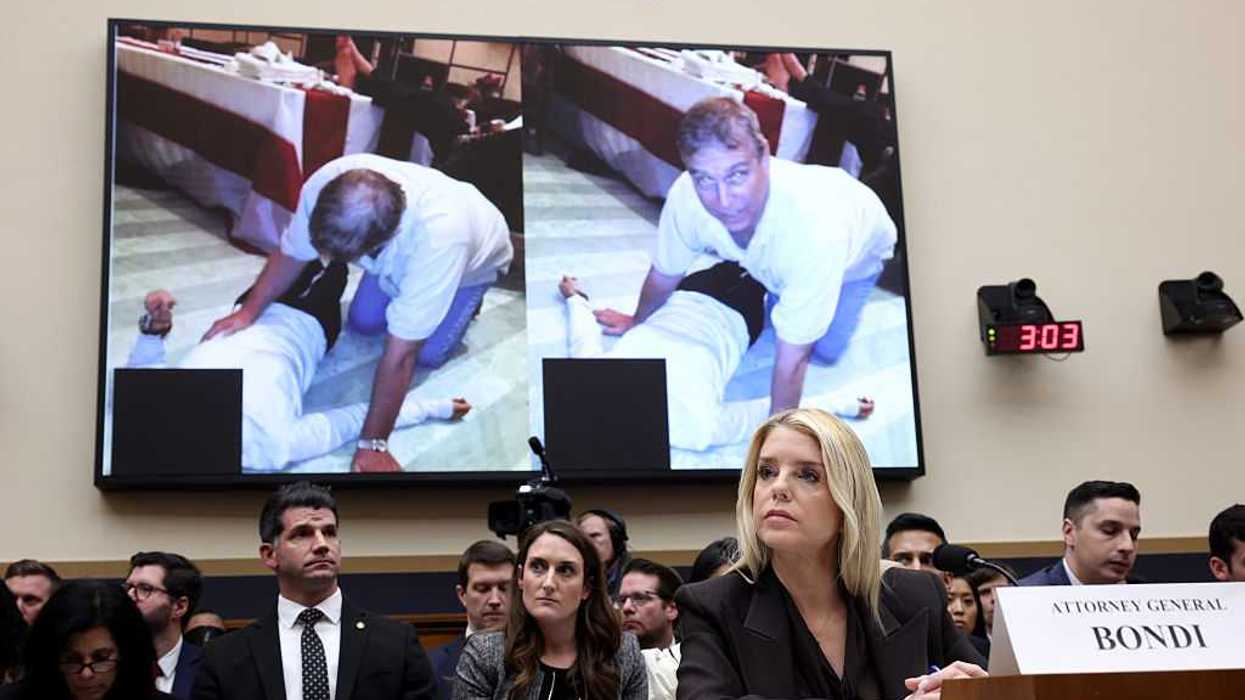

The Epstein files are spelling trouble for elites everywhere.
The 3.5 million emails released recently by the Department of Justice concerning Jeffrey Epstein tell a tale of powerful men, and some women, committing terrible crimes with complete impunity. No wonder people are calling for removing them from power—including President Donald Trump.
Some of the hundreds mentioned have already been fired or resigned from their high positions across the globe, including former Prince Andrew, Peter Mandelson, Larry Summers, Brad Karp, Kathryn Ruemmler, Jack Lang, Thorbjørn Jagland, Ahmed bin Sulayem, Casey Wasserman, and more. This sure is the right thing to do. These people should be held accountable. But stopping there will only prolong the problem.
As a political theorist, I’m struck by the view of power that informs how many talk about the Epstein scandal of sex trafficking more than 1,000 minors and women who have come forward. The discussion is about power as a property, like money, that people either have or don’t. Those who have it can wield their power over those who have little or none. If this is what power is, then of course the goal is to take it away from those who use it for bad.
But what if power isn’t that kind of thing?
My own work draws heavily on the work of the French philosopher Michel Foucault, who argued that power isn’t something we have but something we do. Power is a lot more like playing ice hockey than it is like having money.
As millions watch the Olympic Winter Games Milano Cortina 2026, the aim in ice hockey is to get the puck into the goal, which would be easy enough were it not for other players trying to keep the shooter from scoring. They have a lot of ways to do so, from dispossessing the player of the puck, moving into its trajectory, putting a player in the goal to block the puck, or disrupting the opposing team’s focus with heckles and taunts.
It’s not having the puck that makes one a powerful player, but what they can do with it—and what they can do in relation to other people on the ice who have aims and interests that are in tension with the player playing the puck.
Foucault contends that power is very much like that. It’s not that some have it and others don’t, but that everyone is trying to influence others and evade being influenced. Just as in ice hockey, the positions of defense, center, wings, or goalie are products of the dynamics of the game, so in life, relations of power create a place for us in society. The goalie doesn’t exist before or outside of the game; they exist because the game creates that role.
Thinking of power in this way, it’s clear why it might be difficult to take it away from all those embroiled in the Epstein affair. Power might not be the kind of thing that can be given or revoked. And even if it is possible to cast out the creeps, there will always be more creeps to take their place in pursuit of money, connections, glamour, and the thrill of forbidden sex.
Especially the thrill of forbidden sex.
Some commentators have expressed surprise that the Epstein fallout has been so much more subdued in the United States than in Europe—a sign, they say, that Europeans still have a sense of shame.
But is it really so surprising that a culture with a reputation for prudishness, where Republican lawmakers want to investigate a Super Bowl halftime show for featuring “disgusting and pornographic filth” while dragging their feet on the Epstein files, is particularly challenged at confronting sexual depravity?
Foucault, who lived from 1926 to 1984, argued that sexuality is completely central to who we are but that this hasn’t always been the case. Sure, people have always sought pleasure and reproduced sexually. But they didn’t think of themselves as sexual beings whose every behavior—from smoking to nail biting to chewing on pens—is thoroughly sexual.
Yet at the same time as everything became sexualized, sex was shunned from daily language and social life. In the U.S., sexual terms and “dirty” words are bleeped on TV, purportedly sexual images are blurred in movies, and breastfeeding in public is at best frowned upon.
But all that taboo just makes sex more interesting. If sex is repressed, Foucault claimed, then transgressing that prohibition seems powerful and liberating. Perhaps this is why many look on with obscene fascination, as more and more lurid details come out. Being made involuntary voyeurs in this ghastly spectacle is repulsive, to be sure, but it also offers a glimpse of power and freedom, of the sheer possibility of doing what is forbidden.
Certainly, all those implicated in Epstein’s criminal operation must be shamed, shunned, and criminally prosecuted. But no amount of political or organizational resignations, royal ousters, expressions of contrition, and criminal prosecutions will rid the world of the Epstein class. People like this exist because the relations of power we inhabit create the kinds of people who ruthlessly seek wealth, influence, and the rush of transgression. It will take more than going after reprehensible individuals to change that.
With U.S. political representatives now having access to the Epstein files, it is time to act. The question is how we want to play this: try to score some goals or play a different game instead.
Verena Erlenbusch-Anderson is an associate professor of philosophy and political science at the University of Illinois Urbana-Champaign and a Public Voices Fellow with The OpEd Project.











The President Invited Iran to Bomb My Home