
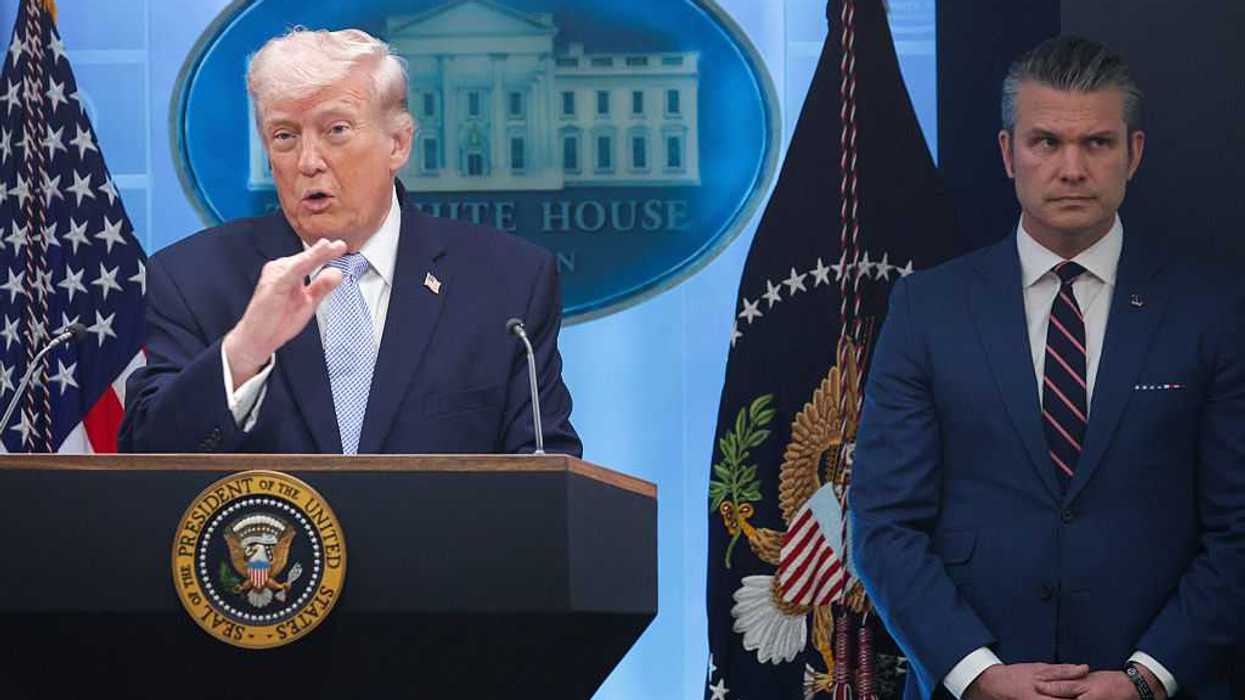

Trump and Hegseth are unconstitutionally foregoing military doctrine as they transform the world’s most powerful secular force into a white Christian nationalist militia. In doing so, they are destroying our military’s legitimacy both domestically and abroad. As a matter of national security, they must be stopped.
Their attempt to radicalize the military is hardly theoretical; Hegseth has left more than enough clues that what he wants is a Crusade. After all, he titled his own book American Crusade. In the book, Hegseth explicitly rejects the separation of church and state as “leftist folklore.” His own tattoos—the Jerusalem Cross and the phrase “Deus Vult” (God Wills It)—are historic rallying cries for the Crusades.
Now, the Secretary of War is working to institutionalize this theology with terrifying speed. He is already using his platform to frame the conflict in Iran as “Jesus versus Muhammad,” according to Michael Weinstein of the Military Religious Freedom Foundation (MRFF). In fact, the MRFF has logged hundreds of complaints by non-commissioned officers reporting that leadership is telling them the war is “part of God’s divine plan” and that the President was “anointed by Jesus to light the signal fire in Iran to cause Armageddon.”
The recent firing spree of top military brass—including General George (the Army’s Chief of Staff), General Hodne (head of Training and Doctrine Command), and Major General Green (the Army’s Chief of Chaplain)–is not a standard reshuffling. By removing these specific leaders, Hegseth has seized the mechanisms of military indoctrination, facilitating the shift from a secular national defense to a brute squad of religiously motivated loyalists.
Meanwhile, the rhetoric accompanying these moves has been nothing short of blasphemous. At past Pentagon services, Hegseth has called for “overwhelming violence” against enemies in the form of a prayer. During a recent Pentagon briefing, Hegseth attacked the press as “incredibly unpatriotic” “Pharisees,” the biblical Jewish group who dismissed Jesus’s miracles, suggesting that criticizing the war in Iran or the administration’s tactics was equal to betraying God himself. This follows Hegseth’s disturbing rewrite of "Ezekiel 25:17,” parodying the fictionalized, violent monologue Samuel L. Jackson delivers before his character conducts a cold-blooded execution in the 1994 cult classic film Pulp Fiction. Quoting a cinematic prelude to murder, in a sermon, to a captive audience of military personnel, in the middle of a war, is incendiary on just about every level, aestheticizing violence with a zealotry that mocks the faith it claims to represent. It is not pious. It is performative and problematic.
While our Secretary of War unabashedly blurs the line between church and state in violation of the Establishment Clause with impunity, the supreme pastor of the Universal church faces criticism for speaking about the church at all. In fact, after the Pope wrote. “God does not bless any conflict,” Vice President Vance responded last week, warning the Pope to “be careful when he talks about matters of theology.” Something doesn’t sit right when the man behind the bombing of 168 schoolgirls can misquote scripture, but the world’s leading expert on Christian ethics can’t share broad thoughts on war and peace. If we are going to weigh the morality of this conflict, then should we not look to those who famously hold moral authority?
While Vice President Vance attempts to mansplain the bible to the Vatican, Pope Leo XIV and other top American cardinals have remained steadfast in their criticism of modern populist demagoguery, state-sponsored violence, and those who attempt to weaponize religion and dehumanize victims for political gain. By the Vatican’s standards, the Trump regime’s efforts in Iran are neither holy nor just. They may be more appropriately described as a desecration.
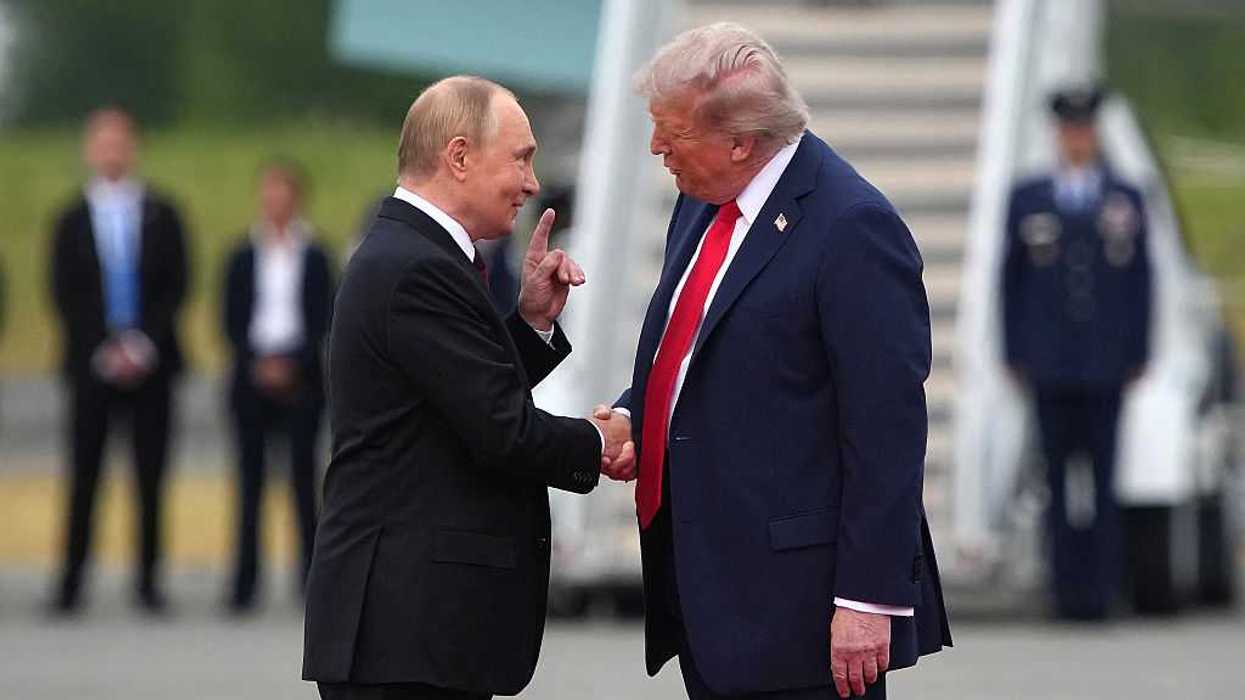
The President, meanwhile, has begun a phase of personal deification. On Palm Sunday, after his spiritual advisor compared him to Christ on Palm Sunday, Trump boasted, smiling: "They call me king now." A few weeks later, he posted a depiction of himself as Jesus on social media. In the meantime, Trump became the first U.S. leader to start a public feud with the pontiff, an “unprecedented moment in history.” When asked if he was going to apologize, Trump said, “I think he’s very weak on crime and other things, so I’m not.” Of course, Trump doesn’t defer to the head of the Roman Catholic church–he sees himself as Jesus. But instead of practicing what Jesus preached, Trump has threatened to destroy an entire civilization and is proposing a budget increase of $1.5 trillion to the military. Perhaps this is an attempt to bribe the rank-and-file into loyalty as the administration continues a war with no clear goals and a growing body count. God, help us.
Our military tradition is rooted in an adherence to the Constitution. Secular law, the Geneva Convention, the Uniform Code of Military Justice, and our Code of Conduct used to be followed and respected. Instead, we now have a Secretary of War who disregards the rules in favor of a religion associated with the belief that women shouldn’t have the right to vote. Ultimately, our constitution is being violated in a place where all involved should have sworn an oath to defend it. If the Constitution can be so easily disregarded there, what remains of it?
The idea that the government cannot create a state religion is fundamental to our country; there’s a reason the founding fathers made sure to include it in the First Amendment. Nevertheless, the President and the Secretary of War continue to push religious propaganda, feeding a narrative of a holy war. As they attempt to indoctrinate those serving to buy into their fantasy, it is more important than ever that we talk about this. Congress must exercise its oversight, a free press must be allowed to report thoroughly on the Pentagon, and we, the American people, must insist on both. It is time to come together to support and defend the Constitution against at least two domestic enemies: the Secretary of Defense and the President.
Julie Roland was a Naval Officer for ten years, deploying to both the South China Sea and the Persian Gulf as a helicopter pilot before separating in June 2025 as a Lieutenant Commander. She has a law degree from the University of San Diego, a Master of Laws from Columbia University, and is a member of the Truman National Security Project.