




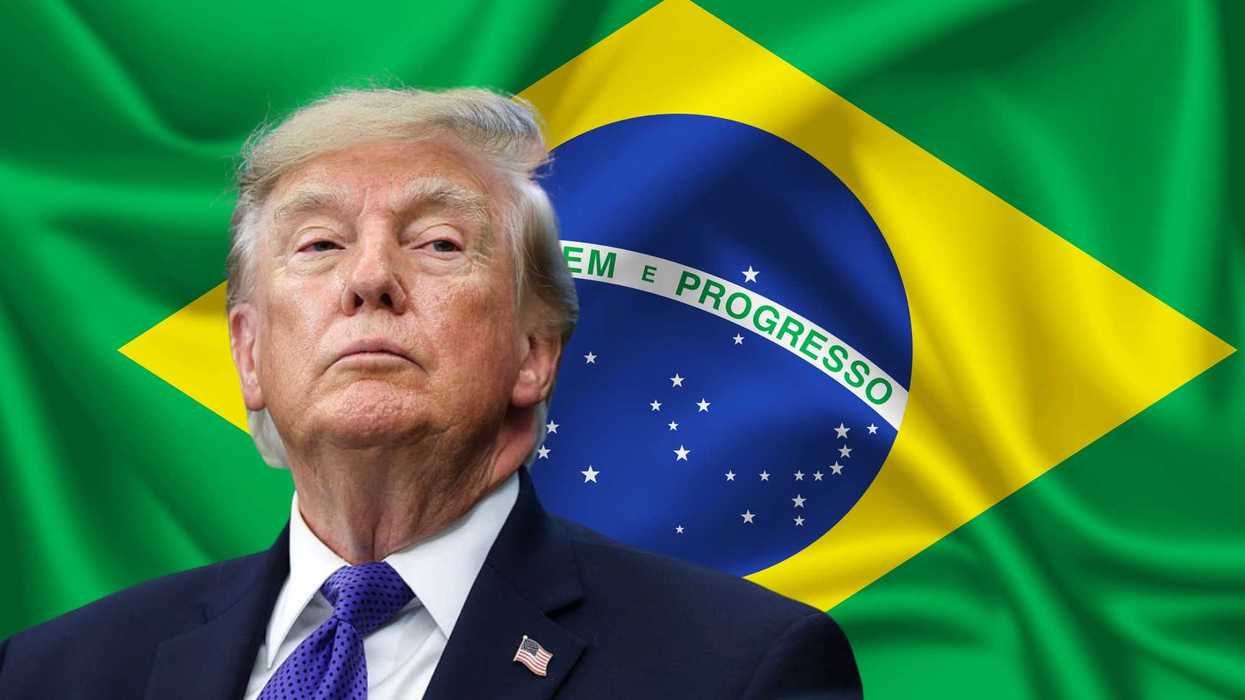
Donald Trump has repeatedly used the phrase “holding the cards” during his tenure as President to signal that he, or sometimes an opponent, has the upper hand. The metaphor projects bravado, leverage, and the inevitability of success or failure, depending on who claims control.
Unfortunately, Trump’s repeated invocation of “holding the cards” embodies a worldview where leverage, bluff, and dominance matter more than duty, morality, or responsibility. In contrast, leadership grounded in duty emphasizes ethical obligations to allies, citizens, and democratic principles—elements strikingly absent from this metaphor.
Take Ukraine as a case in point. In the peace talks on Ukraine this year, Trump has insisted that Russia “holds the cards” in the ongoing conflict. But if Russia does indeed hold them, it is not because of some immutable law of geopolitics. It is because the United States—and Trump himself—has ceded those cards by failing to fully back Ukraine’s defense.
Power in international relations is not simply a fixed hand dealt by fate. Instead, choices, commitments, and the willingness to stand by allies all shape it. By declaring that Russia holds the cards, Trump disregards the moral responsibility the United States bears to ensure that Ukraine is not left vulnerable to aggression.
This card-game metaphor strips away the human stakes, treating war and diplomacy as transactional contests. By contrast, principled leadership recognizes national purpose and moral duty. When leaders use only the language of leverage, they obscure the deeper truth: democratic nations have a duty to resist authoritarian expansion, not just calculate strength. Trump’s language thus reflects a broader erosion of social or humanitarian responsibility.
America’s role in the world is not defined by who holds the cards alone. Far more important is whether those cards are played in defense of freedom or surrendered to expediency.
Trump has used this metaphor countless times. He asserted that the United States “held the cards” in its trade war with China, basing his claim on the size of America’s consumer market. Yet the data contradicts this claim. Even as U.S. tariffs reduced Chinese exports to America by nearly 30%, Beijing redirected its goods elsewhere, fueling a record $1 trillion trade surplus. Exports to Europe and Southeast Asia rose significantly, demonstrating China’s ability to reroute supply chains and blunt the impact of U.S. consumer leverage.
Moreover, China has repeatedly used its dominance in rare earth minerals as a counterweight—a sector worth billions annually and vital to defense systems, semiconductors, and electric vehicles. By imposing export controls on rare earths and finished magnets, Beijing makes clear that leverage is not one-sided. The U.S. may have a vast consumer market, but China’s grip on critical materials and its ability to diversify trade partners show that America’s “cards” are far from decisive. Trump’s metaphor thus often clouds reality. Global trade leverage is fluid. China has proven adept at offsetting Trump’s strategic claims.
Of course, Trump also loves to claim leverage over Congress. His constant insistence that he “held the cards” reveals a deeper pattern: he treats constitutional checks not as guardrails, but as obstacles to be bulldozed. In 2025, he tried to cancel nearly $5 billion in foreign aid—already approved by lawmakers—through a rare maneuver called a pocket rescission. He also deployed thousands of National Guard troops to cities such as Los Angeles and Chicago without the governor's consent. Courts later ruled these moves unlawful. He even fired independent agency officials at the Federal Trade Commission and other bodies, flouting statutory protections and claiming these actions proved executive leverage.
The reality, however, is more complex. Unlike the unilateral leverage Trump describes, real power is balanced by constitutional design. Courts have struck down several of his maneuvers, and even members of his own party questioned their legality. Congress retains the power of the purse, oversight authority, and the constitutional mandate to check executive overreach. Trump’s card-game metaphor focuses on unilateral action, whereas the constitutional system demands collaboration within shared powers. In truth, the cards are distributed by design in our Constitution, and democracy depends on respecting that principle.
Trump’s repeated use of the “holding the cards” metaphor may resonate with some as a symbol of dominance, but it ultimately fails to provide moral direction. Leadership is measured not by who bluffs or claims leverage, but by who upholds responsibility and principle.
Reducing governance to a card game overlooks the values that define America: freedom, trust, and a commitment to democratic institutions.
America needs leaders who play not just to win, but to serve the people and defend democratic values.
David Nevins is the publisher of The Fulcrum and co-founder and board chairman of the Bridge Alliance Education Fund.

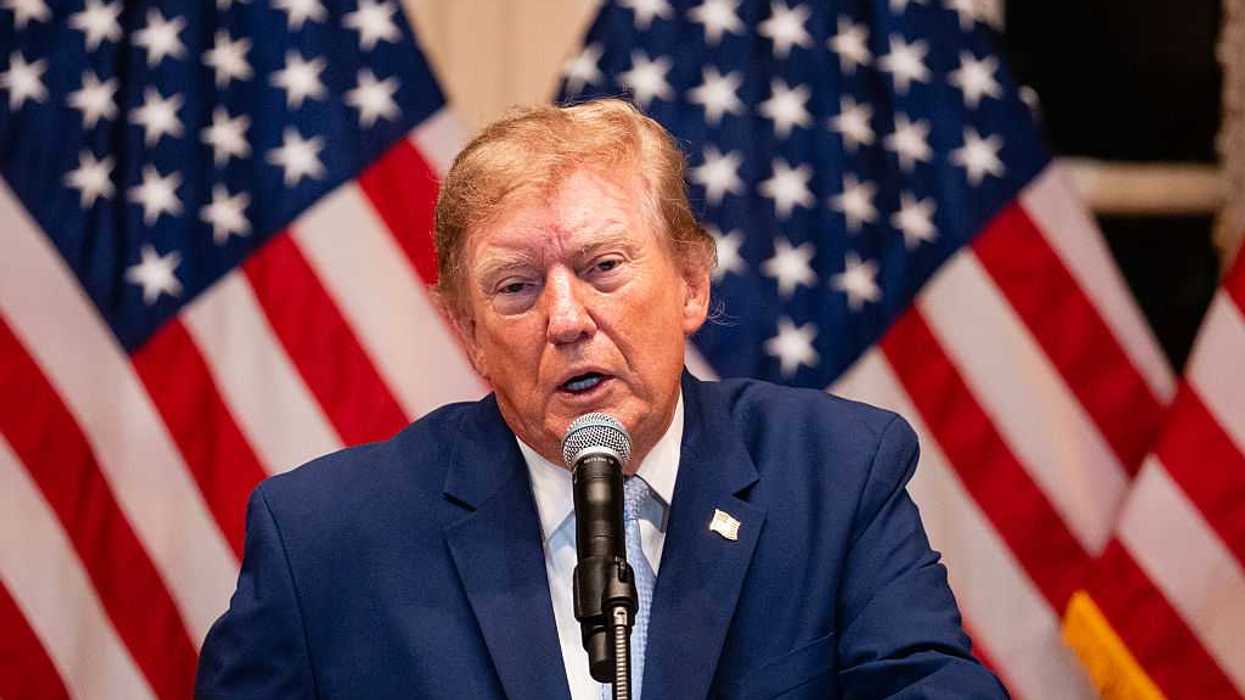







U.S. President Donald Trump speaks during a campaign rally at Pinnacle Bank Expo Center on the Nebraska State Fairgrounds on October 05, 2026 in Grand Island, Nebraska.
The President Invited Iran to Bomb My Home
I was driving home to San Diego from Los Angeles on Monday night when I heard that the President of the United States had offered both cities up to Iran as bomb targets. At a rally in Nebraska, defending his war, Trump told the crowd, “let [Iran] take out Los Angeles, let ‘em take out San Diego.” It was, he said, “a very small price to pay.”
I was coming from a Bernie Sanders rally for Proposition 40, the one-time tax on California billionaires that would send 90% of its revenue to healthcare. We desperately need it to pass because, in order to give tax breaks to billionaires, Trump signed a law that will strip health coverage from 10 million Americans; this tax will make sure we can still cover Californians. Call me crazy, but I think taxing billionaires one time so we can make sure kids in California get to see a doctor is a very small price to pay. I also think that even if Trump were joking, it is indefensible to make jokes about the potential destruction of so many lives. Human life is never a small price to pay. Human life is priceless.
Plus, the reality is: here in San Diego, we’re already paying the price for Trump’s actions, and it’s not small at all. He has gutted FEMA, tried to kill climate resiliency programs, and destroyed public health standards, while his signature law is set to cut off health insurance and food support for hundreds of thousands of San Diegans. Like plenty of American cities, San Diego is already busy finding local solutions to respond to the problems this president has recklessly created.
Not to mention, at least 19 American service members have been killed in this war already. Human rights monitors have documented more than 3,600 dead in Iran by April alone. Here at home, gas is sitting just pennies below its all-time record. Taxpayers have already spent more than $45 billion on the war, while Trump’s oil and gas portfolio has grown by roughly $15.5 million this year alone. Of course anything is a “small price” to someone paying free.99 for this war, and profiting from it. Meanwhile, We the People are paying twice: first for the war, and then for the consequences of that war. But now he wants San Diego to pay a third time, flippantly offering us up to Iran.
It is worth noticing which cities he thought to name. Were San Diego and Los Angeles strategically chosen to signify something to his audience, or were they simply the first cities that came to mind as expendable places? Either way, the effect is to normalize—-and to gauge a crowd’s reaction to–the idea of massive violence in major California cities, suitable targets because of their perceived liberal lean. So what if Iran needs to bomb a little bit of America before the war can be over? Who cares, says Trump, if they target Los Angeles and San Diego?
By the way, why didn’t he offer up San Francisco, the free-love hippie-town MAGA loves to hate (and also my birthplace)? Could it be because that’s where the tech titans live? The same ones who joined Trump for Xi Jinping’s state dinner, a guest list worth a combined $2.4 trillion?
San Diego may have fewer billionaires, but it is home to more than 115,000 active-duty service members and 230,000 veterans. One in six active-duty sailors–in the entire Navy–is stationed here. So is one in four Marines. You cannot throw a rock in this county without hitting a military family: brats and spouses and veterans are among us. I got out of the Navy last year after ten years, and eight of those were here in San Diego. When Trump says “let ‘em take out San Diego,” he’s talking about the backbone of the United States military. He’s also talking about the people fighting his war.
San Diego has not been watching this war from the sidelines. Today, the USS Abraham Lincoln returns to North Island after an almost yearlong deployment to the Middle East that featured food shortages, broken toilets, and mold in the showers after 286 days at sea without a single port call. Eight sailors in the Lincoln’s strike group attempted suicide, but in August, when a reporter asked whether the deployment had gone on too long, Trump said “not nearly long enough.” Now he has told a crowd in Nebraska that we should let Iran take out the city those sailors call home. These are sociopathic sentiments.
Last week at Quantico, Pete Hegseth closed his address to the force by telling them, “President Trump has your back and so do I.” To the contrary, President Trump has put one of the biggest military towns in the country forward as a target for our adversaries. With friends like these, the “domestic” in “against all enemies, foreign and domestic” starts to sound a lot less hypothetical.
San Diego is home to Naval Air Station North Island, Naval Base San Diego, Naval Amphibious Base Coronado, the Point Loma submarine base, Camp Pendleton, and Miramar (and I have been permanently stationed at or trained at all of them). If Iran bombed San Diego and Los Angeles, aside from the devastating loss of life, it would cripple an immense share of our national security readiness.
And for what, exactly? Trump says the war is “essentially almost over with.” This is the same man who claimed in June 2025 that Iran’s nuclear program had been “obliterated,” then launched a war over it anyway on February 28. More than seven months later, he wants us to believe two things at once: that we’ve basically won, and that we might need to sacrifice an American city or two to finish winning. If the war is almost over, why does anybody need to take out San Diego?
I wonder if Trump’s endorsed candidate for California’s 48th District here in San Diego County will respond to these remarks. He recently said “no pain, no gain,” when referring to the gas prices San Diegans are paying. Jim Desmond, would you apply that same mindset if we were bombed? Or do you have the moral courage to stand up for the people you’re running to represent?
Last November, six Democratic members of Congress, all veterans, including Senator Mark Kelly, recorded a video reminding troops of their duty to disobey unlawful orders, restating the law that says so. Trump called it “SEDITIOUS BEHAVIOR, punishable by DEATH,” and then his Justice Department went looking for an indictment, which a grand jury refused. The president treated reading the law out loud to the troops as a capital offense, but then he himself invited a foreign enemy to destroy two American cities, possibly as a punchline. Is anyone calling the latter sedition? Who is demanding accountability?
Calling our lives a small price to pay affirms a moral bankruptcy, as well as an obvious dereliction of duty to the office he holds. While we can’t impeach him or invoke the 25th Amendment ourselves, we must stop being so quiet about what we’re paying already. We can make our voices heard by calling our representatives, writing op-eds, knocking doors, phone banking, and voting in defiance of the man who threatens the safety of our city. Ballots are already arriving in mailboxes. Vote, and vote yes on 40 (and no on 41 and 42).
Trump has been harming our cities for a while, but now he is inviting our military adversaries to join him in the harm. If we have any self-respect as Americans, we must not tolerate our leaders disregarding the dignity of lives in this way. We must fight for our home.
Julie Roland was a Naval Officer for ten years, deploying to both the South China Sea and the Persian Gulf as a helicopter pilot before separating in June 2025 as a Lieutenant Commander. She has a law degree from the University of San Diego, a Master of Laws from Columbia University, and is a member of the Truman National Security Project.