Known for its eclectic charm as an urban oasis and cultural vibrancy, Humboldt Park in Chicago is home to numerous ethnic restaurants, cultural centers, and art galleries. It's no wonder many flock here. As in other big cities across the country, the Windy City has for many years experienced the harmful impact of gentrification. While geographic location varies, the recipe remains identical: while developers purchase/remodel properties seeking skyrocketing rents, longtime residents are continuously displaced. Those negatively impacted are also usually the same: working-class Black and Brown communities.
But one creative entrepreneur is determined to keep the essence of his neighborhood alive and thriving. For over a decade, poet, gallerist, professional tour guide, and Chicago native Eduardo Arocho has been enthusiastically sharing with visitors and locals alike his unconditional love and commitment to his rich Puerto Rican roots. As owner and founder of Paseo Boricua Tour Company, his is more than a "stop-and-drop-names" excursion. Part of Paseo Boricua - the economic, political, and cultural capital of Chicago’s Puerto Rican community - the tour is a culturally immersive experience where participants get to feel the warmth and sabor (flavor) of Arocho and his friendly people - even having the option of adding lunch reservations to support one of the local restaurants featuring Puerto Rican cuisine.
This is his story. It is also the story of thousands of others who, like him, are championing the vibrant cultura to keep Humboldt Park beautifully Latino.
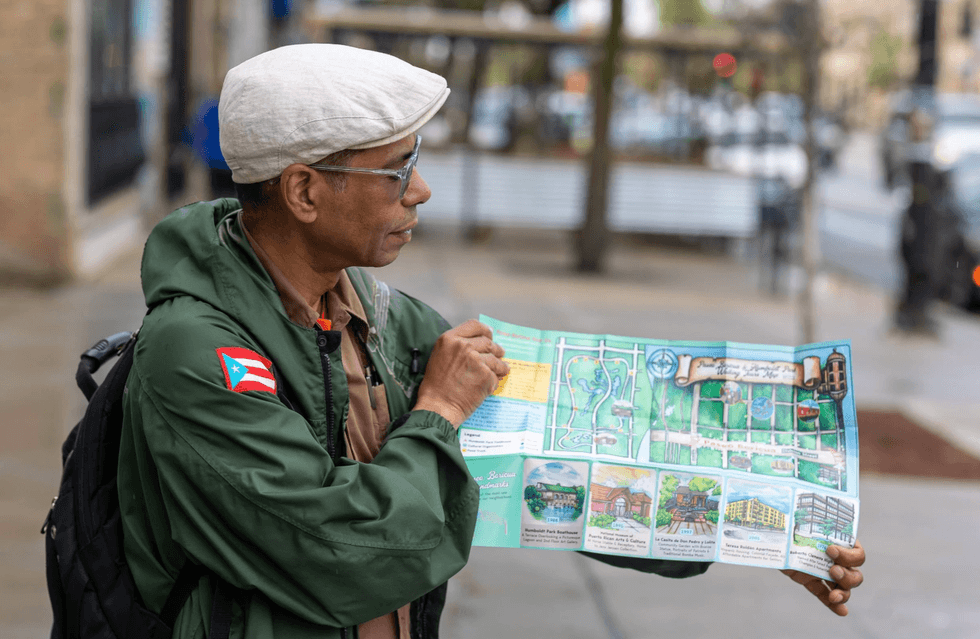 Eduardo Arocho, owner and founder of Paseo Boricua Tour Company, gives culturally immersive tours that show the vibrant Puerto Rican culture in Humboldt Park.Photo by Jesús J. Montero for palabra
A Look at the History of Gentrification
In the late 1940s, a joint U.S. federal government and island government initiative called Operación Manos a la Obra (Operation Bootstrap) - an industrialization program that steered the Caribbean archipelago’s economy away from agriculture toward manufacturing - became the impetus for Puerto Rican mass migration to many cities on the U.S. mainland, including Chicago. The strategic plan, intended to lead to economic growth for the island, brought different consequences: the displacement of a portion of a population seeking a better life in the United States. It also brought the onset of the Industrial Incentives Act, encouraging U.S. manufacturing companies to build factories on the island, eliminating Puerto Rico’s corporate tax.
Against this backdrop, Arocho shares how in the late 1940s/early 1950s, “As part of Operation Bootstrap, the displacement of Puerto Ricans began as they moved to Chicago en masse with roughly a third of them working in the steel mills, particularly in the steel pipeline industry. Many worked as welders - not great paying, but good enough for them to raise their families.” The native Chicagoan tells palabra of how Puerto Ricans were spread across Chicago, creating neighborhoods on the South Side, in the North Loop area, in Lincoln Park, and then Humboldt Park, which became the center of Puerto Rican art, culture, and cuisine. According to a 2019 report by Centro de Periodismo Investigativo (Center forInvestigative Journalism) in Puerto Rico, “By the 1960s, Chicago was home to more than 32,000 Puerto Ricans.” Currently, there are some 97,000 Chicagoans who identify as Puerto Rican.
As Arocho tells it, as early as the ‘60s, gentrification happened. “They would call it urban renewal. We started to be displaced from areas like Lincoln Park - the neighborhoods where the Young Lords were created.” The Young Lords was a political activist group established in 1968 by community organizer Cha Cha Jiménez in response to what residents and community activists said was a lack of action to address police brutality, racism, and local gentrification.
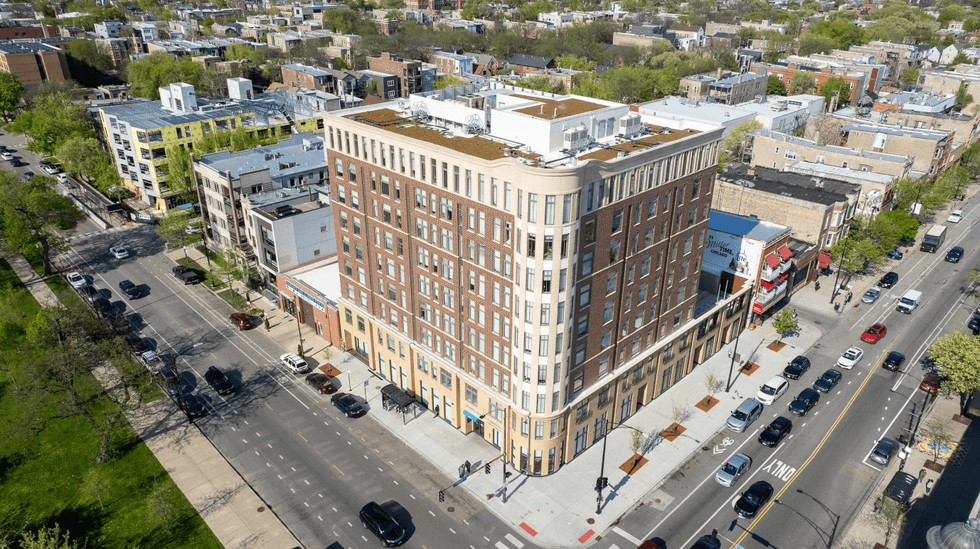 Pedro Albizu Campos Apartments, a new building at the start of the mile-long stretch called Paseo Boricua in Humboldt Park. Photo by Jesús J. Montero for palabra
The Awakening
As often happens when a community is threatened, organizers and activists come together to rebel, resist, and confront those in “authority.” In this case, it was the police shooting of Aracelis Cruz, 20, after Chicago’s first Puerto Rican Day Parade on June 12, 1966. Arocho refers to what happened in his city as “The Awakening” - the spark that caused the Division Street Riots (three days of unrest and protest in response to the shooting). He notes “the young people who either witnessed or participated in the riots then became the artists, activists, teachers, and [everyone] struggling for better housing conditions, [fighting] against police brutality, the struggle to get the Roberto Clemente School and for our community [to become] politically aware.”
Arocho mentions two other impactful events in Chicago. “Dr. Martin Luther King, Jr. moving to Chicago, bringing the civil rights movement here in a big way, and the 1977 riots after two young men were killed by the police after the Puerto Rican parade - sparking another three days of rioting at California and Division (in the heart of Humboldt Park). [After this incident], there were significant changes in the Chicago Police Department (that) forced the police to change their height requirements, (and) the questions in the examinations to allow Puerto Ricans to become police officers. Prior to this, the police was very white.”
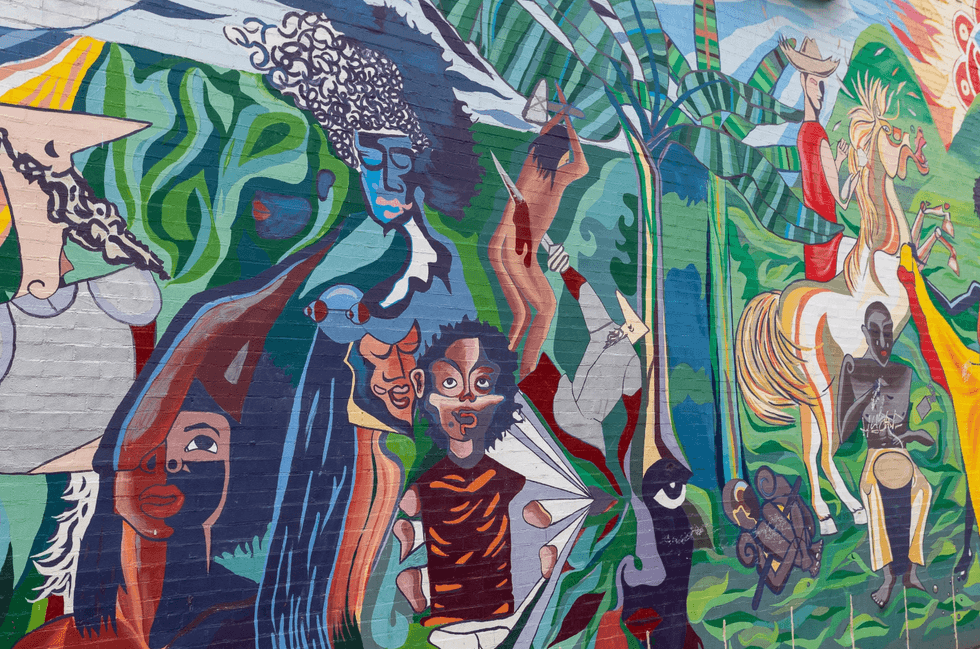 “La Voz del Paseo Boricua” (The Voice of Paseo Boricua) mural in Humboldt Park by artist Cristian Roldán. Photo by Jesús J. Montero for palabra
Plantando Bandera & the Puerto Rican Agenda
“The gentrification that hit Lincoln Park, which used to be a working class, Puerto Rican neighborhood - Lincoln Park nowadays is one of the wealthiest neighborhoods in Chicago with million dollar lots - they were moved to the Lakeview area and then you have Wicker Park, which is where I grew up (on Damon Avenue)- now it's very gentrified, very wealthy area,” Arocho told palabra. “The founders of Paseo Boricua realized that every time we get moved, we get poorer. Every time a new community moves in, they magically get wealthier, and it's not magic, it's good old-fashioned redlining. It's re-segregation of the city.”
And it’s exactly the kind of forced separation that the Puerto Rican community flipped to its advantage, Arocho explains. “So what they decided to do is try something different, and in Spanish, we call it plantando bandera, which literally means planting a flag to create a zone of stability where we can cure ourselves from the problems of poverty, like creating affordable housing, and things like addressing our health care needs, education. [To this point], they didn't make Roberto Clemente High School just because we paid taxes, they made it because young people in the early ‘70s protested and fought with police on the streets just to get a new school.”
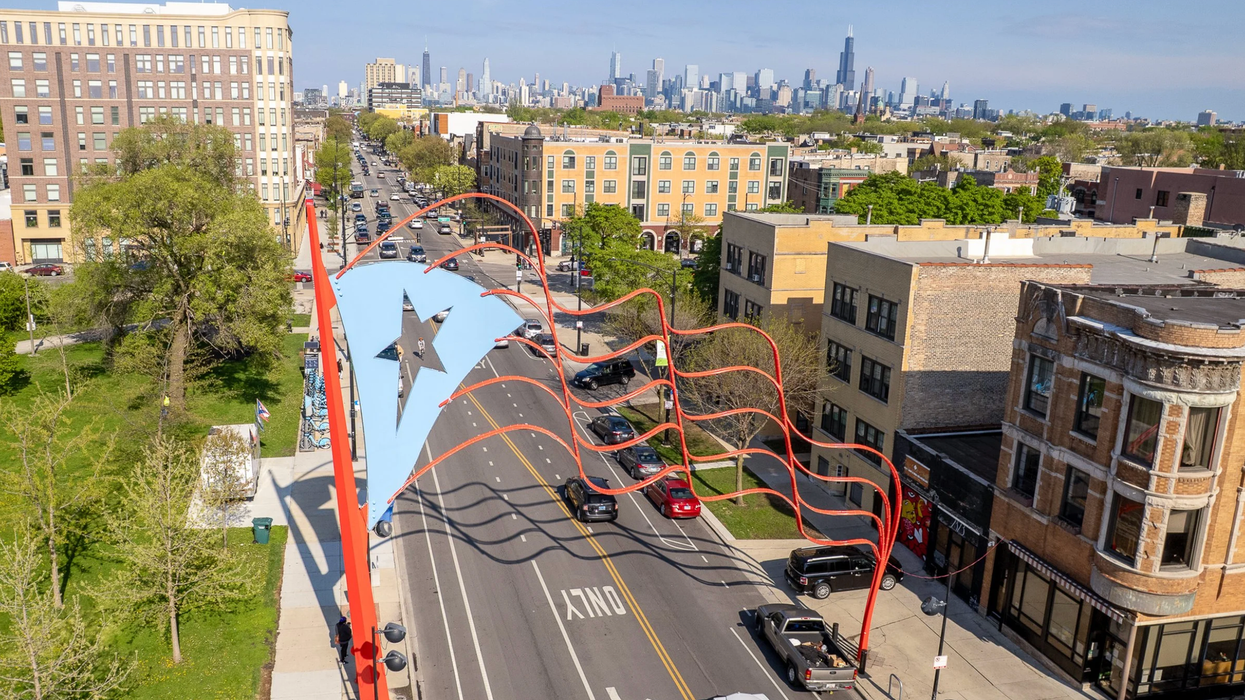
So their idea of “plantando bandera” became a literal and a figurative way of fighting gentrification - of saying we’re here and we plan to stay here! Covering a six-block span along the main street in Humboldt Park, two steel flags standing at 55 feet by 56 feet representing “fluttering Puerto Rican flags” mark The Paseo Boricua - the economic, political, and cultural heartbeat of Chicago’s Puerto Rican community. The flags pay homage to those first puertorriqueños who worked in the steel mills upon arriving in this Midwestern city. “The pipelines on one side are meant to simulate roots in the ground, then they’re tied to a wave connecting to the mast, which is pointing to the future, so it's connecting that past with the future,” Arocho mentions.
A recent meeting in Chicago organized by the think tank National Puerto Rican Agenda of Chicago brought community activists, organizers, educators, and public policy advocates to discuss a number of issues affecting the community, including the issue of housing affordability. The U.S. Department of Housing and Urban Development defines affordable housing as “housing on which the occupant is paying no more than 30 percent of gross income for housing costs, including utilities.” According to the real estate listing Zillow, a one-bedroom apartment in Humboldt Park starts at $1,450, and a two-bedroom rents at nearly $2,000. The median household income in Humboldt Park is $39,464.
Arocho says he feels optimistic about efforts to combat gentrification. “We have more new buildings, including The Paseo Boricua Arts Building - a 24-unit living/workspace geared towards community artists, also affordable for families. Nearby is the Teresa Roldán Apartments, 60 units of affordable apartments for people 55 and over, helping to keep a stable population living here. We also have La Estancia: 60 units of affordable apartments, and across the street is Pedro Albizu Campos Apartments - a brand new 64-unit building.”
Arocho also spoke of an unexpected ally in the fight against gentrification: the state government. Illinois Governor JB Pritzker (along with other legislators) last year announced the establishment of 10 “cultural districts” across the state. Protecting ethnic enclaves like Humboldt Park with the government’s initiative, Arocho says, is a big win for the community as it will “come with economic development dollars.”
Eduardo Arocho and his community are keenly aware of what their beloved neighborhood of Humboldt Park is up against. He says he’s seen a lot of changes throughout the years, but is actively participating in Humboldt Park’s urban plan by working with local businesses, schools, and cultural centers. One initiative includes WEPA! Mercado del Pueblo, a small business incubator and pop-up market, and he was excited to share that the Hispanic Housing Developmental Corporation is building a 44-unit affordable housing complex, and that two more are “in the works, making over 235 additional affordable units.”
He calls all of this the “repopulating of Paseo Boricua.”
Battling Gentrification by Showcasing the Windy City’s Rich Puerto Rican Roots was originally published by Palabra. and is republished with permission.





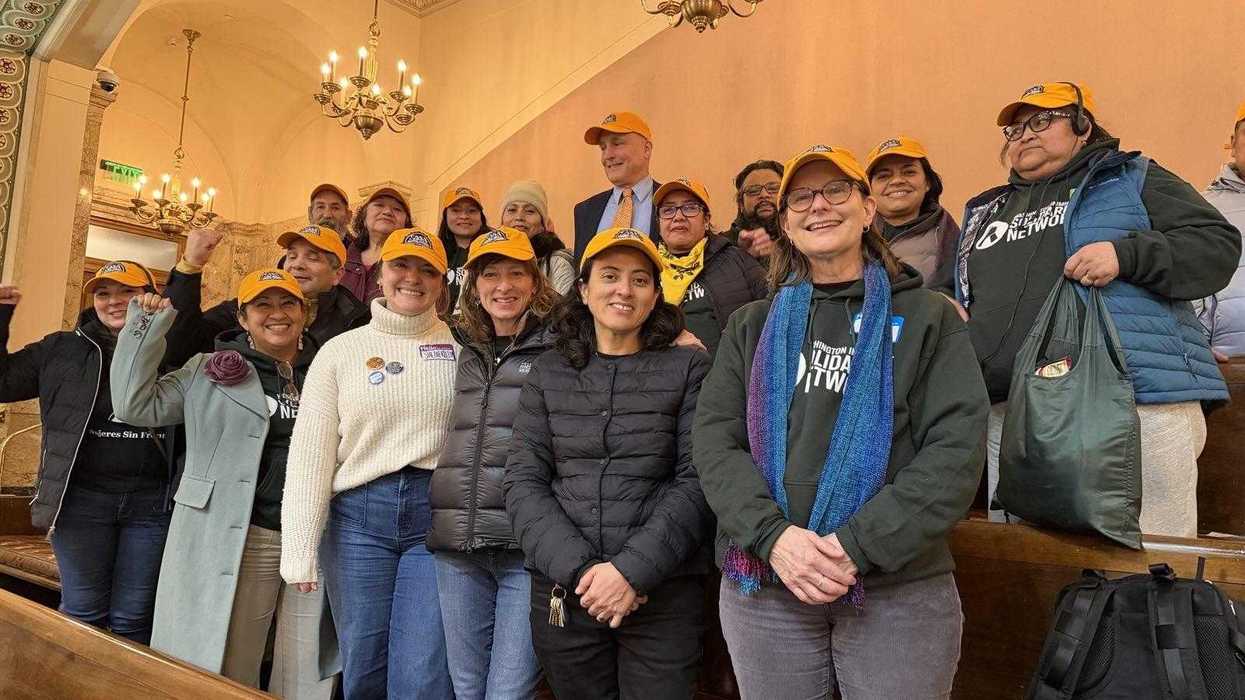
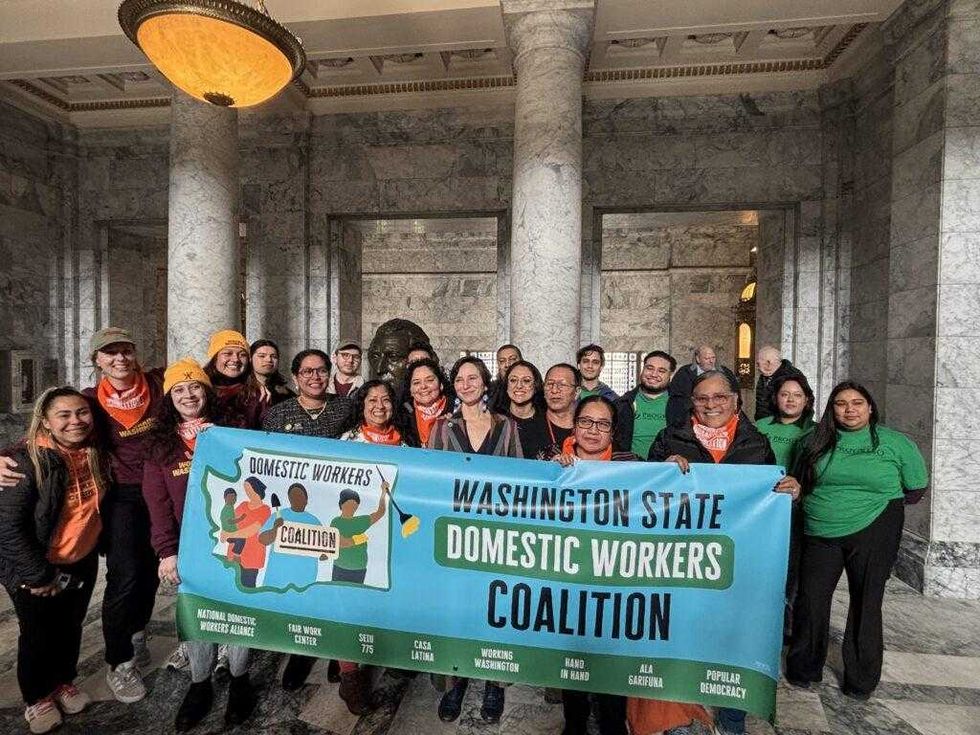 State Sen. Rebecca Saldaña, center, stands with members of the Washington State Domestic Workers Coalition at the state Capitol on Feb. 28, 2026. The Domestic Workers Bill of Rights passed in the House that day, before being signed into law in March. (Photo courtesy of Casa Latina)