

Skip to content
Search

Latest Stories

Follow Us:
Top Stories

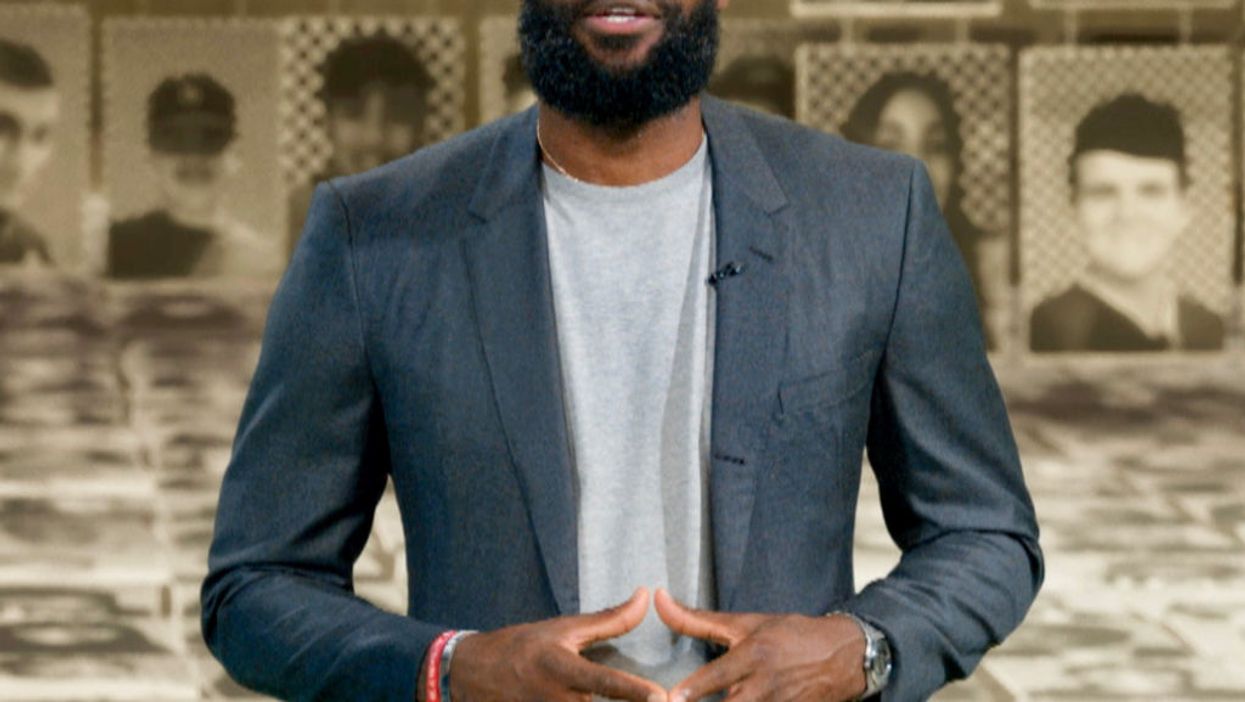
LeBron's group donates $100,000 to pay off Florida felons' fees

Lebron James, felons' voting rights

More Than a Vote, created by LeBron James and other basketball stars, is giving $100,000 to help ex-felons in Florida pay off their fees and fines so they can have their voting rights restored.

Getty Images

Basketball superstar LeBron James' new voting rights group is donating $100,000 to help pay fines and fees for ex-felons in Florida so they can register and vote.

More Than a Vote was founded in June by the Los Angeles Lakers' small forward and other current and past basketball stars including: former NBA player Jalen Rose; Sklyar Diggins-Smith of the WNBA; and young NBA phenom Trae Young.


In 2018, voters in Florida overwhelmingly approved a ballot initiative restoring voting rights to convicted felons who had served their terms. But the GOP-controlled Legislature passed a bill, signed into law by Republican Gov. Ron DeSantis, that required ex-felons to pay all of their outstanding fines and fees before being allowed to vote. They argued that paying these fees and fines constituted completion of their sentences.

Opponents said requiring people to pay fees and fines was equivalent to the poll taxes that had been used to block Blacks from voting in the South after the Civil War.

Udonis Haslem, a former teammate of James' and a member of More Than a Vote, said the fees and fines are "a barrier we all have to come together and break down together" in a video posted on the More Than a Vote Facebook page.

The group is calling on others to donate to pay the fees and fines through the Florida Rights Restoration Coalition.

A federal district judge in May struck down the law requiring fees and fines be paid before voting rights would be restored. The state appealed and earlier this month the 11th Circuit Court of Appeals granted a request from DeSantis to put the trial judge's decision on hold until the full appeals court could hear arguments on Aug. 18.

An estimated 1.4 million Floridians could be eligible to have their voting rights restored. There are no hard numbers, but ex-felons in Florida owe upward of hundreds of millions dollars in fines and fees.

In announcing the donation, a news release from More Than a Vote indicated that more announcements about the group's partnership with the Florida Rights Restoration Coalition would occur in the coming weeks.

One already announced: James' group will host public screenings of "John Lewis: Good Trouble," with the proceeds going to the Florida Rights Restoration Coalition fund.

The coalition already has raised a total of $1.8 million toward a goal of $3 million.

Read More

Trump’s Anti-Latino Racism is a Major Liability for Democracy

Close-up of sign reading 'Immigrants Make America Great' at a Baltimore rally.

Trump’s Anti-Latino Racism is a Major Liability for Democracy

Donald Trump’s second administration has fully clarified Latinos’ racial position in America: our ethnic group’s labor, culture, and aspirations are too much for his supporters to stomach. The Latino presence in America triggers too many uneasy questions (are they White?), too many doubts (are they really American?), and too much resentment (why are they doing better than me?).

Trump’s targeted deportations of undocumented Latinos, unwarranted arrests of Latino citizens, and heightened ICE presence in Latino neighborhoods address these worries by lumping Latinos with Black people. Simply put, we have become yet another visible population that America socially stigmatizes, economically exploits, and politically terrorizes because aggrieved White adults want to preserve their rank as our nation’s premier racial group. The cumulative impacts are serious: just yesterday, an international panel of investigators on human rights and racism, backed by the U.N., found that such actions have resulted in “grave human rights violations.”

Keep ReadingShow less
Just the Facts: The SAVE Act and the Future of Voter ID Rules
A close up of a window with a sticker on it
Photo by Zach Wear on Unsplash

Just the Facts: The SAVE Act and the Future of Voter ID Rules

Last week, I wrote a column in the Fulcrum entitled “Just the Facts: Voter ID, States’ Powers, and Federal Limits.” The facts presented in that writing made it clear that the U.S. Constitution does not require voter ID and left almost all election administration—including voter qualifications—to the states. However, over time, constitutional amendments and federal statutes have restricted states’ ability to impose discriminatory voting rules, but they have never mandated voter ID.

The SAVE America Act

The national debate over voter ID has entered a new phase with the introduction of the SAVE America Act, the most sweeping federal voter‑identification and citizenship‑documentation proposal in modern history. For more than two centuries, voter eligibility rules—ID included—have been primarily a matter of state authority, bounded by constitutional protections against discrimination. The SAVE America Act would shift that balance by imposing federal requirements for both photo identification and documentary proof of citizenship in federal elections.

Keep ReadingShow less
Posters are displayed next to Sen. Ted Cruz (R-TX) as he speaks at a news conference to unveil the Take It Down Act to protect victims against non-consensual intimate image abuse, on Capitol Hill on June 18, 2024 in Washington, DC.

A lawsuit against xAI over AI-generated deepfakes targeting teenage girls exposes a growing crisis in schools. As laws struggle to keep up, this story explores AI accountability, teen safety, and what educators and parents must do now.

Getty Images, Andrew Harnik

Deepfakes: The New Face of Cyberbullying and Why Parents, Schools, and Lawmakers Must Act

As a former teacher who worked in a high school when Snapchat was born, I witnessed the birth of sexting and its impact on teens. I recall asking a parent whether he was checking his daughter’s phone for inappropriate messages. His response was, “sometimes you just don’t want to know.” But the federal lawsuit filed last week against Elon Musk's xAI has put a national spotlight on AI-generated deepfakes and the teenage girls they target. Parents and teachers can’t ignore the crisis inside our schools.

AI Companies Built the Tool. The Grok Lawsuit Says They Own the Damage.

Whether the theory of French prosecutors–that Elon Musk deliberately allowed the sexualized image controversy to grow so that it would drive up activity on the platform and boost the company’s valuation–is true or not, when a company makes the decision to build a tool and knows that it can be weaponized but chooses to release it anyway, they are making a risk-based decision believing that they can act without consequence. The Grok lawsuit could make these types of business decisions much more costly.

Keep ReadingShow less