



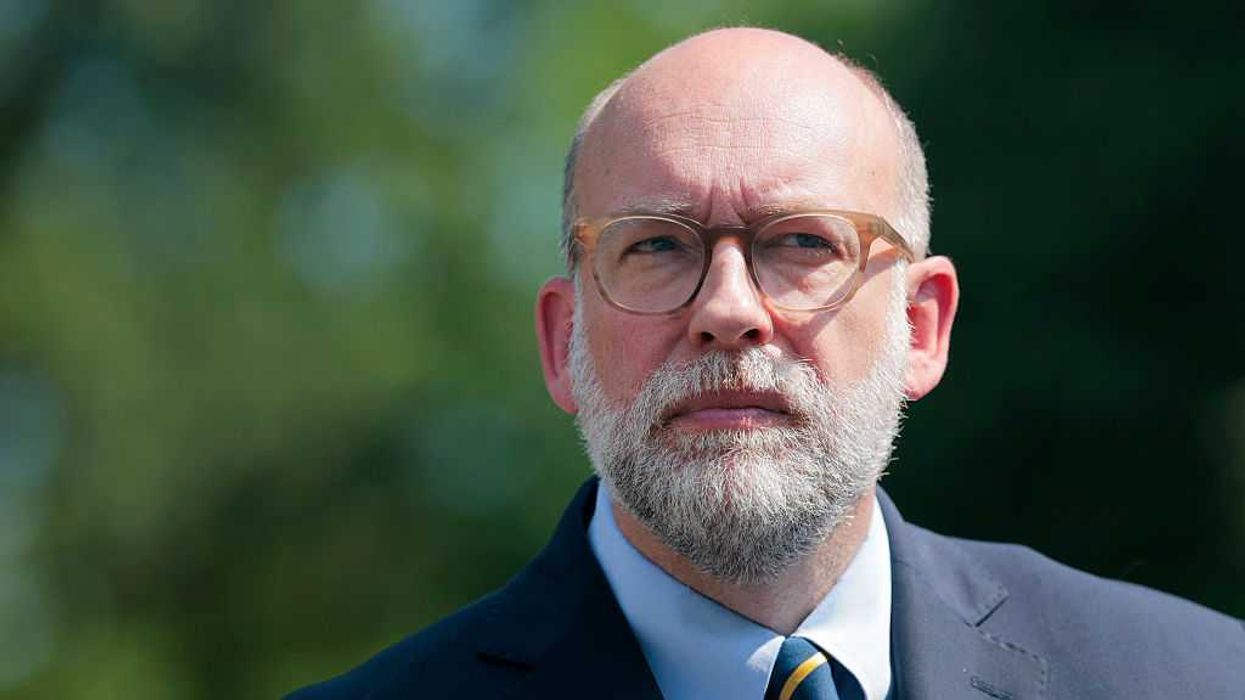

On the second day of the federal government shutdown, President Donald Trump shared an AI-generated video set to the classic song “(Don’t Fear) The Reaper” by Blue Öyster Cult. The star of that video, which quickly went viral, was Russell Vought, the president’s top budget adviser. More than that, Vought is the architect of Trump’s broader plan to fire civil servants, freeze government programs and dismantle entire agencies, and he’s a big reason the second Trump administration has been more effective at accomplishing its goals than the first. In the video shared by Trump, Vought appeared as the scythe-wielding Grim Reaper of Washington, D.C.
Vought’s title is director of the Office of Management and Budget. The OMB directorship is one of the most powerful jobs in Washington, and Vought has used his position to wage a quiet war to change the shape of the entire U.S. government. In Vought’s hands, OMB has acted as a choke point for the funding that Congress approves and agencies rely on to run the government. While he tends to operate behind the scenes as much as possible, his influence in Trump’s second administration is so pronounced that people have described him as akin to a shadow president.
Here are some of the key things you should know about Vought. Read ProPublica’s full investigation here. (Vought declined to be interviewed for the article. A spokesperson for him at OMB would not comment on the record in response to a detailed list of questions.)
1. Vought went from the mail room to becoming the chief antagonist of his own party.
A native of Trumbull, Connecticut, and the son of an electrician father and a mother who spent decades in public education before helping to launch a Christian school, Vought got his first job in D.C. politics working in the mail room for Republican Sen. Phil Gramm of Texas, a fierce budget hawk known for criticizing members of his own party for breaking what he viewed as core conservative principles.
As Vought rose through the GOP ranks, eventually going on to advise then-Rep. Mike Pence, he grew disillusioned with members of his party who claimed to care about balanced budgets and spending cuts yet voted to approve bills loaded with pork-barrel spending and corporate giveaways.
In 2010, he quit Congress and helped launch an offshoot of the Heritage Foundation think tank called Heritage Action for America, which was tasked with strong-arming congressional Republicans to act more conservatively.
“I think he thought the Republican leadership was a bigger impediment to conservative causes than Democrats were,” a former Capitol Hill colleague of Vought’s said.
2. OMB’s massive power supercharges Vought’s influence.
While the Office of Management and Budget is part of the White House, Vought is a member of Trump’s cabinet along with the secretary of defense and attorney general. OMB director has little of the cachet of those jobs, but it plays a vital role. Every penny appropriated by Congress first passes through the OMB. It also reviews all significant regulations proposed by federal agencies, vets executive orders before the president signs them and issues workplace policies for more than 2 million federal employees.
“Every goddam thing in the executive branch goes through OMB,” explained Sam Bagenstos, a former OMB official during the Biden administration.
3. Vought’s early work at OMB helped lead to Trump’s first impeachment.
This isn’t Vought’s first stint as OMB director; he held the same position during the first Trump administration.
In 2019, after the Trump White House pressured Ukraine’s government to investigate then-candidate Joe Biden and his son Hunter, it asked Vought, then acting director, to freeze $214 million in congressionally approved security assistance for Ukraine. He obliged.
This impoundment, later deemed illegal by the Government Accountability Office, would trigger congressional investigations and, ultimately, Trump’s first impeachment. During that process, Vought refused to cooperate with investigators, calling the probe a “sham process that is designed to relitigate the last election.”
After the attempt to freeze the Ukraine funds ultimately failed, Vought and Mark Paoletta, an attorney and close ally of Vought’s, spent the years between Trump’s presidencies developing a legal argument that not only are such impoundments legal, but there is a long history of presidents using the power. (Legal experts have disputed Vought’s version of that history.)
- YouTube youtu.be
4. Vought played a surprising role in popularizing the phrase “woke and weaponized.”
In 2021, Vought launched the Center for Renewing America, a think tank devoted to keeping the MAGA movement alive and preparing for a second Trump presidency. According to previously unreported recordings obtained by ProPublica, Vought accepted an assignment from Trump to come up with a way for conservatives to counter Black Lives Matter. He popularized the concept of “woke and weaponized” government — a phrase embraced by GOP politicians and activists to disparagingly label policies, people and even agencies that didn’t fit with the MAGA agenda.
“If you’re watching television and the words ‘woke and weaponized’ come out of a politician’s mouth, you can know that this is coming ... from the strategies we’re putting out,” Vought boasted in a recording obtained by ProPublica.
When Vought’s think tank released a federal budget blueprint in 2022, calling for $9 trillion in cuts over 10 years, the word “woke” appeared 77 times across its 103 pages.
5. Vought’s vision for what would become Project 2025 began during Trump’s first term.
In 2017, while an adviser at OMB, Vought played a lead role in trying to implement a Trump executive order that called for a top-to-bottom reorganization of the federal government. A former OMB senior staffer said Vought initially wanted to eliminate the U.S. Agency for International Development and the Consumer Financial Protection Bureau, and to fold the Department of Education and the Department of Housing and Urban Development, along with food stamps programs, into a new Department of Welfare. “They wanted to call it that because they think it sounds bad,” a former OMB analyst said. “There were very few, if any, debates where Russ wouldn’t take the most extreme option available to him, the most conservative, the most budget-cutting.”
Trump’s Cabinet secretaries at the time resisted wholesale cuts, and few of the plans reached fruition. But Vought’s suggestions now read like a guide to the second Trump administration, which has gutted both USAID and the CFPB and is hollowing out the Department of Education.
“I didn’t realize it then,” the former OMB staffer said, “but I was writing the first draft of Project 2025.”
6. Vought’s role shows Project 2025 has indeed shaped the administration.
Vought was a key figure in the work of Project 2025, the coalition of conservative groups that created a roadmap and recruited future appointees for the next Republican administration. He led Project 2025’s transition portion, which included writing some 350 executive orders, regulations and other plans to more fully empower the president. “I don’t want President Trump having to lose a moment of time having fights in the Oval Office about whether something is legal or doable or moral,” Vought said in a private 2024 speech.
During the 2024 campaign, Trump repeatedly claimed to have nothing to do with Project 2025. His campaign aides criticized the initiative, and news reports suggested that Project 2025 leaders would be blacklisted from working in the Trump White House.
But Vought deftly navigated the controversy, and Trump brought him back to OMB. Meanwhile, the administration has moved quickly to fulfill many of Project 2025’s policy objectives. Early on in this month’s government shutdown, when Trump announced that he would soon meet with Vought to decide which “Democrat Agencies” to temporarily or permanently cut, he referred to his budget director as “Russ Vought, he of PROJECT 2025 Fame.”
7. Elon Musk and DOGE often acted at Vought’s direction, insiders say.
Elon Musk, Tesla’s CEO and the world’s wealthiest person, may have grabbed the headlines as his Department of Government Efficiency took a chainsaw to budgets and staffing. But court records, interviews and other accounts from people close to Vought show that DOGE’s efforts were guided, more than previously known, by the OMB director.
“I can’t imagine that the DOGE team knew to target all these little parts of the government without Russ pointing them there,” a former OMB branch chief told ProPublica.In May, an official with Citizens for Renewing America, a group founded by Vought, credited Vought with steering DOGE’s cuts. “DOGE is underneath the OMB,” the official said, according to a video of her remarks. “Honestly, a lot of what Elon began pinpointing … was at the direction of Russ.”
An administration official who has worked with Vought and Musk told ProPublica that DOGE showed Vought that it was possible to ignore legal challenges and take dramatic action. “He has the benefit of Elon softening everyone up,” the official said. “Elon terrified the shit out of people. He broke the status quo.”
8. Vought has used OMB to try to pressure Democrats into reaching a deal with Republicans to end the shutdown.
Vought has frozen $26 billion in federal funding for infrastructure and clean energy projects in blue states in the days after the federal government shut down on Oct. 1. The government has also followed through on Vought’s earlier threat to fire a massive number of civil servants if the shutdown were not averted.
“We work for the president of the United States,” a senior agency official who regularly deals with the OMB told ProPublica. But right now, he added, “it feels like we work for Russ Vought. He has centralized decision-making power to an extent that he is the commander in chief.”
What You Should Know About Russ Vought, Trump’s Shadow President was first published on ProPublica and republished with permission.
Andy Kroll covers justice and the rule of law, including the Justice Department, U.S. attorneys and the courts.
Kirsten Berg contributed research.











The President Invited Iran to Bomb My Home