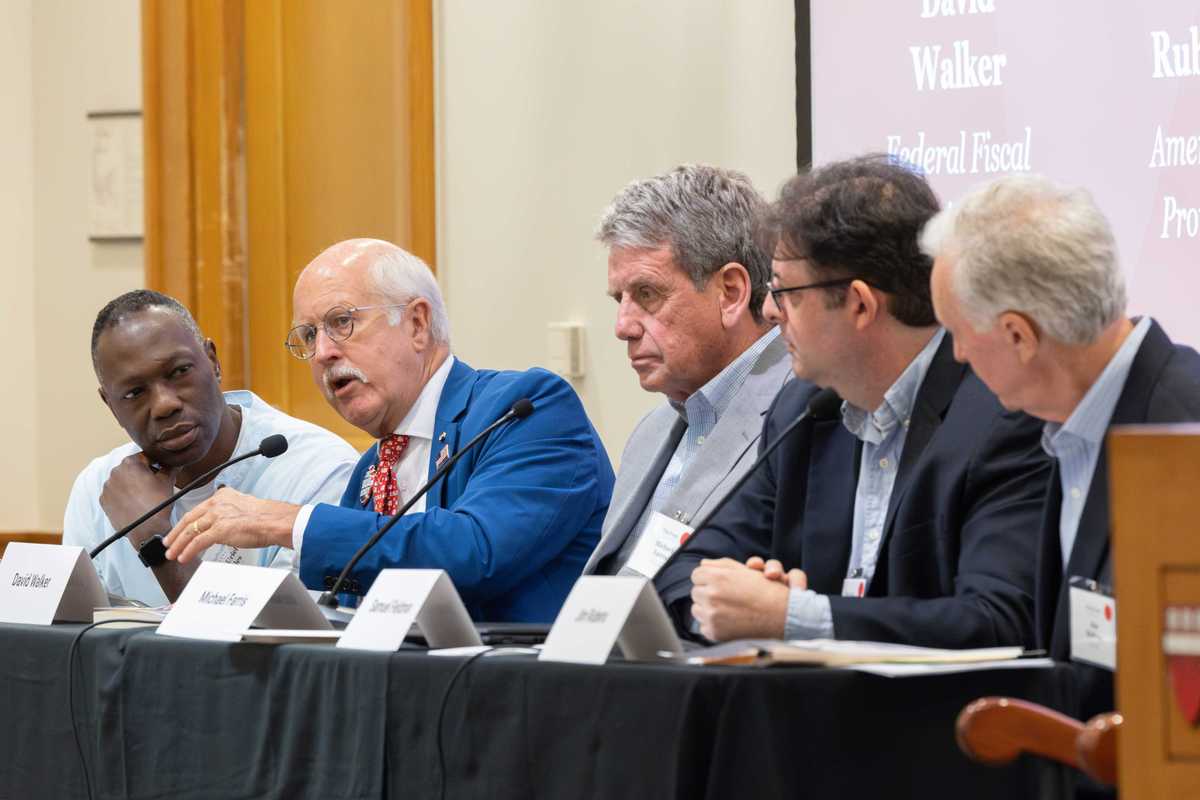
SLLF is a nonpartisan, nonprofit organization dedicated to professional development for our nation's current and future state legislative leaders. Our educational programs, held in partnership with leading colleges and universities, are designed to give these leaders the objective information they need to make reasoned decisions on important public policy issues. We educate and inspire our nation's current and future state legislative leaders to excellence, without regard for party, policy or ideology.
Site Navigation
Search
Latest Stories
Join a growing community committed to civic renewal.
Subscribe to The Fulcrum and be part of the conversation.
Top Stories
Latest news
Read More

U.S. Secretary of Defense Pete Hegseth, White House' border czar' Tom Homan, and Attorney General Pam Bondi listen as President Donald Trump speaks before swearing in the new Secretary of Homeland Security Markwayne Mullin in the Oval Office of the White House in Washington, D.C., on March 24, 2026.
(AFP via Getty Images)
Beware for all the president’s men (and women)
Mar 31, 2026
If I were Defense Secretary Pete Hegseth, I might start packing up my office at the Pentagon.
While President Trump is boasting about the so-called success of a war with Iran that has no clear mission nor end in sight, Americans are souring on it. Big time.
New polling from CBS News/YouGov shows an increasingly bearish public when it comes to the war, with 57% saying it’s going somewhat or very badly. Sixty-three percent believe the war will make the U.S. economy weaker in the short term, while a whopping 92% say the most important thing the U.S. should do with regard to Iran right now is “end the conflict as quickly as possible.”
Hardly a rousing endorsement. We know Trump closely monitors the polls, which is perhaps why he said what he did on Monday while at a roundtable in Memphis.
While discussing crime, Trump oddly detoured to brag about his decision to go to war with Iran and then pointed to Hegseth, who was in the room, and said: “And Pete, I think you were the first one to speak up. And you said, ‘Let’s do it, because you can’t let them have a nuclear weapon.’ ”
Now, any other time and any other president and you’d call this a compliment. But seasoned Trump-watchers’ eyebrows raised at the subtle but discernible sign of what may be to come.
It would be, after all, a very Trumpian and convenient blame-shift to make the war all Pete’s idea when it’s slumping in the polls, and it doesn’t help Hegseth that reports are swirling around D.C. that Republicans on the Hill and inside the administration have “zero confidence” in him.
As former Department of Homeland Security Secretary Kristi Noem knows all too well, Trump only loves you until he doesn’t. When ICE raids in Minneapolis turned deadly and the sordid headlines around her spending and personal life got too unbearable, Trump dumped the glammed-up grifter with an unceremonious thanks and a move to a made-up new post.
Former Kennedy Center head Ric Grenell had also been one of Trump’s longtime favorites, but he too lost his job this month after overseeing plummeting ticket sales, a mass exodus of artists, and scathing headlines. And that’s after he put Trump’s name on the building!
A couple other Trump cabinet members may want to prepare for early exits, while we’re at it.
Attorney General Pam Bondi’s DOJ has been rightfully dragged through the mud for its incompetence and political hackery, overseeing multiple failed attempts at indicting Trump’s political opponents, an obvious cover-up of the Epstein files, and losing so much talent it now has to recruit prosecutors straight out of law school. Maybe that’s why Bondi recently hung the North Korea-coded banner of Trump on DOJ HQ.
DNI Tulsi Gabbard might not be long for this world either. She’s been excluded from high-level meetings at the White House, so much so that the joke among aides is that DNI stands for “Do Not Invite.” Even Trump has publicly dismissed her advice.
If you’re wondering why these folks continue to work for a guy who humiliates them, sidelines them, and then dumps them, that’s easy — they have no principles, integrity or self-respect! And when you’re solely motivated by naked power grabs and money, you can put up with a lot.
Only time will tell if Hegseth, Bondi and Gabbard can survive what will only become worse and worse headlines. But in the meantime, Pete might want to put a Trump banner up on the Pentagon — just in case.
S.E. Cupp is the host of "S.E. Cupp Unfiltered" on CNN.
Keep ReadingShow less
Recommended

man in white robe holding a book statue
Photo by Caleb Fisher on Unsplash
Clarity Is Power: The Three Pillars That Keep the People in Charge
Mar 30, 2026
American democracy does not weaken all at once. It falters when citizens lose clarity about how power is being used in their name. Abraham Lincoln warned that “public sentiment is everything… without it, nothing can succeed.” When people understand what their leaders are doing, they can hold them accountable.
But when confusion takes hold, power shifts quietly, and the public’s ability to act begins to erode. Clarity enables citizens to participate fully in democratic life and shape a government that responds to them. Confusion is not harmless; it erodes the safeguards, public awareness, and civic action that make self‑government possible. Clarity strengthens all three pillars at once — it protects our constitutional safeguards, sharpens public awareness, and fuels civic action.
Clarity is more than an ideal; it is the condition that keeps the public in charge. Without it, citizens cannot see how power is being used or recognize when leaders are overstepping.
Our constitutional system rests on the belief that the people are not bystanders to government—they are its authors, its guardians, and its ultimate check. Maintaining that role requires strengthening three pillars that keep the public in charge: constitutional safeguards, public awareness, and civic action.
America’s democracy is faltering in real time. The most troubling threats to its stability are no longer primarily external—they are internal. Concentrated presidential power, a largely silent Congress, election interference within our political system, and structural weaknesses in our institutions are converging. Issues once considered external pressures—international conflicts and geopolitical distractions—now amplify domestic decay rather than simply challenge it from abroad. Plans to reshape the federal government, such as the Heritage Foundation’s Project 2025, have quietly entered the national conversation.
Together, these forces erode democratic accountability and undermine the public’s voice. This moment is not only a crisis for American institutions; it is a test of citizens’ ability to defend democracy itself. Meeting that test requires clarity—organizing facts, interpreting risks, and communicating them honestly. Clarity gives citizens the power to navigate today’s chaotic headlines — to separate noise from consequence, distraction from danger, and spectacle from the decisions that shape their lives.
Institutional safeguards are the constitutional and legal protections that prevent government power from being abused. They include freedoms of speech, religion, and the press; the right to a fair trial; and protections against unreasonable searches and seizures. These safeguards protect the public by preventing any leader from silencing dissent, manipulating institutions, or concentrating power beyond constitutional limits.
The framers understood human nature—its ambition and its tendency toward overreach. They designed a system in which no single person or branch could dominate. Congress makes the laws, the president executes them, and the courts interpret them. Checks and balances give each branch the tools to restrain the others. Additional protections—including civil service safeguards and transparency laws—have developed over time to reinforce this design.
When safeguards weaken, the public loses the protections that allow people to speak, worship, publish, assemble, and challenge government actions. When these protections erode in practice, the effects become visible in public life. Threats to religious freedom, pressure on journalists, and harm against peaceful demonstrators all signal that the constitutional guardrails protecting the public’s voice are under strain.
Safeguards protect the people’s ability to act, but they only function when citizens can see how power is being used.
Public awareness is the collective understanding citizens have about how government works, what decisions are being made, and why they matter. It relies on transparent information, a free press, and the ability to evaluate government conduct. Public awareness ensures that citizens can recognize abuses of power and withhold consent when leaders overstep.
At its core, public awareness enables informed consent. Without it, citizens cannot meaningfully participate in self-government. The framers protected a free press, open debate, and the right to petition the government because citizens must understand what their leaders are doing to judge whether those actions align with constitutional principles.
Public awareness is most vulnerable when the flow of information is distorted—when reporting is suppressed, journalists face intimidation, or misinformation spreads. When transparency declines, citizens cannot see how power is being used or abused, making informed judgment difficult.
Understanding proposals such as Project 2025 is a matter of civic literacy. A democracy cannot defend what it does not understand. When major governing plans are treated as abstractions rather than concrete policy agendas, the public loses the ability to evaluate what is being done in its name.
Awareness, however, is only the beginning. Once people understand how power is being used, they must be able to act on that understanding. That is where civic action becomes indispensable.
Civic action is the people’s power made visible. It includes voting, participating in peaceful protests, staying informed, and engaging in public forums. It also includes quieter forms of engagement—community involvement, service, and collective problem solving—that strengthen democratic life beyond partisan politics. Civic action is how the public exercises sovereignty between elections. The Constitution begins with “We the People” because the people themselves are the ultimate check on government.
When civic action weakens—when people are discouraged from voting, when participation is dismissed, or when protest is suppressed—the public loses its most direct means of exercising power.
I did not begin with clarity; I began with confusion — the kind that unsettles your footing and obscures what is at stake. But confusion is not neutral. It is the condition in which power shifts quietly, without the people’s consent. As I learned more about the scope and implications of Project 2025, fear gave way to clarity.
Staying in charge will require a bipartisan commitment to democratic principles. Americans must understand the stakes and recognize when leaders are not acting in the public’s best interest. Citizens must rely on the Constitution’s protections and institutional guardrails to prevent the republic from faltering.
The three pillars—constitutional safeguards, public awareness, and civic action—can keep the public in charge, but only if citizens actively defend them. Americans must understand the separation of powers to prevent any president from becoming too powerful. They must expect each branch of government to exercise its responsibility to check the others. Protecting these structures means defending constitutional rights, staying informed, and participating in civic life.
Elections remain the public’s most direct form of accountability. Voting is power, and citizens must use it in every election—local, state, and national. When leaders support policies that weaken democratic safeguards, concentrate power, or suppress civic participation, voters have the authority to replace them.
Even the strongest pillars cannot stand alone. Clarity is power. To remain in charge of the republic, Americans must defend constitutional safeguards by demanding transparency, accountability, and adherence to the rule of law. Citizens must strengthen civic action by participating beyond election day.
The Constitution places power in the hands of the people—not in any plan, party, or president. Democracy survives only when the public understands what is being done in its name — and insists on its right to be heard. Being heard is only the beginning; in a healthy democracy, leaders must respond with action that reflects the public’s needs rather than ignore them while conditions worsen.
Carolyn Goode is a retired educational leader and a national advocate for ethical leadership, civic literacy, and government accountability. She writes about democratic principles, institutional integrity, and the responsibilities of citizenship in a constitutional republic.
Keep ReadingShow less

As America marks the 250th anniversary of the Declaration of Independence, a growing nonpartisan movement urges communities to focus on civic service, unity, and shared democratic values beyond political division.
Getty Images, Hill Street Studios
Uniting Americans Through Service for the 250th Anniversary
Mar 30, 2026
In an atmosphere of deep political and social division, many individuals, communities, and organizations are asking how, or even if, they should participate in this year's 250th anniversary of the Declaration of Independence. As writers like Jill Lepore, articles in USA Today, and others have pointed out, it’s not that people don’t want to honor our nation’s history or many virtues. Rather, there are legitimate concerns that certain “official” events and national organizations associated with the occasion have become increasingly and troublingly politicized.
Commemorating the Declaration of Independence can and should be an opportunity to focus on shared values, not aggrandizing any one individual or advancing one political faction over another. That is true regardless of who the president happens to be or what political party is in power. Precisely because our nation is so divided, this unique occasion calls for initiatives that transcend personalities and superficial celebrations in ways that engage all Americans and will help ensure our constitutional democratic republic endures for another quarter millennium.
Achieving that worthy goal may at times seem improbable if not impossible, but for inspiration on how to do so, we can turn to the Declaration itself, notably its powerful closing words, “we mutually pledge to each other, our Lives, our Fortunes, and our sacred Honor."
That timeless “pledge to each other” is perhaps the greatest shared commitment to service ever written. It is also the essential, yet too often ignored, key to the success of any democratic republic, and it should guide how we celebrate this semiquincentennial.
History tells us that democracies fail when people of selfish motives use the democratic process to gain power, then use their power to undermine democracy. Democracies succeed only when voters and the people they choose are motivated by a commitment to do what is best for the nation as a whole, not for one faction versus another or short-term selfish gain at the long-term expense of the common good.
Not only this year, but every day of every year, we need to instill and sustain the cultural expectation that all of us, throughout our lives, should serve the community and nation as part of our responsibilities as human beings and citizens. As Martin Luther King said in his “Drum Major Instinct” sermon, “Everybody can be great, because everybody can serve.”
Consistent with how local communities rose up and colonies joined together in 1776, there is a powerful way for every community and school in the nation to celebrate service in ALL its forms every day. What’s more, this can be done without applying for unobtainable external grants, without depending on direction, permission, or resources from the federal or state government, and without tacitly or actively promoting or elevating any political person or organization.
The process is strikingly simple yet incredibly impactful.
1. Bring together service groups and nonprofits, and invite or help them to create physical posters or digital displays telling the stories of who they are, what they do, why it matters, and how to get involved or contribute.
2. Then mount or project those displays throughout the community in public or private spaces so wherever people go, they will see examples of people from all walks of life and all ages serving.
3. Do the same in schools, with students creating the exhibits and posting them publicly inside and out of their buildings so it is not just athletic championships that are recognized; it’s also service by students, alums, faculty, and staff.
The results, when implemented nationwide, will reach millions of people each day with inspiring examples and ways to get involved. As Martin Luther King Jr. said, “Everybody can be great because everybody can serve!”
To facilitate this process, a number of prominent national and local service organizations have collaborated to create a truly nonpartisan and nonpolitical grassroots initiative called 250andBeyond. The name reflects both the tradition of service extending back much earlier than 250 years ago, and that what matters most now is how we continue as a constitutional, democratic republic far beyond this year.
This movement is the initiative of the nonprofit National Museum and Center for Service (NMCFS.ORG) in close partnership with Independent Sector. The NMCFS has created free, open-source toolkits and case studies that can be used by schools and communities all across the nation to create their own “exhibitions of service." The toolkits for creating exhibits have been field-tested and proven, with communities, organizations, and schools using them to create and publicly display their own compelling exhibits remarkably affordably, and within a matter of months.
Lived experience, history, and abundant research demonstrates that there is no more powerful way than participation in service to unify people from diverse backgrounds, strengthen community, and enhance people’s sense of personal purpose and engagement. Even the experience of seeing others serve can elevate people’s feelings and inspire greater kindness and generosity. Every nonprofit, service, charitable and philanthropic organization stands to benefit as more people become aware of the importance of service, understand how it benefits their own lives and communities, and see examples of how they too can become involved and contribute in meaningful ways.
The good news is it is not too late to do this for the 250th, and it is intrinsically worth doing and sustaining long after the anniversary year concludes. Everyone, regardless of their politics or background, can play a part, and the result will create a legacy of honoring service in new ways that will continue for as long as the nation itself.
For more information and to access the free toolkits and case studies - visit the National Museum and Center for Service - NMCFS.ORG and 250andBeyond.org. For curriculum and discussion materials specifically related to service and the nation’s founding, visit the resource site accompanying the documentary series The American Revolution.
You can also join the upcoming 250AndBeyond Service Symposium, to be held in Washington, D.C., on April 24, with a free live webcast available online.
The Honorable Brian Baird, Ph.D., is a former Member of Congress, neuropsychologist, university president, and the founder, executive director of the National Museum and Center for Service NMCFS.ORG
Keep ReadingShow less

Apple’s upcoming AI-powered wearables highlight growing privacy risks as the right to record police faces increasing threats. The death of Alex Pretti raises urgent questions about surveillance, civil liberties, and accountability in the digital age.
Getty Images, aislan13
AI Wearables and the Rising Risk of Recording Police
Mar 30, 2026
Last month, Apple announced the development of three wearable smart devices, all equipped with built-in cameras. The company has its sights set on 2027 for the release of their new smart glasses, AI pendant, and AirPods with built-in camera, all of which will be AI-functional for users. As the market for wearable products offering smart-recording capabilities expands, so does the risk that comes with how users choose to use the technology.
In Minneapolis in January, Alex Pretti was killed after an encounter with federal agents while filming them with his phone. He was not a suspect in a crime. He was not interfering, but was doing what millions of Americans now instinctively do when they see state power in motion: witnessing.
Pretti’s death is still under investigation, and the legal facts will be contested. But the moral and political question it raises is already clear. In an era when nearly every citizen carries a camera, the act of observing government force has become both easier and more dangerous. Technology has democratized documentation, but it has also transformed the witness into a perceived threat. The result is a troubling pattern: the very tools that were supposed to make power more accountable are increasingly met with intimidation, targeting, and, in the most extreme cases, lethal force.
This is not an isolated dynamic. The bystanders who filmed George Floyd were initially threatened with arrest. Journalists covering the Atlanta “Cop City” protests have been detained and charged under expansive domestic terrorism statutes. In Portland during the 2020 protests, federal officers repeatedly seized and questioned individuals whose primary “offense” was recording. Abroad, reporters in Gaza and the West Bank have been shot while clearly marked as press. The specifics differ, but the logic is consistent. When cameras proliferate, the state begins to treat the act of seeing as subversive.
Pretti’s case brings that logic home. Federal agents operating in an American city confronted a civilian whose only apparent act was observation. Whether through panic, misjudgment, or institutional culture, the presence of a recording device was treated not as a protected exercise of constitutional liberty, but as a provocation. This is the quiet inversion taking place. The First Amendment once stood as a shield for those who spoke and those who watched. Today, in moments of tension, it is increasingly treated as an obstacle.
Technology has changed the architecture of accountability. In the twentieth century, oversight flowed primarily through institutions: courts, legislatures, and professional media. In the twenty-first century, it flows through networks. A single video can expose misconduct, contradict official statements, and mobilize public scrutiny within hours. For communities that have long experienced disproportionate policing and surveillance, the smartphone has become a tool of self-defense in the civic sense. It is how power is checked when formal channels fail or move too slowly.
But this shift has also created a perverse incentive. When documentation becomes ubiquitous, those who wield force know that every action may be dissected and judged. In that environment, the witness is no longer neutral but becomes a liability. The danger is not only the tragic loss of life in cases like Pretti’s, but the chilling effect that follows. If observing police activity can get you detained, pepper-sprayed, or worse, rational citizens will think twice before lifting their phones. The public square grows quieter, and misconduct becomes easier to hide. This is how a democracy drifts, not quite through the abolition of rights on paper, but through the normalization of fear around exercising them.
If the act of witnessing is now central to how constitutional accountability functions, then the law must evolve to protect it explicitly.
First, Congress should enact a clear federal “Right to Witness” statute. Courts have recognized a First Amendment right to record police, but doctrine alone is insufficient when agents on the ground operate under stress and ambiguity. A statute should make plain that recording or observing law enforcement, including federal agents, is presumptively lawful, and that detention, seizure of devices, or use of force solely on that basis is prohibited. Retaliation against witnesses should carry enhanced civil and criminal penalties, and evidence obtained after unlawful interference with recording should be subject to automatic suppression, much as statements taken in violation of Miranda are.
Second, qualified immunity should not shield officers who use force against individuals engaged in clearly lawful observation. The doctrine was designed to protect reasonable mistakes in fast-moving situations, not to insulate retaliation against constitutional oversight. When the conduct at issue is the suppression of a core First Amendment activity, the legal system should err on the side of accountability.
Third, states and cities should assert their role as constitutional backstops when federal operations occur within their borders. “Sanctuary for witnesses” laws could limit cooperation with federal agencies in cases where force is used against civilians engaged in protected recording, and require automatic review by state attorneys general whenever such incidents occur. Federalism should not mean abdication when fundamental liberties are at stake.
Fourth, the legal system should treat bystander footage with the same seriousness as official body-camera recordings. Preservation requirements, chain-of-custody rules, and penalties for destruction or suppression should apply equally. The public’s camera is now part of the evidentiary infrastructure of justice. It deserves institutional protection.
Finally, there should be a clear civil cause of action for obstruction of lawful civic observation. When individuals are targeted, injured, or killed because they were documenting state conduct, they and their families should not have to rely solely on discretionary prosecutions or protracted constitutional litigation. The law should recognize interference with witnessing itself as a distinct and grave harm.
Some state laws already recognize parts of what a federal ‘Right to Witness’ statute would codify. For example, New York’s Civil Rights Law § 79-p explicitly protects the right to document police activity and allows those whose rights are violated to seek damages, a civil remedy that goes beyond mere constitutional claim-making. Several states, such as Colorado, Hawai‘i, and Illinois, also independently protect the right to record police in public in their statutes or constitutions. Yet even in these jurisdictions, officers sometimes detain or seize recording devices, and courts are left to sort out the violations later. This patchwork shows that while recording rights are increasingly recognized, they lack the clear, uniform statutory safeguards against interference, force, and impunity that a federal law would provide.
Beyond statutes and doctrines, there is a cultural shift that must occur. Filming police is often framed as antagonistic, as if the camera were an insult rather than a safeguard. In reality, it is an expression of the same civic impulse that underlies jury service, public trials, and a free press. It is how ordinary people participate in the maintenance of lawful government.
Alex Pretti did not set out to be a symbol. He was a citizen with a phone, recording in a community that promises freedom of speech and freedom of the press. That those freedoms can now place someone in mortal danger should trouble anyone who cares about constitutional democracy. The question his death forces is not only what happened in one encounter, but what kind of political order we are becoming when seeing is treated as a threat.
David M. Hatami is an Offensive Security Project Manager and a Public Voices Fellow on Technology in the Public Interest with The OpEd Project. He previously managed cybersecurity and penetration testing operations at Amazon Web Services and was a fellow with Youth for Privacy.
Editor's Note: This story was updated on 3/30 to accurately reflect the timeliness of past events.
Keep ReadingShow less
Load More