
Skip to content
Search

Latest Stories

Follow Us:
Top Stories

Kemp's claim that Democrats hacked state election site not true, report finds

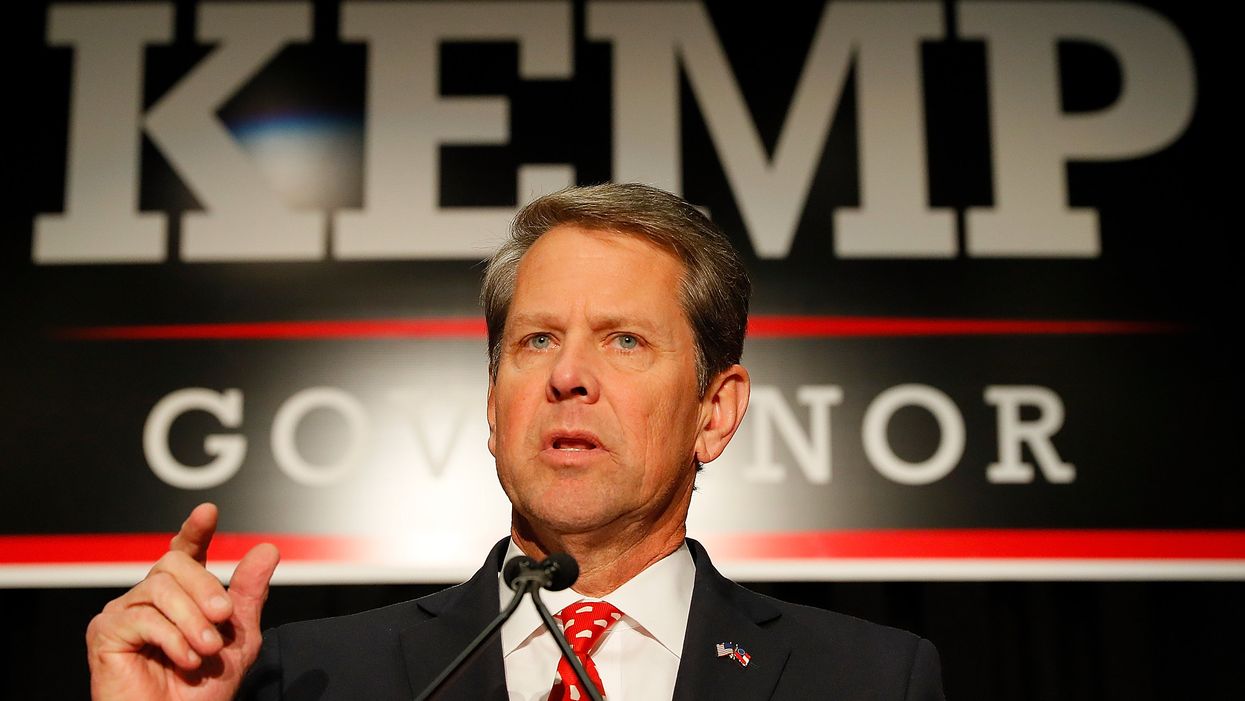
Georgia Gov. Brian Kemp

Gov. Brian Kemp charged late in the 2018 campaign, when he was still secretary of state, that Democrats had hacked into Georgia's election websites. An investigation unveiled this week found that the charge was not true.

Kevin C. Cox/Getty Images

A sensational charge levied by Republican Brian Kemp during his savage but successful campaign for governor of Georgia against Democrat Stacey Abrams has not yielded any criminal charges.

Georgia Attorney General Chris Carr, also a Republican, issued a three-page memo on Monday stating he did not find evidence to back Kemp's claim two years ago that Democrats had hacked into the computer system of the secretary of state, the position Kemp held when he ran.

He defeated Abrams by 54,000 votes out of 3.9 million cast, a margin of less than 1.5 points, and Democrats said Kemp's claim was one of his many ploys to gain political advantage — along with what they view as a multifaceted campaign of voter suppression


The claim originated from a report made by Georgia businessman Richard Wright that several election-related pages on the secretary of state's website were vulnerable to an enemy cyber invasion. Those claims were passed to a volunteer with the state Democratic Party and ended up in Kemp's office, which prompted his allegation.

But investigations of Wright's claims found them not to be accurate. While the web pages had been vulnerable, such problems had been fixed.

Did anyone actually hack the site? Prior intrusions into the site were actually cybersecurity tests conducted by the federal Department of Homeland Security, which had been contracted by Kemp's office to do the work.


Read More

California Voters Don’t Like Either Party. Good Thing the Primary Doesn’t Belong to The Parties.

California voters increasingly distrust both major parties. Here's why the state's Top Two primary gives independent voters more power to shape elections.

Image: Duncan Shelby on Alamy.

California Voters Don’t Like Either Party. Good Thing the Primary Doesn’t Belong to The Parties.

SAN DIEGO, Calif. - California voters have already received ballots for the June 2 primary, and the message they have going into these elections may not be what the political class wants to hear: They are not thrilled with either major party.

A recent analysis from the Public Policy Institute of California (PPIC) found that majorities of likely voters have unfavorable views of both parties—61% unfavorable toward the Democratic Party and 70% unfavorable toward the Republican Party.

Keep ReadingShow less
How the Voting Rights Act Reshaped Texas’ Electoral Maps

President Lyndon B. Johnson, Martin Luther King Jr., Clarence Mitchell Jr., Patricia Roberts Harris, and other guests at the signing of the Voting Rights Act on August 6, 1965.

Yoichi Okamoto - Lyndon Baines Johnson Library and Museum

How the Voting Rights Act Reshaped Texas’ Electoral Maps

In 2002, U.S. Rep. Henry Bonilla, a Republican, nearly lost his South Texas seat to Democrat Henry Cuellar. So when the GOP used its newfound majority in the state Legislature to redraw the voting maps the next year, they sawed through Cuellar’s hometown of Laredo and scattered Latino voters, who tended to vote Democratic, into other districts.

Latino advocacy groups sued under Section 2 of the Voting Rights Act, the cornerstone provision of the law that prevents government bodies from diluting the voting power of specific groups. The Supreme Court found Texas lawmakers had taken away Latino voting power “because they were about to exercise it.”

Keep ReadingShow less
A group of people wait in line to get their ballots to vote in the election.

The National Popular Vote Interstate Compact could reshape presidential elections as Midwest states debate Electoral College reform, political polarization, and the future of winner-take-all voting in America.

Getty Images, SDI Productions

700+ Proposed Amendments Failed, Midwest Voters Can Succeed

The Midwest served as the vanguard and ideological heartland of the Progressive Era, acting as a crucial laboratory for political, social, and economic reforms that later adopted national significance. Midwestern states (the cradle of the movement) pioneered anti-monopoly efforts, democratic, and social improvements.

After 770+ failed proposed U.S. Constitutional Amendments (the most on record for one issue) to remedy the factionalism (21st century polarization) feared by the Framers of the U.S. Constitution.

Keep ReadingShow less
“We Can’t Afford It” Is Never an Acceptable Excuse To Deny Independents a Vote

DC voting rights advocate Lisa D.T. Rice criticized the DC City Council for failing to fund Initiative 83’s semi-open primary system, leaving 85,000 independent voters unable to participate in taxpayer-funded primaries despite overwhelming voter approval in 2024.

Photo by Getty Images on Unsplash.

“We Can’t Afford It” Is Never an Acceptable Excuse To Deny Independents a Vote

WASHINGTON, D.C. - Lisa D.T. Rice spoke before the DC City Council during a Budget Oversight Hearing on May 1 to talk about Initiative 83, the semi-open primary and ranked choice voting measure she proposed that was approved by 73% of voters in 2024.

- YouTube youtu.be

Keep ReadingShow less