
Editor’s note: More than 10,000 officials across the country run U.S. elections. This interview is part of a series highlighting the election heroes who are the faces of democracy.
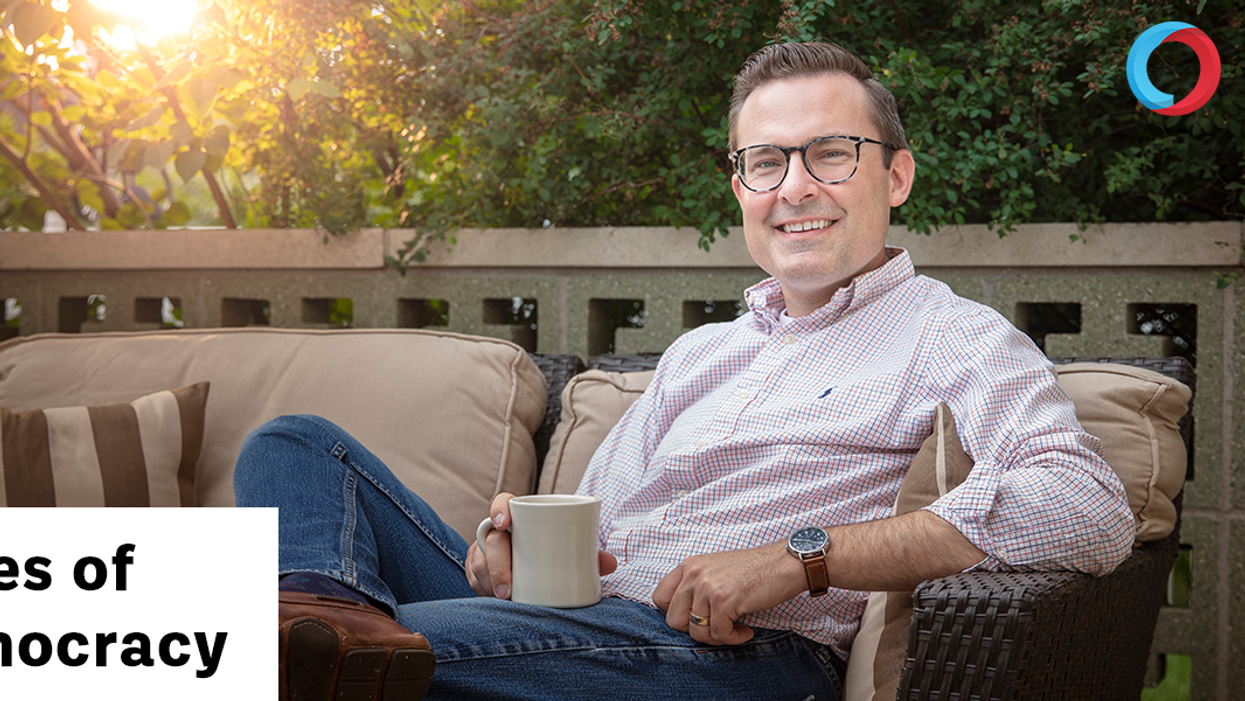
Justin Roebuck, a registered Republican, serves as the county clerk and register of deeds in Ottawa County, Michigan, which is nestled along the shore of Lake Michigan in the southwestern part of the state, about halfway between Chicago and Detroit.
Election administration in Michigan is highly decentralized, with county clerks, municipal clerks, and township clerks all playing a role. Ottawa County is the seventh most populous county in Michigan, with approximately 220,000 voters. As county clerk, Roebuck oversees elections processes in 23 local cities and townships.
A self-proclaimed history nerd who loves his family, community, and gardening, Roebuck was first appointed as county clerk in 2014. He was then elected to the position in 2016 and was reelected in 2020. Previously, he worked in the office of Michigan’s secretary of state and managed a congressional campaign.
In 2021, Roebuck was recognized as the County Clerk of the Year by the Michigan Association of County Clerks. He has served as the chair of the Michigan Council of Election Officials, co-chair of the legislative committee of the Michigan Association of County Clerks, and a member of the U.S. Election Assistance Commission’s standards board. He is also a member of the historical society in Zeeland, Michigan, where he lives with his wife and two children.
Since 2022, he has been part of Issue One’s Faces of Democracy project advocating for protections for election workers and for regular, predictable, and sufficient federal funding of elections.
This interview has been edited for length and clarity.
Issue One: How did you end up in this profession?
Justin Roebuck: I’ve sort of been in the political science space since I was about nine years old and fascinated with politics. But I got my start in election administration working for the Michigan secretary of state, where I interned as I was finishing up high school. Then I worked for the secretary of state through college, and ultimately became a member of the executive staff. Then, I left to do some other political things. I managed a congressional campaign right out of college, which was interesting and fun. But at the end of the day, I was drawn back to the election administration side. I’ve been an election administrator officially since 2009. I was hired to run elections for the county, and then was appointed county clerk in 2014. And I’ve run for reelection ever since.
Issue One: How many voters are on the rolls in Ottawa County, and what are the main challenges of having a jurisdiction of that size?
Justin Roebuck: We have about 220,000 registered voters on any given day. We’re in the top 10 in Michigan counties in terms of our size, but we are still a lot smaller than a lot of other jurisdictions around the country.
Some of the challenges that we face are somewhat unique because we have a decentralized election administration system in Michigan. City and township clerks are essentially on the front lines of running the election process, and the county is a major support to them. But we are a step removed from the day-to-day management of elections.
I have 23 local jurisdictions, where city and township clerks hire election workers, manage the polling places on Election Day, and distribute absentee ballots. The county doesn’t do those things. The county gets the results into the database and certifies the election, but we aren’t actually issuing the ballots.
Decentralization can be a really good and healthy thing, but it’s also a challenge to get everyone on the same page and to avoid voter confusion.
Issue One: What would you consider your greatest achievement as an election administrator?
Justin Roebuck: I absolutely love the collaboration with local jurisdictions. Being able to partner with them to provide excellent customer service is a huge priority for me. It’s something we’ve been able to do really well. At the end of the day, voting is a customer service experience. Another thing we’re really proud of is the way we’ve been able to communicate with our customers and ensure transparency. Good quality, fact-based, pre-emptive communication is something that we strive for every day.
Issue One: What’s the ballpark estimate price tag for running an election in Ottawa County?
Justin Roebuck: Obviously, it depends on the election. We had a special election in May that covered most of the county and its school districts. Voter turnout is certainly a lot lower for that kind of election, and the price tag for an election that size is in the $200,000 to $250,000 range. In a presidential election, I would say the price tag is closer to $400,000.
Issue One: Where does funding for election administration in Ottawa County come from?
Justin Roebuck: It primarily comes from local units of government, as well as whatever limited grant funding we can acquire through the state or federal government. We don’t receive direct state funding for anything other than our presidential primary.
Issue One: What challenges have you faced, as it relates to having limited resources for election administration?
Justin Roebuck: In one sense, we’ve been really fortunate. My county board of commissioners has been supportive of our needs. But one of the real challenges we face now is because we’re in a situation where election administration has been chronically underfunded.
For a long time, we’ve just sort of operated under this mentality that we do a lot with a little, and we have been nickel-and-diming the process over the last several decades. We really need to take a serious look at a systemic investment in our election infrastructure.
Elections have drastically changed in terms of how we administer the process. Technology has improved and changed. And election administrators have had to adjust to that to become more tech savvy and more skilled in those ways.
We also need to be able to respond to Freedom of Information Act requests. We need to have a communication specialist on our teams.
Telling our story better is one thing that we need to make sure that we are doing. Law enforcement in our community is a great example of this. They have a good, proactive, community engagement plan to be out and about in the community and be visible partners — and there's real recognition of the importance of law enforcement.
As election administrators, we need to engage on that level. We’re performing a critical function for our communities — a constitutionally mandated function that is essential for government, and I think we need to recognize that and celebrate that in ways that will tell that story better and result in more buy-in from the community.
Issue One: If you had more funding in your jurisdiction, how would you spend it?
Justin Roebuck: That communications piece would be at the top of our list for sure. We also have some other real needs that are very practical and related to the security of our election process. For example, more secure storage facilities across the counties for election equipment.
Issue One: A lot of people are pretty surprised to learn that the federal government doesn’t routinely fund election administration. Why do you think the federal government should?
Justin Roebuck: One of the challenges I have as someone who really believes in the federalist system of how our elections are run is that the federal government should only be mandating a few key pieces of the process for the states. But I still think there are some really key pieces where the federal government should be funding at a baseline level because elections are critical infrastructure.
One thing that is not currently managed at the federal level that I think should be is an inter-state system to cross-reference voters, so jurisdictions can better check when people move. That’s something the federal government could step in and help fund.
Issue One: If you could speak to one common misconception about election administration, what would you say?
Justin Roebuck: I can definitely speak to you for a long time about misconceptions in election administration. I think one broad misconception about election administration is that we just throw this together and decide to have an election and hold it overnight. But we are trained professionals who go through numerous certifications and spend hundreds of hours learning our job.
We plan for these things for months. Elections are events that are purposely planned for months and months in advance. We actually do think about things like how to prevent someone from sending in an absentee ballot that is not theirs, for example. There have been laws on the books for years and years. I’m not saying that the system is perfect — we can always improve, always make things better — but I think we have a pretty robust, bipartisan system in place with checks and balances and a process for running elections that has been on the books for years.
To use a really specific example of misinformation that we’ve been seeing a lot recently: I get a lot of emails from constituents claiming that algorithms are programmed into ballot processing equipment that essentially skim votes from certain candidates — and there are hundreds of hours of YouTube videos about this. We’ve dealt with this on so many occasions, with so many conversations, with so many people. There are always rational explanations for why one candidate got more votes than another candidate. And we do post-election audits where we do a handcount tally of ballots to ensure accuracy. I will send a personal note to someone who is concerned and say: “Show up, meet me at this audit. We’ll allow you to sit right at the table. You can’t touch the materials, but you can watch everything play out, and we’ll show you every ballot, and we’ll show you how this was accurately counted.”
Issue One: In your job, how do you personally work to embody the principle of transparency in election administration?
Justin Roebuck: Transparency is the key to what we do because we operate in an environment that relies on trust. This is how we choose our government. We want to make sure that we’re operating to the best standards of integrity and making sure that our process is secure and accurate. Those are the fundamentals.
There are other things that play a role in that too, like perception. Perception is important, because perception is also a key to trust. If voters perceive that there isn’t access, then they’re not going to trust the system. If voters perceive that there isn’t security, then they are not going to trust the system. And so, for us, over-communication is really important, opening up our office and opening up our process. A lot of what we do is very technical and data-driven. We might be using these technical terms and doing these things, but we need to make sure that we’re explaining ourselves really well and making sure that we’re available to meet with people.
Issue One: The issue of election administrators in states like Pennsylvania and Michigan not being able to “pre-process” mail ballots has made national headlines over the past few years. Why do you think giving local election officials more time before Election Day to process ballots that have been mailed in is a good idea?
Justin Roebuck: When you’re waiting for a few days for election results in your community, it will affect trust. That’s not to say that there’s anything wrong going on. It’s just a matter of how people are perceiving the process, and perception is really important.
Issue One: Outside of being passionate about running safe and secure elections, what are some hobbies you have or what’s a fun fact that most people might not know about you?
Justin Roebuck: We have a 100-year-old house. I like working to restore the home and preserve that history. I’m a total nerd for history. I also love to be outside in my garden. I love just being outside and digging in the dirt. I’m also a dog lover. We have a golden retriever, and she's awesome. And we’re pretty involved in our local church community as well.
Issue One: What is your favorite book or movie about politics or elections?
Justin Roebuck: I’m a total nerd for Abraham Lincoln. I’ve read like 60 books on Lincoln. Particularly, for this moment in history that we’re in, I think it’s really fascinating to look at the things that Lincoln dealt with, the division and crisis moments that he had. It’s really meaningful to me to look back at historical perspectives and say, “Yeah, here's where we were before, and what it took to kind of rise above the situation.” The movie Lincoln is a really great example of that. It’s a snapshot in time of how he dealt with the 13th Amendment. It’s a good one.
Issue One: Which historical figure would you have most liked to have had the opportunity to meet?
Justin Roebuck: Oh, definitely Lincoln. I would have also really loved to sit down with Martin Luther King Jr. And honestly, I have real regrets for not trying to meet [former Georgia Congressman and civil rights activist] John Lewis when I had the opportunity, because John Lewis is someone I really respect as a historical figure as well.
Issue One: What part of the election administration in your area do you think is not told enough or is not widely understood?
Justin Roebuck: I don’t think it’s widely understood how much of the community has to come together for an election to work. Hundreds of people in your smaller communities — and thousands of people in the larger communities — have to come together to do this work. A lot of us have to be trained and certified to do it. Others are just volunteering their time to do it. But there are so many important pieces of the puzzle that come together, simply with our friends and our neighbors, people who say, “This matters to me. I’m going to sign up. I’m going to take the time and commit to doing this for my community and for my neighbors.” Sometimes that is an unheard piece of the story.
Mia Minkin is part of the research department at Issue One, the leading cross-partisan political reform group in Washington, D.C., uniting Republicans, Democrats, and independents in the movement to fix our broken political system and build an inclusive democracy that works for everyone.