



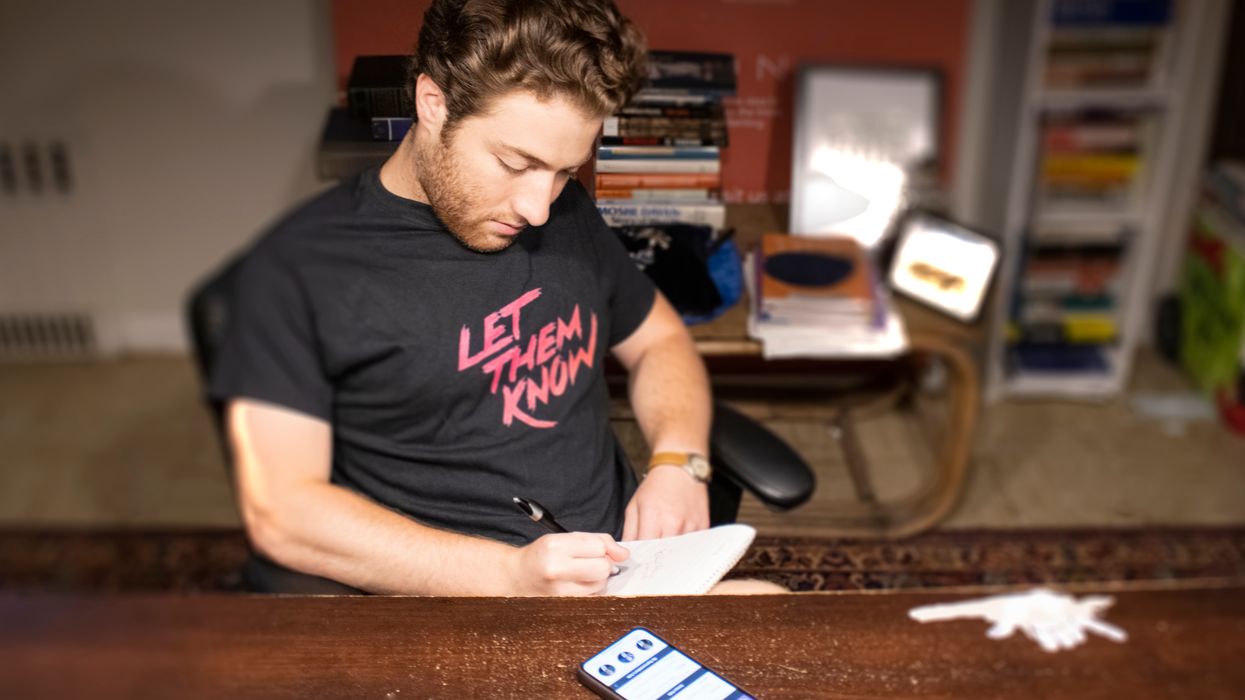
He's only 22 and a year out of college, but Troy Fritzhand's resume describes experience in commercial real estate, investment banking, event planning, high-end athletic shoe sales — and good-government websites, created with the help of older brother Tyler and younger brother Brad. First was the boldly named Ballot, software local governments can purchase to verify the authenticity of signatures on absentee ballot forms. (While pitching that product two summers ago the brothers got arrested in a restricted Senate hallway. The Capitol Police alleged the trio falsely claimed to work for Sen. Chuck Schumer when confronted. They denied doing so but agreed to perform community service to get the case dismissed.) For the past six months Fritzhand has been pitching Let Them Know, a free civic education and grassroots advocacy site. His answers have been edited for clarity and length.
What's the tweet-length description of your organization?
A mobile and web-based civic engagement platform that helps educate Americans on the issues important to them, reach out to their members in Congress and easily register to vote.
Describe your very first civic engagement.
That's hard, since I've been working to assist the community around me for as long as I can recall. In high school on Long Island it was educating fellow students on HIV/AIDS and working with the local special education population. At Ohio State I started a food banking club to feed the local homeless community, which still exists today, and made a volunteer consulting trip to a women's economic development center in Kathmandu. All these experiences opened my eyes to the possibility that when the effort is right, change is not only possible, but necessary.
What was your biggest professional triumph?
Getting arrested in the Capitol definitely stands out as a turning point in my career. I got caught in the wrong place at the wrong time. Because of a clear misunderstanding, I ended up held for almost 24 hours in D.C.'s Central Cell Block. Some of the men I met there may have committed unspeakable crimes. Most were there for petty crimes, but their circumstances and backgrounds likely led to some time behind bars — stifling their voice, and for a time their chance to vote. Everyone should be able to voice their opinion on issues important to them and getting a short glimpse of hopelessness behind bars motivated me to do better, be better, and launch Let Them Know.
And your most disappointing setback?
I've been taught that every setback, no matter how disappointing, should be viewed as a chance to grow. My stay in Nepal included a three-day hike in the Annapurna mountain range. We reached the peak at dawn and got ready for a beautiful sunrise overlooking some of the largest mountains on Earth. But the clouds were thick and completely blocked the sunrise. The other hikers all left, but my group stayed to wait out the storm. Sure enough, we had it all to ourselves when the most incredible vistas appeared — the clouds tumbling over Dhaulagiri Mountain and its surrounding peaks as the sun burst through. Utter disappointment yielded to something breathtaking, and an even better message: Patience is key, so never give up no matter how bad it may seem.
How does your identity influence the way you go about your work?
Growing up in the very diverse and family-oriented town of Great Neck outside New York, I was taught to love everyone I met unconditionally. This helped me when I left home for college, where I arrived knowing only one person. The culture of my hometown enabled me to make friends from many countries and backgrounds — and to recognize the true power education offers to bridge gaps. That's why Let Them Know. Our goal is to educate voters in an unbiased, fact-based manner.
What's the best advice you've ever been given?
I was 4 years old and ready to fall asleep when my dad sat down by my bed. He told me about the time he first went skiing. It was with a group of experienced skiers. Rather than hold them back, he went up the mountain and told himself that under no circumstance would he fall. He didn't. The lesson: If you believe 100 percent in what you are doing, no matter what it is, you will be successful. I have lived by that motto ever since.
Create a new flavor for Ben & Jerry's.
I prefer Haagen Dazs. I also love ice cream. A new Ben & Jerry's flavor should be Caramel Cookies Compound: vanilla ice cream with chocolate chip cookie dough, brownie and caramel.
What's your favorite political movie or TV show?
"Fauda," an Israeli television series on Netflix. It is a political thriller showing the human side of both Israelis and Palestinians in the Israel-Palestine conflict.
What's the last thing you do on your phone at night?
Usually I check Twitter to see if anything notable has happened, but then I read myself to sleep with a paperback.
What is your deepest, darkest secret?
Although I am on the phone speaking to people all day long, I hate my phone and would like nothing more than to go off the grid abroad for a year. Maybe after the election.











A golden tray sits on the Resolute Desk as President Donald Trump speaks during an announcement on American nuclear innovation in the Oval Office at the White House on July 24, 2026, in Washington, D.C. Trump is signing multiple executive orders targeting the nuclear energy sector and easing rules for new reactors and nuclear fuel supply chains.
Trump’s hubris rivals the fallen heroes of ancient Greek mythology
In January, the New York Times asked President Donald Trump if there were any limits on his global powers.
“Yeah,” the president responded, “there is one thing. My own morality. My own mind. It’s the only thing that can stop me.”
That was eight months ago, but fortunately Christopher Nolan’s blockbuster adaptation of “The Odyssey” has made ancient Greek literature newly relevant. Before that window closes, I’d like to talk about hubris.
Today, the term mostly means excessive pride or arrogance. That’s part of what the Greeks meant by it too, but the meaning was a bit richer and more specific. Hubris was an insolent or outrageous act that offended the gods, often because the transgressor was claiming abilities or authorities that solely belonged to supreme beings.
Nolan renamed and slightly modified the concept of xenia for the film, calling it “Zeus’ law.” In the director’s telling, mortals should follow the rules laid out by the gods, specifically the requirement to treat strangers with respect lest they be gods in disguise.
In a sense, hubris is the opposite, or at least the rejection, of xenia. The hubris of the suitors, and at times Odysseus himself, invites punishment by the gods and their mortal instruments.
Which brings me back to Donald Trump. His claim that there are no constraints on his personal power to dictate events on the global stage was one of the greatest expressions of hubris ever uttered by a political leader.
Trump’s claim was obviously false when he made it.
He vowed that he could end the Russia-Ukraine war in 24 hours. He’s proved powerless to make that happen. If he had divine powers to work his will, why would he have balked at implementing his tariffs so often that Wall Street adopted the “TACO trade” term for his deals? “TACO” stands for “Trump always chickens out.”
And why would Trump have made so many embarrassing concessions to China — from rescinding tariffs on Chinese goods to allowing them to buy crucial and incredibly valuable computer chips?
But Trump saw his success at capturing Venezuelan strongman Nicolas Maduro as proof of his ability to launch missiles to the same effect as Zeus’ lightning bolts. Trump believed he was the most powerful man who ever lived.
This is no exaggeration. In March, when the Iran invasion seemed successful, Trump gave a document penned by“Presidential Historian David King” to New York Times reporters Maggie Haberman and Jonathan Swan purporting to prove that Trump was “the most powerful person to have EVER walked this planet.” King was, in fact, a businessman and occasional caddy for legendary golfer Gary Player.
King compared Trump favorably to many of history’s most powerful, and often heinous, figures: Alexander the Great, Attila the Hun, William the Conqueror, Napoleon Bonaparte, Joseph Stalin, Genghis Khan, Mao Tse Tung, Adolf Hitler and Vladimir Lenin. Many of these men thought they were the most powerful person in the world, too. And many were defeated precisely because they believed it.
At least Napoleon and Hitler had a string of truly impressive victories before they learned the folly of hubris. The limits on Trump’s power have been exposed by far less august forces than the combined might of the allies in World War II or the fearsome Russian winter.
Iran is a comparatively middling power. But the regime’s ability to absorb punishment while imposing its will on the Strait of Hormuz has proved to be a greater constraint on Trump’s power than his morality or mind. We should note that, at least rhetorically, his morality has not proved much of a constraint. He has repeatedly promised to destroy Iranian “civilization” if the regime refuses to capitulate.
But they haven’t — and won’t anytime soon — because the regime’s tolerance for pain far outstrips Trump’s. The combined fear of skyrocketing oil prices, outrage of Gulf state potentates, diminishing weapon supplies and domestic unpopularity is doing the work that international law, congressional oversight and the collective opinion of foreign policy experts can’t or won’t do.
If I considered Trump more heroic than reason and facts could allow, I would say his Sisyphean predicament has the whiff of Greek tragedy to it. Trump is vexed by the fact that the Iranians won’t honor deals or ratify his countless premature claims of victory — giving new meaning to his vow that his presidency would make people tired of winning. It’s almost like they’re out-Trumping Trump.
Things might have gone better if he’d heeded that great Greek tragedian Sophocles: “For Zeus utterly abhors the boasts of a proud tongue.”
____
Jonah Goldberg is editor-in-chief of The Dispatch and the host of The Remnant podcast. His Twitter handle is @JonahDispatch.