


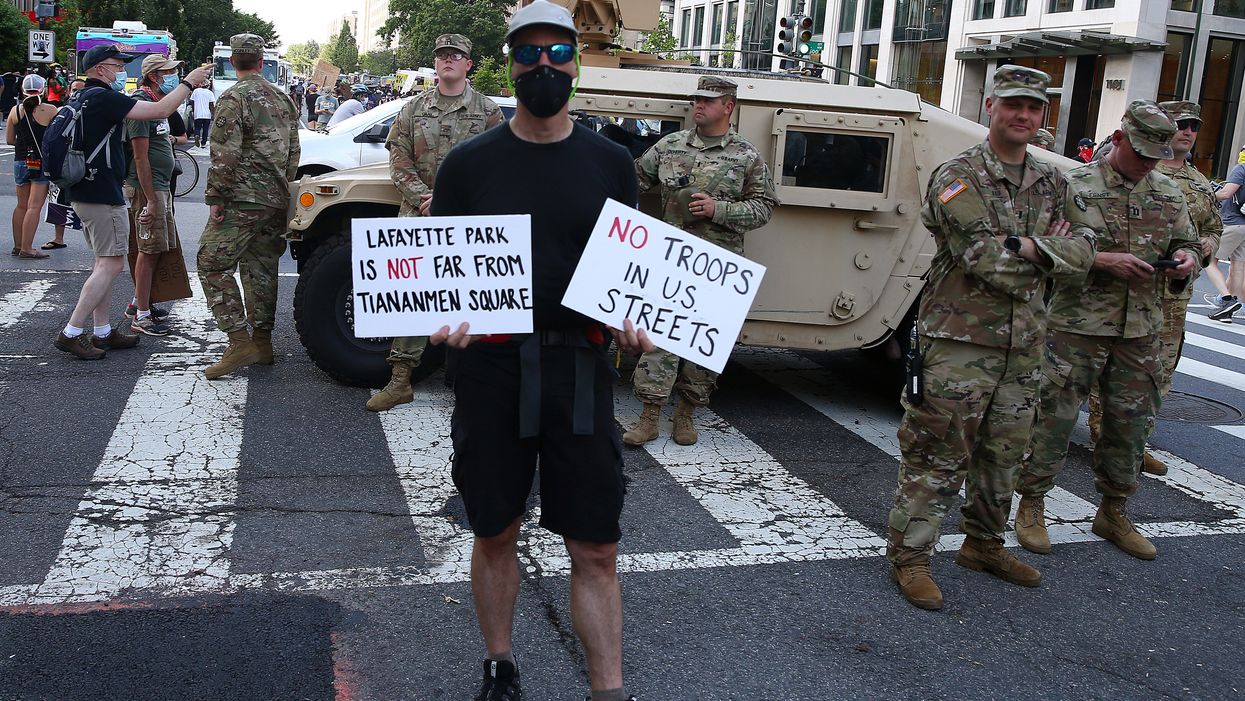
Some good-government groups have made their first tangible move to align their cause with protesters nationwide — pressing for 10,000 allies to decry "the unthinkable" use of the military to quell demonstrations.
President Trump has ordered National Guard troops to begin withdrawing from the nation's capital, responding to the widespread condemnation of his use of force to drive protesters away from the White House and his threatening to have troops put down demonstrations in other cities. Some of the rebukes came from current and former military leaders.
But the organizers of the petition drive say it is important to galvanize sentiment against any return of the armed forces to the streets — which they say would trample democracy not only by violating protesters' free speech rights but also by shredding the balance of power.
"Our cities are not a 'battlespace' to be dominated by our military and our citizens' constitutional rights cannot be infringed upon for a photo op," says the petition, which calls on Defense Secretary Mark Esper and the chairman of the Joint Chiefs of Staff, Army Gen. Mark Milley, to refuse any order "to turn the U.S. military against American citizens."
The groups started circulating their document online over the weekend, gathering 2,000 signatures as a week of protests against racial injustice and excessive policing spread across the country and were almost completely peaceful.
The groups backing the effort are the Renew Democracy Initiative, Protect Democracy, the Niskanen Center, Freedom House, Third Way, Stand Up Republic and the Lubetzky Family Foundation.
This week, the coalition will begin its digital media campaign to share the petition more widely and rally public support around this issue. The tentative goal is at least 10,000 signatures.
"The use of military might to quell peaceful protests is a tool of dictatorships like Russia or China that rule by terror and force," said RDI Chairman Garry Kasparov, the former world chess champion, adding that his organization will do "whatever it can to ensure that America sticks to rule of law."
Most notably, the troops had used chemical irritants and flash-bang grenades to clear peaceful protesters outside the White House for a photo opportunity by the president. National Guard helicopters flew low over demonstrators to scatter them and active-duty troops were summoned to just outside the capital.
On Sunday the president said the National Guard soldiers would withdraw "now that everything is under perfect control." But, he added on Twitter, "They will be going home, but can quickly return, if needed."
Claim: President Trump has the rights to invoke the Insurrection Act. Fact check: True
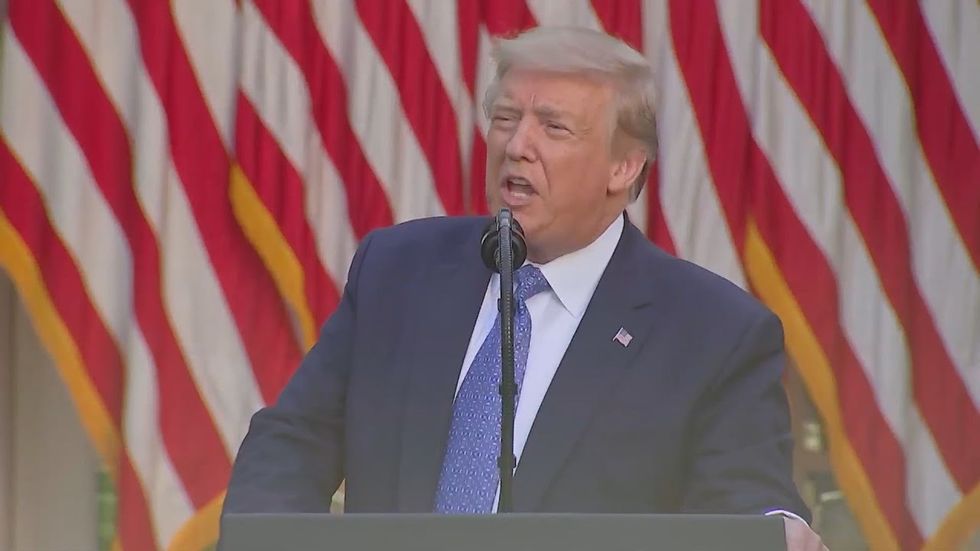
Bing Xiao, Medill School"I am mobilizing all federal and local resources, civilian and military, to protect the rights of law-abiding Americans."
"If a city or state refuses to take the actions necessary to defend the life and property of their residents, then I will deploy the United States military and quickly solve the problem for them."
White House press secretary Kayleigh McEnany said at a briefing June 1 that President Trump has the prerogative to invoke the Insurrection Act to resolve violent protests that broke out in support of George Floyd across the nation.
According to the definition from the Legal Information Institute of Cornell Law School, the Insurrection Actt, adopted in 1807, authorizes the president, at the request of a state government, to federalize the National Guard and to use the remainder of the Armed Forces to suppress an insurrection against that state's government. It further allows for the president to do the same in a state without the explicit consent of a state's government if it becomes impracticable to enforce federal laws through ordinary proceedings or if states are unable to safeguard its inhabitants' civil rights. However, the Posse Comitatus Act prohibits the government from using military forces to act as a police force within U.S. borders.
Governors prefer relying on National Guardsmen to de-escalate the tensions.
On Wednesday, Defense Secretary Mark Esper said he does not support invoking the Insurrection Act and using active-duty military forces to deal with the unrest in U.S. cities — a statement that puts him at odds with his boss.
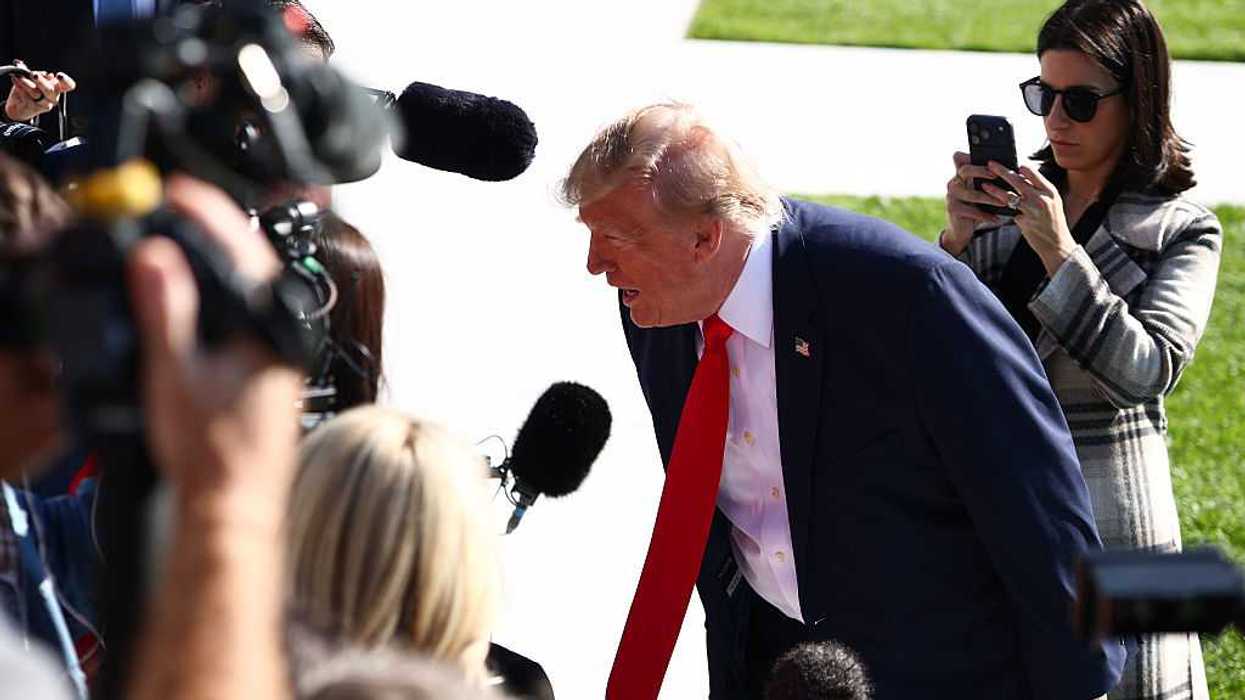










Eric Trump, the newly appointed ALT5 board director of World Liberty Financial, walks outside of the NASDAQ in Times Square as they mark the $1.5- billion partnership between World Liberty Financial and ALT5 Sigma with the ringing of the NASDAQ opening bell, on Aug. 13, 2025, in New York City.
Why does the Trump family always get a pass?
Deputy Attorney General Todd Blanche joined ABC’s “This Week” on Sunday to defend or explain a lot of controversies for the Trump administration: the Epstein files release, the events in Minneapolis, etc. He was also asked about possible conflicts of interest between President Trump’s family business and his job. Specifically, Blanche was asked about a very sketchy deal Trump’s son Eric signed with the UAE’s national security adviser, Sheikh Tahnoon.
Shortly before Trump was inaugurated in early 2025, Tahnoon invested $500 million in the Trump-owned World Liberty, a then newly launched cryptocurrency outfit. A few months later, UAE was granted permission to purchase sensitive American AI chips. According to the Wall Street Journal, which broke the story, “the deal marks something unprecedented in American politics: a foreign government official taking a major ownership stake in an incoming U.S. president’s company.”
“How do you respond to those who say this is a serious conflict of interest?” ABC host George Stephanopoulos asked.
“I love it when these papers talk about something being unprecedented or never happening before,” Blanche replied, “as if the Biden family and the Biden administration didn’t do exactly the same thing, and they were just in office.”
Blanche went on to boast about how the president is utterly transparent regarding his questionable business practices: “I don’t have a comment on it beyond Trump has been completely transparent when his family travels for business reasons. They don’t do so in secret. We don’t learn about it when we find a laptop a few years later. We learn about it when it’s happening.”
Sadly, Stephanopoulos didn’t offer the obvious response, which may have gone something like this: “OK, but the president and countless leading Republicans insisted that President Biden was the head of what they dubbed ‘the Biden Crime family’ and insisted his business dealings were corrupt, and indeed that his corruption merited impeachment. So how is being ‘transparent’ about similar corruption a defense?”
Now, I should be clear that I do think the Biden family’s business dealings were corrupt, whether or not laws were broken. Others disagree. I also think Trump’s business dealings appear to be worse in many ways than even what Biden was alleged to have done. But none of that is relevant. The standard set by Trump and Republicans is the relevant political standard, and by the deputy attorney general’s own account, the Trump administration is doing “exactly the same thing,” just more openly.
Since when is being more transparent about wrongdoing a defense? Try telling a cop or judge, “Yes, I robbed that bank. I’ve been completely transparent about that. So, what’s the big deal?”
This is just a small example of the broader dysfunction in the way we talk about politics.
Americans have a special hatred for hypocrisy. I think it goes back to the founding era. As Alexis de Tocqueville observed in “Democracy In America,” the old world had a different way of dealing with the moral shortcomings of leaders. Rank had its privileges. Nobles, never mind kings, were entitled to behave in ways that were forbidden to the little people.
In America, titles of nobility were banned in the Constitution and in our democratic culture. In a society built on notions of equality (the obvious exceptions of Black people, women, Native Americans notwithstanding) no one has access to special carve-outs or exemptions as to what is right and wrong. Claiming them, particularly in secret, feels like a betrayal against the whole idea of equality.
The problem in the modern era is that elites — of all ideological stripes — have violated that bargain. The result isn’t that we’ve abandoned any notion of right and wrong. Instead, by elevating hypocrisy to the greatest of sins, we end up weaponizing the principles, using them as a cudgel against the other side but not against our own.
Pick an issue: violent rhetoric by politicians, sexual misconduct, corruption and so on. With every revelation, almost immediately the debate becomes a riot of whataboutism. Team A says that Team B has no right to criticize because they did the same thing. Team B points out that Team A has switched positions. Everyone has a point. And everyone is missing the point.
Sure, hypocrisy is a moral failing, and partisan inconsistency is an intellectual one. But neither changes the objective facts. This is something you’re supposed to learn as a child: It doesn’t matter what everyone else is doing or saying, wrong is wrong. It’s also something lawyers like Mr. Blanche are supposed to know. Telling a judge that the hypocrisy of the prosecutor — or your client’s transparency — means your client did nothing wrong would earn you nothing but a laugh.
Jonah Goldberg is editor-in-chief of The Dispatch and the host of The Remnant podcast. His Twitter handle is @JonahDispatch.