

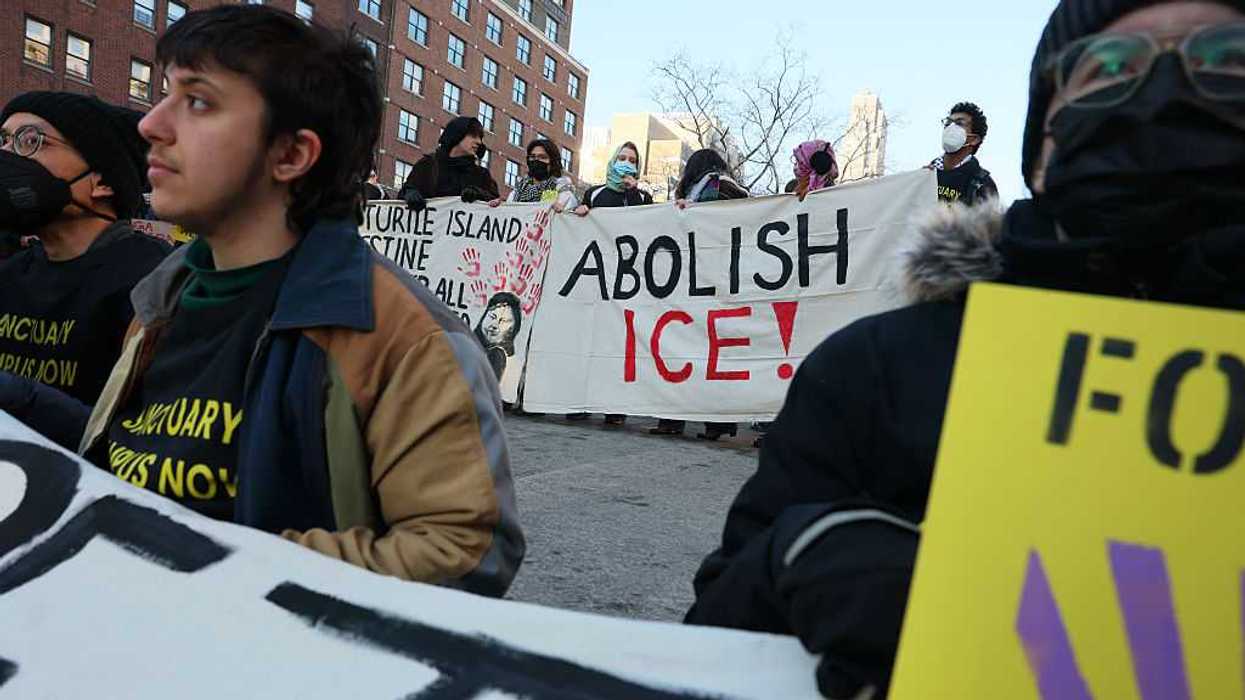

In a perfect world, Democrats would be pushing to defund ICE – the position supported by 76% of their constituents and a plurality of all U.S. adults. But this world is far from perfect.
On February 3, 21 House Democrats voted with Republicans to reopen the government and keep the Department of Homeland Security (DHS) funded for two weeks. Democrats allege that unless there are “dramatic changes” at DHS and “real accountability” for immigration enforcement agents, they will block funding when it expires.
On February 4, Senate Minority Leader Chuck Schumer (D-NY) and House Minority Leader Hakeem Jeffries (D-NY) issued a list of ten demands, including prohibiting agents from wearing masks, requiring them to show IDs, and regulating the type of uniforms and equipment they carry.
These demands might have been acceptable if Renee Good and Alex Pretti hadn’t been killed; if Marimar Martinez hadn’t been shot five times by a Customs and Border Protection (CBP) agent; if immigration enforcement agents hadn’t been detaining children, breaking into the homes of U.S. citizens, and assaulting people indiscriminately. Democrats – to the surprise of no one – are not meeting the moment.
Even if Democrats won’t push for abolishing ICE, they should be demanding far more than they are. Here’s a better list of demands:
1.Enforce existing policies and regulations
ICE officers are trained not to approach vehicles from the front – Jonathan Ross violated this. Immigration enforcement agents are trained not to use deadly force unless the subject poses an imminent threat of death or serious injury to officers – Jesus Ochoa and Raymundo Gutierrez violated this. Except in limited circumstances, DHS prohibits agents from detaining U.S. citizens, yet more than 170 have been kicked, dragged, and held by ICE. Before adding new policies, Democrats need to ensure that current ones are being enforced.
2.Investigations involving immigration enforcement agents must be led by a Congressional committee
To date, six federal prosecutors and an FBI agent have resigned due to the Department of Justice’s (DOJ) reluctance to investigate Ross. The killings of Good and Pretti must not be swept under the rug by politically biased officials. Congress must take charge of all investigations involving immigration enforcement agents and coordinate with state and local officials.
3.Investigate and put Jonathan Ross, Jesus Ochoa, and Raymundo Gutierrez on trial for their crimes
Following the second demand, Congress must begin by immediately investigating Ross, Ochoa, and Gutierrez. They must be put on trial and held accountable for their crimes. A failure to do so only emboldens other agents to act without impunity or regard for public safety.
4.Impeach Homeland Security Secretary Kristi Noem
Noem has consistently, deliberately, and recklessly lied to the American public. Under her leadership (or lack thereof), ICE agents are being poorly trained and deployed at unprecedented levels across the nation. She is responsible for the chaos they have unleashed – she must be held accountable.
5.End indiscriminate biometric surveillance
Immigration enforcement agents are using facial recognition technologies like Mobile Fortify to scan citizens and immigrants alike. U.S. citizens like Juan Carlos Lopez Gomez and Mubashir (who chose only to reveal his first name to the press) have been detained by ICE because of these technologies. They must be banned.
6.End domestic terrorist lists
ICE is reportedly scanning the faces of protestors and uploading them to “domestic terrorist” lists. Investigative journalist Ken Klippenstein reports that there are over a dozen “secret and obscure” watchlists that DHS and the FBI are using to track anti-ICE and other protestors. These lists must be erased entirely. Those agencies must provide proof of their deletion to Congress.
7.Fine anyone who spreads disinformation about ICE’s violence
The Trump administration immediately smeared Good and Pretti as “domestic terrorists.” Noem alleged that Pretti was “brandishing” a weapon. Home Security Advisor Stephen Miller called him an “assassin.” Several news outlets and political commentators amplified these lies. They must all be held accountable.
8.Protect journalists from DHS
On January 30, Don Lemon and Georgia Fort were arrested by federal agents. They were charged with conspiracy and interfering with the rights of worshippers while covering an anti-ICE protest at Cities Church in St. Paul.
These arrests were politically motivated. DHS has insisted that people do not have the right to record ICE agents in public – a complete lie from an administration that consistently lies to the public. At a time when journalism is under attack, Democrats must protect the rights of reporters and bystanders to observe and monitor federal agents. Americans need access to complete and honest coverage of what’s happening across the nation. We cannot allow journalists to be silenced or intimidated by the administration.
9.Restitution for victims of ICE’s violence
Tatiana Martinez was dragged out of her car by federal agents and thrown onto the ground. A masked agent then pressed his knee into her neck while she was handcuffed. She passed out from the trauma. George Retes was heading to his job in Camarillo when ICE agents smashed his car window, pepper-sprayed him, forcibly pulled him out, and threw him onto the ground. Kaden Rummler was left completely blind in one eye after being hit in the face with a projectile fired by a federal agent.
All victims of ICE’s violence must be able to seek restitution. This must include monetary compensation paid directly from ICE’s funding.
10.No additional funding for ICE
With a budget of $85 billion, ICE is currently the highest-funded U.S. law enforcement agency. No more taxpayer money should go to an agency assaulting, detaining, and killing U.S. citizens.
11.Everything included in the Schumer-Jeffries list
The demands made by Democrats are not inherently bad. If enforced, requiring judicial warrants, building safeguards, and protecting sensitive locations such as hospitals and schools could help curb ICE’s violence. The major problem with their list is that it’s far too modest.
ICE is increasingly unpopular. Democrats must seize this moment to take bold and meaningful steps to protect the American public from the Trump administration’s most authoritarian impulses.Jordan Liz is an Associate Professor of Philosophy at San José State University. He specializes in issues of race, immigration and the politics of belonging.











The President Invited Iran to Bomb My Home