
Skip to content
Search

Latest Stories

Follow Us:
Top Stories

Biden campaign creates a senior post for protecting voting rights

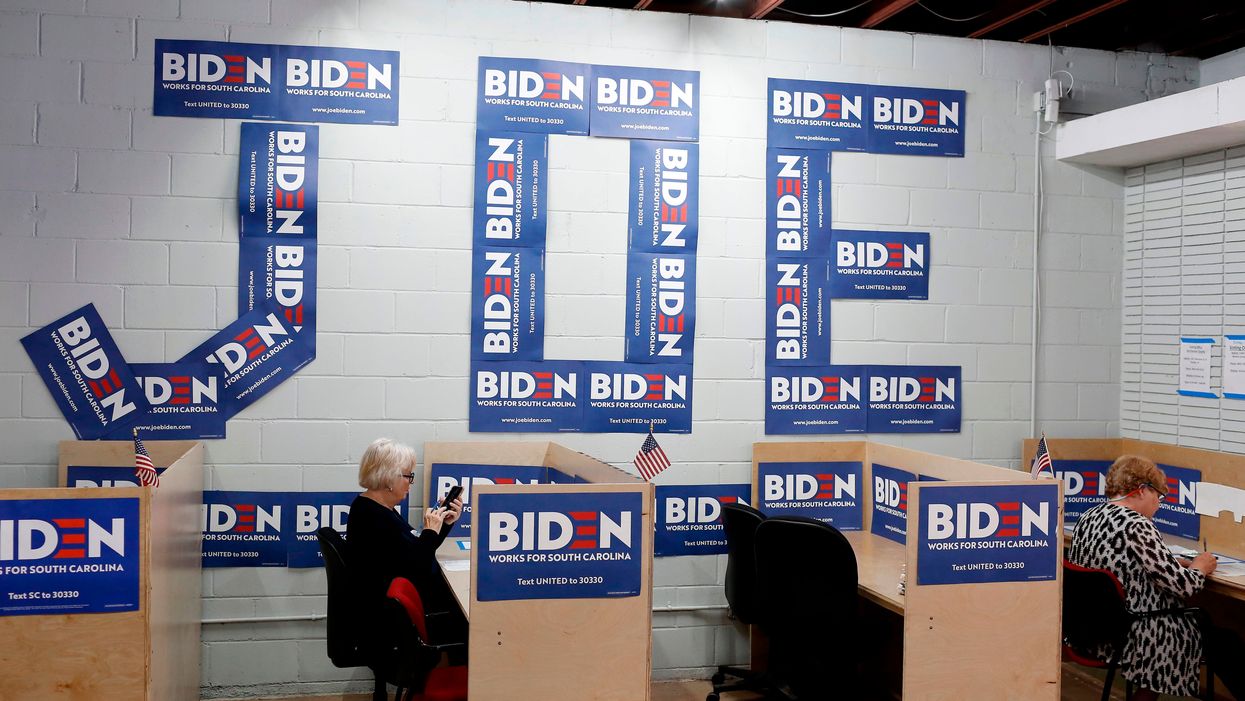
Joe Biden campaign headquarters

Joe Biden's campaign has hired a new senior staffer, Rachana Desai Martin, to focus on protecting voting rights amid the coronavirus crisis.

Joshua Lott/Getty Images

Joe Biden has created a new senior campaign position to focus on protecting the right to vote in an election remade by the coronavirus.

Rachana Desai Martin, a senior Democratic Party official, will be the national director for voter protection and senior counsel on the legal team, the presumptive nominee's campaign announced Tuesday.

It appears to be the first job of its kind in a modern-day major-party presidential campaign, but the circumstances are also nearly without precedent — the first national election in a century during a nationwide public health emergency. Martin will focus on ballot accessibility for all voters and combating the disenfranchisement of people of color.


Martin worked in the Obama administration and on Hillary Clinton's 2016 campaign. She is now the Democratic National Committee's chief operating officer, but she previously headed civic engagement and voter protections efforts at party headquarters.

Her work has already put her in the middle of one of the party's main campaign strategies of the year, filing dozens of lawsuits around the country hoping to force relaxation of rules limiting access to the voting booth in normal times — and especially to mail-in ballots this year. Spurred by President Trump, Republicans are fighting those suits mainly with the minimally substantiated argument that the current rules and a continued reliance on voting in person are essential to preventing election fraud.

At the same time, at least two dozen states have temporarily expanded their mail-in voting systems and eligibility criteria on their own since March. But last-minute changes have led to ballot delivery challenges and long lines at polling stations in the few primaries that have taken place.

The pandemic has disproportionately impacted people of color, with black Americans having an outsized share of infections and deaths. Progressive advocates for making voting easier and safer are pushing not only expanded absentee voting but also more sanitizing and safety rules for polling places, which research shows are preferred by African-Americans. A strong turnout from minority communities, especially in cities where Covid-19 has hit hardest, is essential to Biden's roadmap for defeating Trump.

And while many states want to ease voting rules and expand balloting by mail to assure a safe but sizable turnout, they're running out of money to do so. The $400 million Congress has allocated is not nearly enough to cover the costs, good-government groups and election administrators say, but an additional $3.6 billion approved by the Democratic House looks to be substantially reduced if not eliminated, perhaps next month, once the Republican Senate gets its say in the next economic rescue package.

In addition to addressing the intersection of voting rights and public health, the Biden campaign said, Martin will also work to combat strict voter ID laws, the purging of registration rolls and disinformation campaigns.

Read More

Voters lining up to vote.

Voters line up at the Oak Lawn Branch Library voting center on Primary Election Day in Dallas on March 3, 2026. Republicans' decision to hold a split primary from the Democrats and to eliminate countywide voting forced Dallas County voters to cast ballots at assigned neighborhood precincts, leading to confusion. Republicans have now decided to use countywide polling locations for the May 26 runoff election.

Shelby Tauber for The Texas Tribune

Dallas County GOP Will Agree To Use Countywide Voting Sites for May 26 Runoff Election

Dallas County Republicans will agree to allow voters to cast ballots at countywide voting sites for the May 26 runoff election after a switch to precinct-based voting sites caused chaos, the county party chair said Tuesday.

Dallas County Republican Chairman Allen West supported the use of precinct-based sites earlier this month, but said using precincts again for the runoff would expose the county party to “increased risk and voter confusion” because the county is planning to use countywide sites for upcoming municipal elections and early voting.

Keep ReadingShow less
A person signing a piece of paper with other people around them.

Javon Jackson, center, was able to register to vote following passage of a 2019 Nevada law that restored voting rights to formerly incarcerated individuals.

The Nation Is Missing Millions of Voters Due to Lack of Rights for Former Felons

If you gathered every American with a prison record into one contiguous territory and admitted it to the union, you would create the 12th-largest state. It would be home to at least 7 million to 8 million people and hold a dozen votes in the Electoral College.

In a close presidential race, this hypothetical state of the formerly incarcerated could decide who wins the White House.

Keep ReadingShow less
With the focus on the voting posters, the people in the background of the photo sign up to vote.

An analysis of Trump’s SAVE Act strategy, the voter ID debate, and how Pew data is being misused—exploring election integrity, voter suppression, and the political fight shaping U.S. democracy.

Getty Images, SDI Productions

Stop Fighting Voter ID. Start Defining It.

President Trump doesn't need the SAVE America Act to pass. He only needs the debate to continue. Every minute spent arguing about voter suppression repeats the underlying premise — that noncitizen voting is a real and widespread problem — until it feels like an established fact. The question is whether Democrats will contest Republicans’ definition before the frame hardens.

Trump's claim that 88% of Americans support the bill traces to a Pew Research Center survey — a survey that found 83% support a “government-issued photo ID to vote,” not extreme vetting for proof of citizenship. That support included 95% of Republicans and 71% of Democrats, indicating genuine, broad, bipartisan support for a basic civic principle. That's worth taking seriously.

Keep ReadingShow less
People standing at voting booths.

The proposed SAVE Act and MEGA Act would require proof of citizenship to register to vote, risking the disenfranchisement of millions of eligible Americans.

Getty Images, EvgeniyShkolenko

The SAVE Act is a Solution in Search of A Problem

The federal government seems to be barreling toward a federal election power grab. Trump's State of the Union address called for the Senate to push through the SAVE Act, which has already passed the House, in the name of so-called "election integrity." And the SAVE Act isn’t the only such bill. Like the SAVE Act, the Make Elections Great Again (MEGA) Act—introduced in the House—would require voters to provide a document outlined in the Act that allegedly proves their U.S. citizenship. We’ve been down this road before in Texas, and spoiler alert: it was unworkable.

Both the SAVE and MEGA Acts would disenfranchise millions of eligible U.S. citizens without making our federal elections more secure. They seek to roll out a faulty federal voter registration system, despite the existing separate registration and voting process for state and local elections. And these Acts target a minuscule “problem”—but would unleash mass voter purges and confusion.

Keep ReadingShow less