

Skip to content
Search

Latest Stories

Follow Us:
Top Stories

No ballot box is safe: Volunteers hacked into all 100 voting machine types they went after

Hacking voting systems

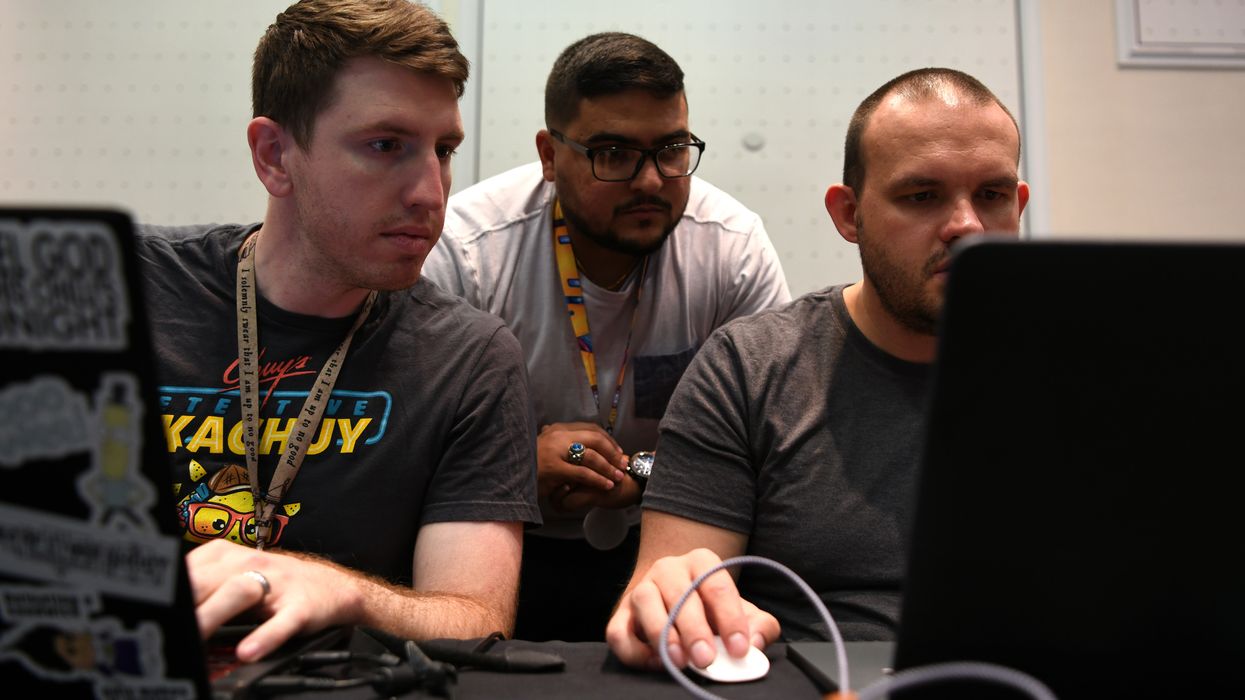
Hackers, academics and military experts like these were among those who spent three days hacking into all the voting equipment in wide use across the country.

Air Force Tech. Sgt. R.J. Biermann

It wasn't the kind of test that you hope produces a perfect score. But hackers, technology geeks, academics and others were 100 for 100 this summer in their attempts to infiltrate and compromise an enormous array of voting machines using all sorts of technologies.

Their astonishing results will only boost the widespread anxiety among election security experts that American election systems remain widely vulnerable to hacking and Washington is not doing nearly enough to shrink the risks ahead of next year's presidential contest.


The total failure of voting hardware to ward off intrusion was revealed in a report last week summarizing the third Voting Machine Hacking Village, a three-day hack-a-thon held in Las Vegas in August as part of Def Con 27, one of the world's largest hacker conferences.

The participants either found new ways to break into the machines this year or replicated already published methods that could be used to alter stored vote tallies and change ballots displayed to voters.

"As disturbing as this outcome is, we note that it is at this point an unsurprising result," the report states.

The first such hacking village, in 2017, took on 20 types of voting devices. The second, last year, targeted more than 30 brands of equipment.

The equipment broken into included touchscreens, optical scan paper voting devices, paper ballot marking devices and electronic poll books — all the technologies that are currently in widest use by the more than 5,000 local jurisdictions that conduct our elections.

The volunteer intruders gained access in most cases through external interfaces accessible to voters or precinct workers.

Despite these vulnerabilities, the report's authors said some of the equipment is still viable for use in elections as long as there are "rigorous post-election audits." Legislation to mandate such audits is in a tall stack of election security bills that remains stalled in the Senate, where Majority Leader Mitch McConnell says none of those policy measures is necessary even though he has agreed to support $250 million in federal spending to protect the 2020 balloting from outside interference.

Attention has been focused on the vulnerability of the voting systems in the United States since Russian intelligence agents attempted to disrupt the 2016 presidential election.

Special counsel Robert Mueller's report on the Russian interference found that operatives attempted to hack into voting systems around the country and were successful in gaining access to a voter registration database in Illinois and to computers of some election officials in Florida.

The Voting Village report also includes a series of recommendations for improving security ahead of the 2020 elections, almost all of which are also being pushed by Democrats and some Republicans on Capitol Hill. They include mandating post-election audits and the use of machines that generate a paper trail, and increasing funding to help local election officials protect their IT infrastructure.


How Hackers Can Target Voting Machines | NBC News Now

NBC News' technology correspondent Jacob Ward gives an inside look into how hackers can target voting systems with ease.


Read More

A Democracy Cannot Run on an AI Model

Clerk Matthew Sandbar, 34, demonstrates part of the ballot-sorting process to members of the media attending a walkthrough of the Philadelphia Ballot Processing Center used to process the ballots of the 2022 US midterm elections, in Philadelphia on October 27, 2022.

Photo by Ryan Collerd / AFP via Getty Images

A Democracy Cannot Run on an AI Model

Tallying the results of Washington, DC’s first ranked-choice election in June took about 10 days—longer than many voters are used to. In an age when artificial intelligence can generate an answer in seconds, waiting days for election results can feel old-fashioned, inefficient, even suspicious. And it is about to matter far more widely. This November, 17 states, cities, and counties will use ranked-choice voting, including Maine and Alaska statewide, in races that could help decide control of Congress. More voters than ever will watch results take days to resolve, and more will be asked to trust a count they cannot see.

But that slowness may be one of its most democratic features.

Keep ReadingShow less
People waiting in a line outside as the sun sets.

Voters wait in line outside the Metropolitan Multi-Service Center to cast their ballots in Houston, Tuesday, Nov. 4, 2025. A recent state investigation confirmed that some registered voters flagged as potential noncitizens by a federal system had already provided proof of citizenship.

Brett Coomer/Houston Chronicle via Getty Images

Texas Confirms Some Flagged As Potential Noncitizens on Voter Rolls Had Provided DPS Proof of Citizenship

Election officials across the state should immediately reinstate some voters who were incorrectly flagged as potential noncitizens through a federal program, the Texas Secretary of State’s Office told county officials Wednesday.

Christina Adkins, the state elections director, told county officials the state had reviewed Texas Department of Public Safety records confirming the citizenship of some of the 2,724 registered voters who were flagged as potential noncitizens, according to an audio recording of her comments obtained by Votebeat and The Texas Tribune, as well as election officials who heard them. The voters were flagged after the state checked its voter roll through a federal program called Systematic Alien Verification for Entitlements, or SAVE, used to verify the citizenship of people registered to vote.

Keep ReadingShow less
People walking down the steps of the U.S. capitol.

House Minority Leader Hakeem Jeffries (D-NY) (C), Democratic Conference Chair Rep. Pete Aguilar (D-CA) (R), and House Minority Whip Katherine Clark (D-MA) (L) and other House Democrats arrive for a news conference on the House steps on November 12, 2025 in Washington, DC.

Andrew Harnik/Getty Images

DNC's Proposed RCV Ban Sparks Debate Over 2028 Presidential Primaries

Democratic National Committee insiders are poised to ban the use of ranked choice voting (RCV) in selecting their presidential nominee in 2028 – overriding presidential primary laws in Maine and Washington, D.C, and squashing great interest in this use of RCV among state legislators and the many state parties who run their own primaries.

Presidential primaries are among the most compelling use cases for RCV. They draw crowded fields of candidates that voters get to know and are eager to rank rather than be limited to one. Parties must unite their big tent of voters, and RCV rewards unifying candidates. The sequential nature of primaries is a problematic fit with early voting – in 2020, for example, more than three million Democratic voters cast a ballot for a candidate who had withdrawn before that vote was counted.

Keep ReadingShow less
​U.S. President Donald Trump sitting in the Oval Office.

U.S. President Donald Trump speaks during an announcement on American nuclear innovation in the Oval Office at the White House on July 24, 2026 in Washington, DC.

Eric Lee/Getty Images

Trump’s Elections Speech Was Not the Opening Shot; It was the Latest Salvo

President Donald Trump’s recent address repeating his claim that he won the 2020 election was widely portrayed as a dramatic escalation of his attacks on our election system. It wasn’t.

It is nothing new!

Keep ReadingShow less