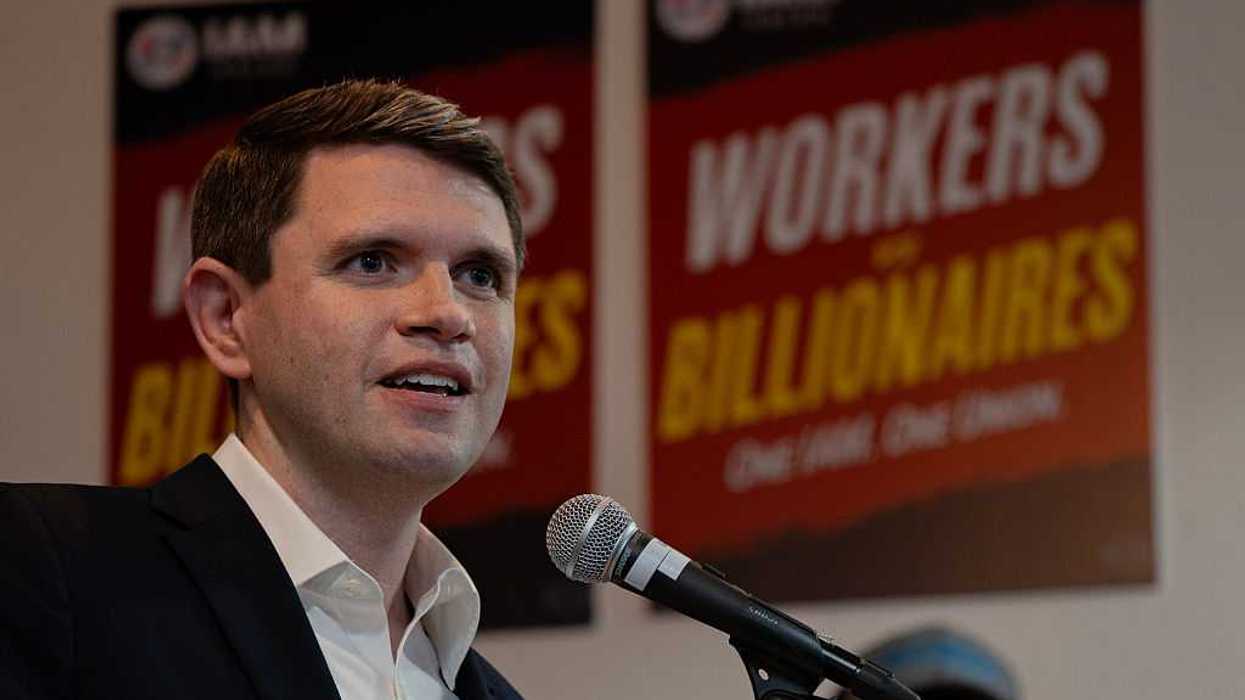



Ross Sherman serves as Media Relations Manager with RepresentUs.
Democracy only works when our representatives put our country and the rule of law first. But with the midterms approaching, politicians are so focused on getting wins for their party that they're actually taking steps to weaken our elections.
Republican candidates are running on the lie that the 2020 election was stolen, and excommunicating party members who say otherwise. Meanwhile, Democrats are doubling down on a dangerous political strategy: Financially supporting election deniers in GOP primaries in the hopes they’ll be ‘weaker’ candidates in the general election. As a result, they’re pushing election deniers closer to power and closer to the mainstream. Democrats, including those on the January 6 Committee, should be unified in condemning this practice, but they’re not.
Why is all of this happening in the first place? Because our corrupt political system incentivizes this behavior. Short-term partisan gain clouds our politicians’ decisions and keeps them from doing the right thing. To preserve free elections for generations to come, Republicans should denounce all forms of election denial in their ranks, and Democrats should speak out against boosting election deniers. Without doing so, they not only risk their own credibility, but the credibility of our government as a whole.
Beyond the immediate term, we need to fix these perverse incentives. Republicans and Democrats need to band together to pass laws that fix the underlying flaws in our political system – rendering these tactics irrelevant.
Election denial is a feature of the 2022 primary elections
Many Republican leaders and candidates, including former President Donald Trump, continue to parrot the lie that the 2020 election was stolen. They also dismiss the severity of the January 6 capitol riot. With mountains of evidence confirming a free and fair election, they know it wasn’t stolen. We heard as much in testimony during the hearings from many close to the former president. But they continue to say so anyway in an attempt to rile up their supporters and win the next election.
Let me be clear: No one on the Democratic side is running on a platform of election denial. They have also correctly been warning the country about the threats our democracy faces, and were unified in supporting federal legislation to improve our elections early this year.
But because of the same short-term political incentives, Democrats are simultaneously hoodwinking voters by running political advertisements aiding the most extreme election denier candidates in GOP primaries across the country. While the goal of this strategy is to make the general election easier for their side to win, pushing an election denier closer to power is completely irresponsible – and could backfire.
Democrats have meddled in several races throughout the primary season, including running ads to boost insurrectionist Doug Mastriano’s chances in Pennsylvania’s gubernatorial primary. And while Democrats led the charge to impeach former President Trump for his conduct around January 6, now they've turned around and poured money into a campaign to defeat one of their only Republican allies in the impeachment vote – Michigan Rep. Peter Mejier – in favor of another election denier.
The January 6 Committee must be united against election denial
The January 6 hearings have been a great example of public officials putting country over party. Reps. Liz Cheney and Adam Kinzinger have shown tremendous courage by telling the truth about January 6 and former President Donald Trump’s culpability. As a result, they’ve faced vicious harassment. Rep. Cheney has barely made public appearances in her Wyoming primary because of credible death threats, and Rep. Kinzinger has shared voicemails he’s received threatening his wife and baby.
On the Democratic side, Rep. Stephanie Murphy condemned her party’s strategy of propping up dangerous candidates in Republican primaries. As she told Axios, “This is bigger than any one candidate or campaign. No one should be promoting election deniers and peddlers of the 'Big Lie.'"
In order to preserve the Committee’s credibility, Democrats should follow her lead and disavow this cynical strategy. It shouldn’t be hard to say that supporting election deniers is wrong.
It’s time for more Democrats and Republicans to put country over party
None of these partisan shenanigans would be happening if we had better elections. If we swapped out closed partisan primaries for open primaries, running on a platform of election denial would be a political nonstarter and meddling in another party’s elections wouldn’t even be an option. With open primaries, every candidate regardless of party appears on the same ballot, and every registered voter can participate.
Another simple way we can chip away at perverse partisan incentives is to adopt Ranked Choice Voting. In RCV elections, voters rank candidates in order of preference. Through an instant runoff system, the eventual winner is guaranteed to win a majority of votes, leading to more acceptable candidates across the political spectrum.
Americans know that our political system is broken. We’re sick of politicians putting their own self interest ahead of what’s best for our country. It’s time for more Democrats, Republicans and everyone in between to stand up for the truth, put country over party, and advance solutions to make our elections work for us, not them.