



Two former NBA players have said they want to play in the Women’s National Basketball Association (WNBA). Enes Kanter Freedom and Royce White announced their intent to enter the WNBA draft, claiming—falsely—that they identify as women to force the WNBA to clarify its policy, which restricts participation to women without defining what it means to be a woman. The players’ announcement followed closely on the heels of WNBA player Sophie Cunningham’s public comments that it was “common sense” that only “biological women” be permitted to compete in the WNBA. Cunningham’s comments drew competing rallies to her games, either supporting or denouncing her stance. Her statement was preceded by the first Supreme Court ruling on eligibility for female sports competitions at the school and college level, a ruling that does not apply to professional sports. In West Virginia v. B. P. J., the Supreme Court affirmed that U.S. states may legally bar transgender girls and women from female school or collegiate sports teams, leaving states to decide.
Public discussion of this issue has been deeply polarized. Some on the political left have asserted that “trans women are women” and that anyone who opposes their participation in elite women’s sports is a bigot. Meanwhile, some on the political right have presented trans women athletes as male athletes stealing women’s trophies. This is a classic case of affective polarization—a phenomenon in which people feel their identities, values, or rights are at stake. They become less willing to consider alternative perspectives and demonize those with opposing views.
My book Gender Flashpoints: The Power of Dialogue discusses how affective polarization makes discussion about topics such as women’s sports challenging, while also showing how we can use dialogue across differences to overcome it. And there have recently been glimpses of common ground on this contentious topic—including in West Virginia v. B. P. J. In that ruling, the Supreme Court unanimously ruled that it is not a violation under Title IX for US states to exclude transgender women or girls—including those who used puberty blockers to avoid going through male puberty—from female sports competitions. All nine justices agreed that sports are different from other social contexts, such as housing or employment, because physiology is central: female athletes would never win if they had to compete with males. Illustrating this, in 2017 alone, Olympic champion Tori Bowie’s lifetime best in the 100 meters was beaten 15,000 times by male athletes.
As I discuss in my book, the sex gap in sports is driven primarily by testicular production of testosterone during three crucial stages: in utero, infancy, and beginning at puberty. Scientific research shows that hormone therapy reduces some but not all of the male advantage in trans women athletes who have undergone male puberty. Moreover, there is a meaningful sex gap even among the best prepubescent athletes, due to the burst of testosterone that male children experience in infancy and early life, known as “minipuberty.”
Some progressives have argued that male athletic advantage is no different from other unfair advantages, such as coming from a wealthy family or, in swimming, having a long wingspan. But those are competitive advantages, not category advantages, such as age, weight, and sex, that justify separate competition categories in the first place. Sex differences in strength, speed, power, and endurance are pervasive—conferring male advantage across virtually every sport and competitive category. All nine justices conceded this.
The question on which three justices partially dissented and would have liked to have the lower courts do more fact-finding was whether trans women who never went through male puberty retain male advantage from early exposure to male levels of testosterone. There are good reasons to expect that they do, but no studies test this specifically.
Importantly, neither the justices nor the plaintiff’s lawyer claimed that anyone who identifies as a woman should be allowed to compete in women’s sports. Equally importantly, the majority opinion affirmed the dignity of transgender athletes, noting that their desire to compete warrants respect and that no athlete should be vilified, a necessary reminder given some of the rhetoric in this debate. The ruling also affirmed its 2020 ruling that firing an employee for being transgender violates federal law.
While the Supreme Court ruling provides a glimpse of an emerging consensus, people continue to talk past each other in public debate over this issue. For instance, while Sophie Cunningham has emphasized the need for fairness in elite sports, Minnesota Lynx coach Cheryl Reeve has stressed the importance of trans kids being allowed to participate in (recreational) sports. Both are important principles that could be reconciled with rules that, say, distinguish between high-stakes sports competitions and recreational sports. One could also envision having co-ed teams for recreational leagues among prepubescent children.
Reaching that kind of compromise, though, requires having the conversation—something some would rather avoid. Some political progressives understandably worry that the issue will continue to be weaponized by some bad-faith actors to exclude and demean transgender children and their parents. Yet, avoiding the topic will not make it go away. Indeed, the refusal of the Democratic Party or the WNBA to address people’s legitimate concerns about fairness in women’s sports has provoked backlash that has also harmed transgender people and their families. Rather than avoiding the issue, we need to engage in dialogue that recognizes competing values of fairness and inclusion and seeks compromise and common ground.
Abigail C. Saguy is Professor of Sociology and Gender Studies at UCLA and the author of Gender Flashpoints: The Power of Dialogue (Russell Sage Foundation, 2026).








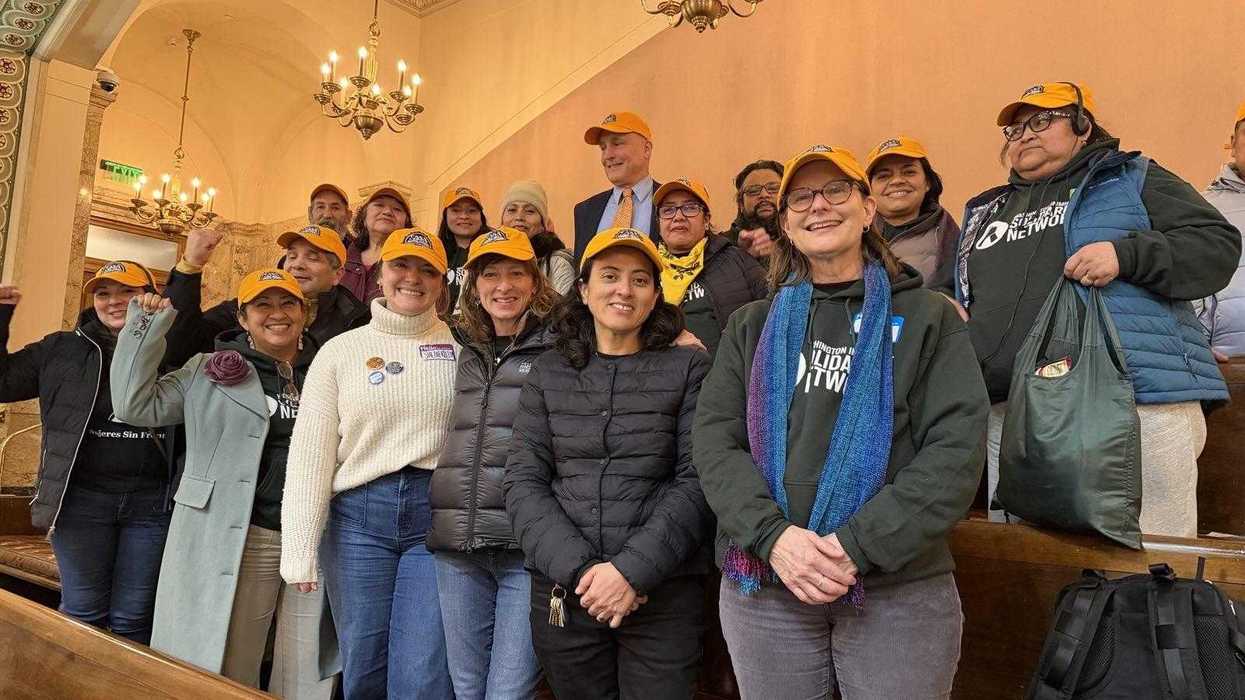
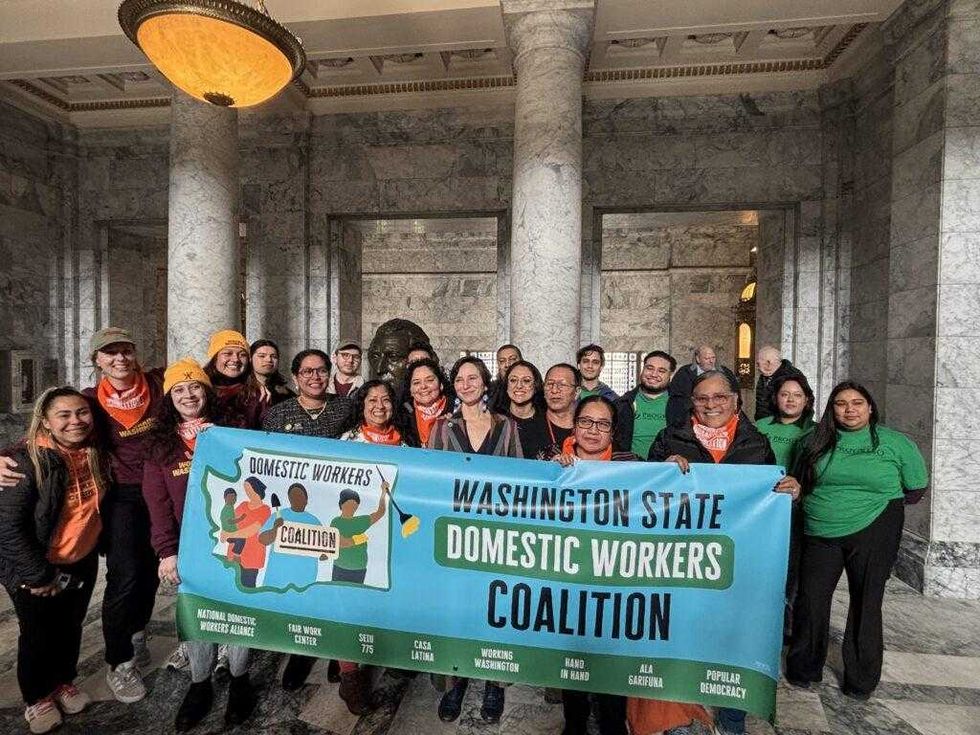 State Sen. Rebecca Saldaña, center, stands with members of the Washington State Domestic Workers Coalition at the state Capitol on Feb. 28, 2026. The Domestic Workers Bill of Rights passed in the House that day, before being signed into law in March. (Photo courtesy of Casa Latina)