




Three Wisconsin commercial driver training schools have been removed from a federal registry as the Trump administration increases enforcement of English-language proficiency requirements for truck drivers.
The U.S. Department of Transportation announced in August that more than 110 Entry-Level Driver Training providers would be removed from the Federal Motor Carrier Safety Administration’s Training Provider Registry.
Federal officials said the action followed a review of roadside inspections involving drivers cited for failing to meet English-language proficiency requirements. Investigators then traced those drivers to the schools that had certified their training.
In Wisconsin, the schools affected are CDL Pro School in Kenosha, On Your Way CDL Training in Milwaukee and Tez CDL School in Sturtevant, according to Wisconsin Public Radio.
Removal from the federal registry prevents the schools from providing federally recognized entry-level driver training. The training is generally required for people obtaining a Class A or Class B commercial driver’s license for the first time, upgrading from a Class B to Class A license or seeking certain endorsements, according to the Federal Motor Carrier Safety Administration.
The removals are part of a federal review of commercial driver training and testing. Federal investigators conducted nearly 400 investigations across 40 states in July and found violations including unlicensed instructors, missing records and inadequate training facilities.
Transportation Secretary Sean Duffy has also moved to enforce a federal requirement that commercial drivers be able to read and speak English well enough to communicate with officials and understand highway signs and signals. Drivers who fail an English-language assessment can be placed out of service.
According to the U.S. Bureau of Labor Statistics, the enforcement could have implications for Latino drivers, who make up a large share of the country’s trucking workforce. In 2024, Hispanic or Latino workers accounted for 24.3% of U.S. driver/sales workers and truck drivers.
The issue also intersects with how Wisconsin licenses commercial drivers.
The state allows applicants to take most CDL knowledge tests in Spanish and several other languages, according to the Wisconsin Department of Transportation. It also makes its commercial driver’s manual available in Spanish.
The Spanish-language testing options are separate from federal English-language requirements for drivers operating commercial vehicles.
Federal regulations require commercial drivers to have enough English proficiency to communicate with officials, respond to questions and understand highway traffic signs and signals. Federal guidance outlines how officers assess English proficiency during roadside inspections.
That means a driver can take most of Wisconsin’s CDL knowledge tests in Spanish but must still meet federal English-language requirements while operating a commercial vehicle.
More than 72,000 Wisconsin workers were employed as driver/sales workers or truck drivers in 2024, according to Census Bureau data compiled by Data USA.
The Federal Motor Carrier Safety Administration also announced a nationwide audit of third-party CDL skills testers and states’ oversight of those testers.
Federal trucking crackdown reaches Wisconsin as English-language rules tighten was first published by Common Dreams and is republished with permission.
Angeles Ponpa is the Managing Editor of Latino News Network Midwest, overseeing Illinois Latino News, Wisconsin Latino News, and Michigan Latino News. She is based in Illinois.











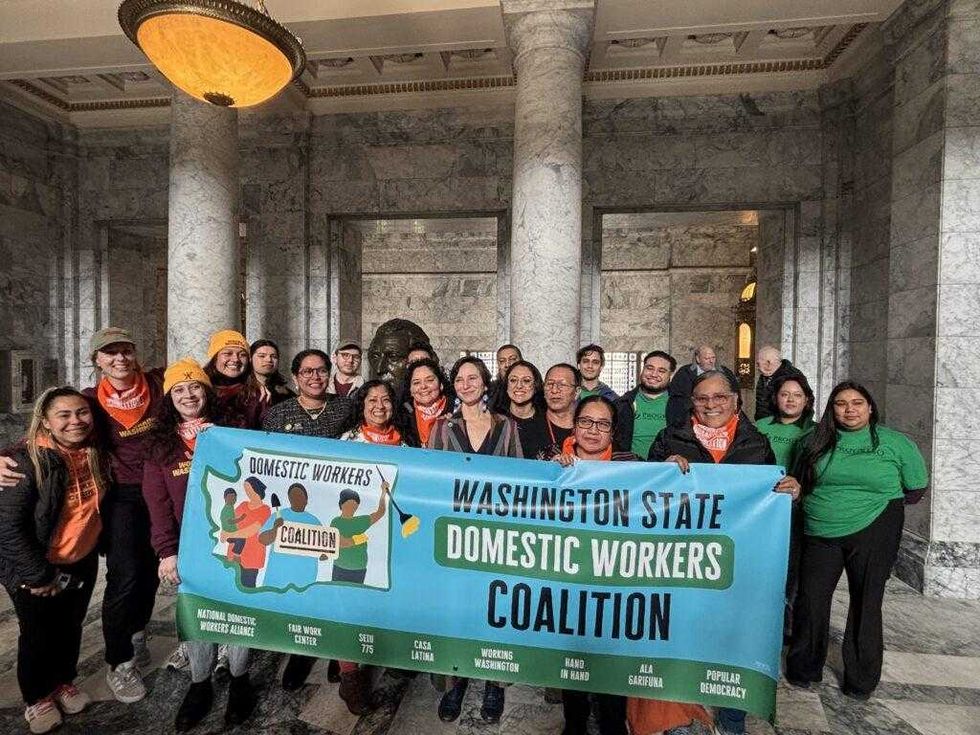 State Sen. Rebecca Saldaña, center, stands with members of the Washington State Domestic Workers Coalition at the state Capitol on Feb. 28, 2026. The Domestic Workers Bill of Rights passed in the House that day, before being signed into law in March. (Photo courtesy of Casa Latina)


The President Invited Iran to Bomb My Home