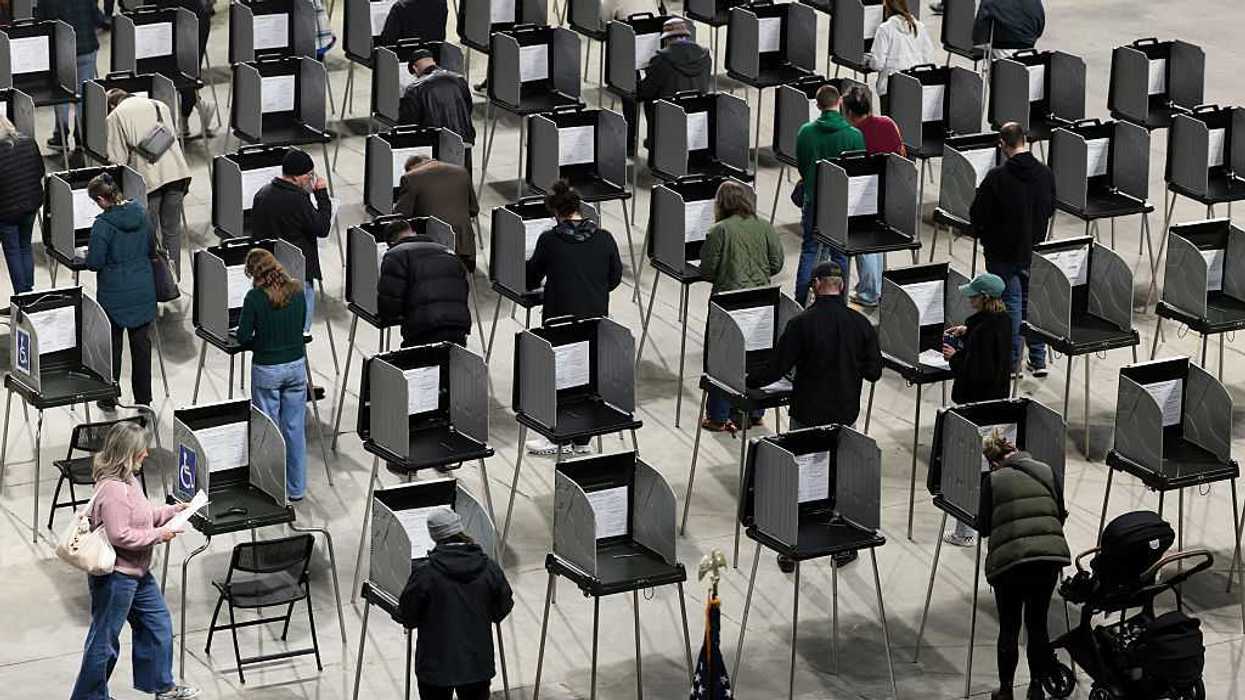





More than 5.3 million California voters enter the final weeks of the 2026 election without belonging to either of the state’s two major political parties.
Among Latino voters, the space outside the two parties is significant too. An analysis by the Center for Inclusive Democracy found that 23 percent of Latino registered voters in California identified as No Party Preference in 2024.
Those numbers do not mean California is experiencing a wave of independent candidates. The state’s top two primary system makes it difficult for candidates outside the major parties to reach November.
But the growing number of voters with weaker party ties is changing how some candidates campaign.
Rep. Kevin Kiley offers the clearest example.
His campaign raises a basic question.
Can a candidate separate himself from the party that defined much of his political career simply by removing the label?
Art Estopiñán, a Republican political consultant who spent 27 years as chief of staff to former Florida Rep. Ileana Ros Lehtinen, believes independent voters will be central to the answer.
“The issue is with the independents,” Estopiñán told Latino News Network in an interview. “I think these elections are going to be decided with the support of independents.”
Estopiñán said Republicans cannot assume voters who supported President Donald Trump in 2024 will automatically support Republican congressional candidates in 2026.
“Republicans have to communicate that agenda to the Hispanic and Latino community directly in Spanish,” he said.
He pointed to Southern California, South Texas and South Florida as regions where Latino voters could prove decisive in determining control of Congress.
But Cristina Mora, Chancellor’s Professor of Sociology at UC Berkeley, said weaker attachment to political parties among Latino voters should not automatically be interpreted as a shift toward the center.
“I think the dissatisfaction is with traditional parties,” Mora told Latino News Network in an interview.
On the Republican side, Mora sees some Latino conservatives who remain ideologically conservative but are dissatisfied with Trump and the Republican Party’s approach to the economy and immigration enforcement.
“These are less likely to say that they are no longer Republicans, or conservatives, but not enthusiastic about the direction of the administration,” she said.
Among younger Latinos, particularly Latinas, Mora sees a different source of frustration.
Some believe Democratic leaders have failed to deliver on promises or push back strongly enough against the Trump administration, particularly on immigration enforcement.
For those voters, identifying as independent does not necessarily mean becoming more moderate.
“Independent might mean more of a Bernie Sanders disposition,” Mora said, describing voters who may actually see themselves as more progressive than Democratic leaders such as Gov. Gavin Newsom or Los Angeles Mayor Karen Bass.
That makes the Latino independent electorate difficult to define.
Candidates running outside traditional political structures are testing whether Latino voters are looking for something beyond a party label
Some voters may be moving away from Republicans because they believe Trump policies go too far. Others may be frustrated with Democrats because they believe the party does not go far enough.
The common thread may be dissatisfaction rather than ideology.
Randy Villegas is a Democrat, but his campaign in California’s 22nd Congressional District reflects another version of this independent political style.
The son of Mexican immigrants, Villegas is a college professor, school board member and co owner of his family’s auto repair business in Bakersfield.
National Democratic officials initially backed Assemblymember Jasmeet Bains in the primary.
Villegas ran against that decision, emphasizing his Central Valley roots and support from local Democratic leaders. He won and now faces Republican Rep. David Valadao in November.
Villegas never left the Democratic Party, but his campaign showed that a candidate can position himself against the political establishment while remaining inside it.
Mora said local identity can matter, but national politics still shape how voters judge those candidates.
For left leaning voters, frustration can come from seeing local Democratic officials as unwilling to challenge the national party.
“My hunch is that these voters want to see much more push back,” she said.
For conservative voters, dissatisfaction can come from economic concerns and from Republican officials failing to challenge policies they believe are hurting industries such as agriculture and manufacturing.
One issue may cut across those divisions.
“Gas prices seem to be a unifying marker of dissatisfaction across all independents,” Mora said.
That focus on affordability is visible elsewhere in California politics.
His challenge is similar to Kiley’s.
Candidates can try to distance themselves from national party politics, but voters still see their endorsements, records and political histories.
That may be the central tension behind the independent candidate effect.
California is unlikely to elect large numbers of independent officeholders this year.
But candidates increasingly recognize that millions of voters cannot simply be counted on because of a party label.
For Latino voters, that may be particularly important.
A younger Latina in Los Angeles is frustrated that Democrats have not pushed back hard enough against Trump. Moreover, she may call herself independent for different reasons than a conservative Latino small business owner in the Central Valley.
Both can appear in the same political category.
They may want completely different things.
Estopiñán sees those voters as crucial to Republican prospects.
Mora sees dissatisfaction moving in both directions.
Together, their assessments suggest that the biggest independent effect in California may not be the number of independent candidates who win.
It may be the growing number of voters telling both parties that their support can no longer be assumed.
The Essential Independent Candidate Effect in California’s Latino Vote is published as part of LNN’s partnership with IVN and The Fulcrum to expand voter‑first journalism and strengthen public‑centered coverage of democracy.
The Essential Independent Candidate Effect in California’s Latino Vote was first published by California Latino News and is republished with permission.
Alex Segura is Managing Editor for Latino News Network West, overseeing California Latino News and Washington Latino News. He is a journalist based in California with more than a decade of experience covering U.S. politics, immigration and Latino communities.