




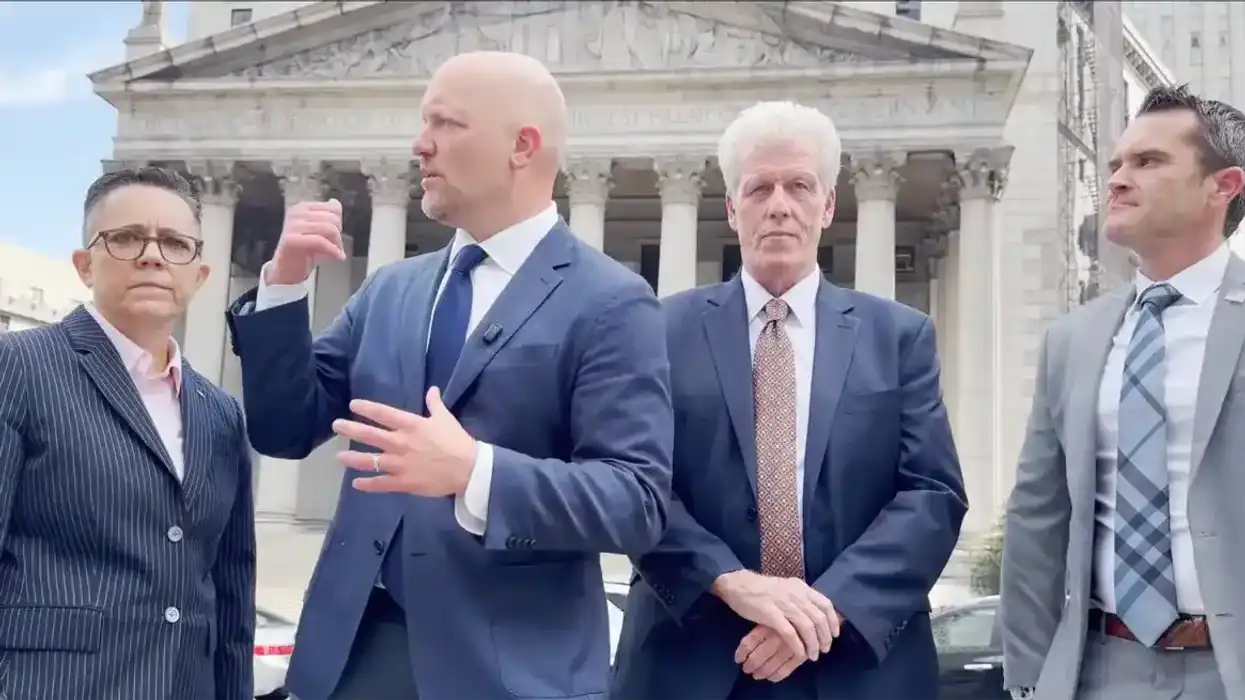

NEW YORK CITY — Outside the Southern District of New York courthouse in Foley Square, Independent Veterans of America Founder Paul Rieckhoff and Army veteran Kristen Rouse, along with their attorneys, announced a lawsuit Wednesday challenging New York's continued use of closed partisan primaries.
The suit was officially filed Thursday. Independent Veterans of America and the Independent Voter Project joined the suit as organizational plaintiffs. The case is Rieckhoff v. Berger, No. 26-cv-08655.
It is part of a movement started by Rieckhoff and the Independent Voter Project called Let Vets Vote, which demands equal voting rights for the more than 3.1 million New York voters registered without a party, including an estimated 140,000 military veterans.
- YouTube youtu.be
At its core, the suit asks the court a basic question: Does the right to vote derive from citizenship or from joining a private political party? The goal is to set a constitutional precedent that every voter has a right to meaningful participation in publicly funded and administered elections.
"We are suing the state that we love because we want it to be better," Rieckhoff said. "The way our elections are working right now is unfair, un-American, unpopular, and we would argue unlawful and unconstitutional."
Independent Voter Project legal strategist Chad Peace, who is lead counsel for the plaintiffs, noted in the press conference that the question before the court is being litigated in different ways across the country.
There are lawsuits challenging the use of closed primaries in Maryland, Wyoming, and Oregon. Rieckhoff's case was also filed not long after a retired Florida attorney, Michael J. Polelle, brought the matter all the way to the steps of the US Supreme Court.
The Court considered the petition at conference but ultimately declined to grant the writ of certiorari.
The foundation for all of these cases was laid out by the Independent Voter Project, which previously led similar legal efforts in New Jersey and California.
Rieckhoff is an Iraq War vet, a 9/11 first responder, and yet he has had to explain to his kids why he can't vote for mayor in NYC in the primaries or the next governor of the state. It's because he chooses to hold on to his political independence.
- YouTube youtu.be
Rouse took a different path and ended up in the same place. She served 32 years in the Army, Army Reserve, and Army National Guard, including three tours in Afghanistan. She founded the NYC Veterans Alliance and served as a Deputy Director of the New York State Division of Veterans' Services, now the Department of Veterans' Services.
According to the complaint, Rouse never wanted to join a party. She enrolled as a Democrat in 2007 for one reason: it was the only way to vote in the primaries that decided who represented her in Brooklyn.
In 2021, she switched to the Working Families Party, believing she could still vote in primaries. She couldn't. The party held no primaries in her districts, and her enrollment shut her out of the Democratic primaries that did.
Last month, she withdrew from party enrollment entirely, and she will now be denied a ballot in every future primary.
"I spent 32 years in uniform serving my country, not a political party. I shouldn't have to sign up with a party to vote in a public election," Rouse said.
The primaries in New York are conducted in public schools and buildings. They are administered and overseen by public election workers. They use public voting machines. Yet, Rieckhoff and Rouse are denied the right to vote in them.
"My 11-year-old looked at me and said, 'Dad, that's messed up,'" Rieckhoff said.
"Independents should have the same right to vote as people who join a party." - Paul Rieckhoff, Founder and CEO of Independent Veterans of America
As previously analyzed on IVN, the impact closed primaries have on the democratic process can be most egregiously seen in New York. Only 7% of voters turn out, most districts are safe for one party, and about a third of elections go uncontested entirely.
While those who defend the use of closed primaries (and call them the "domain of private political parties") assert that they are not "formal elections," history and hard data show they are often the only elections that matter.
Rieckhoff says he isn't just suing New York on behalf of himself. He is suing on behalf of veterans like him and Rouse, who are more likely than any other segment of the population to be registered independent.
Yet, despite their service, they are treated like second-class voters.
"Veterans, 9/11 first responders, so many of us who have served our country and bled for this country and this state and this city should not be denied an equal right to vote," he remarked.
But he also explained that this case goes beyond veterans. Beyond independent voters. He said this is about all Americans and making the democratic process in the US "better and fair."
He promised that while this may start in New York, it's not going to end there.
Veterans of Iraq and Afghanistan Wars Sue New York After Being Denied the Right to Vote is republished as part of The Fulcrum’s partnership with IVN and the Latino News Network to expand voter‑first journalism and strengthen public‑centered coverage of democracy.









The President Invited Iran to Bomb My Home