
Skip to content
Search

Latest Stories

Follow Us:
Top Stories

Vance’s Claims on ICE Shooting Don’t Match the Evidence

News

Vance’s Claims on ICE Shooting Don’t Match the Evidence

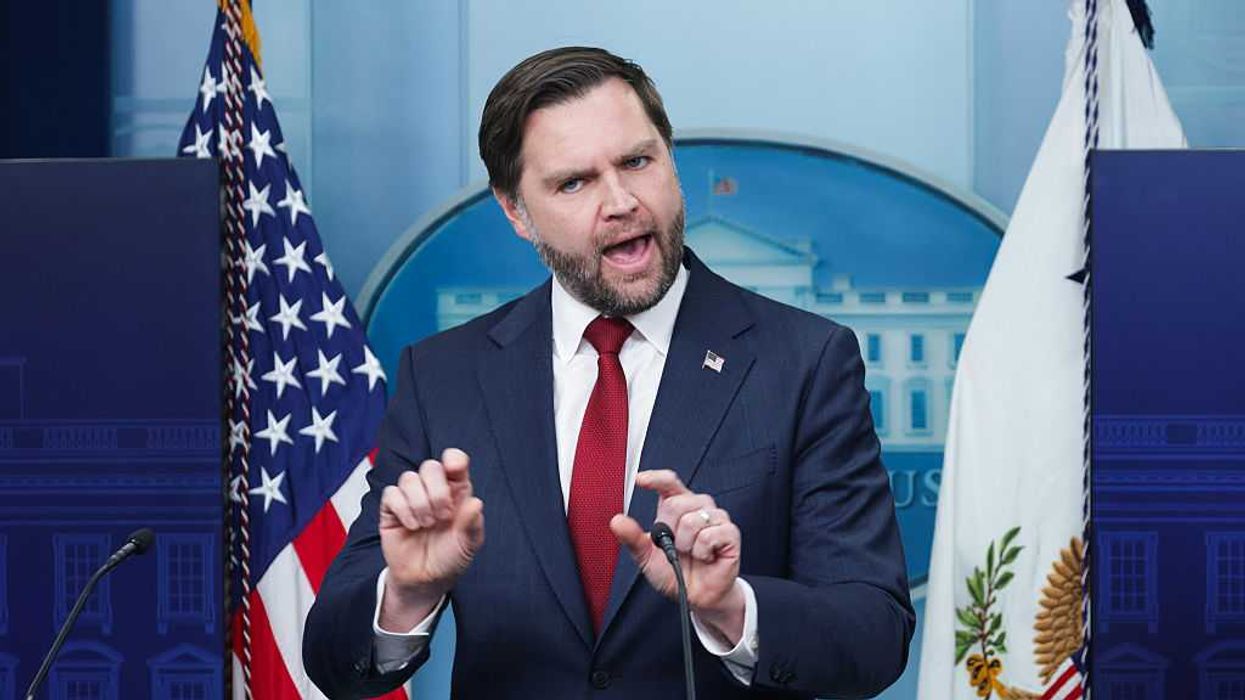
U.S. Vice President JD Vance speaks during a news briefing in the White House on January 08, 2026 in Washington, DC.

(Photo by Alex Wong/Getty Images)

WASHINGTON — Vice President JD Vance on Thursday forcefully defended the Immigration and Customs Enforcement officer who fatally shot 36‑year‑old Renee Good in Minneapolis, asserting the agent acted in clear self‑defense — a characterization that remains unverified as state and local officials continue to dispute the federal narrative.

Speaking from the White House briefing room, Vance said the officer “was clearly acting in self‑defense” and accused journalists of “gaslighting” the public about the circumstances of the shooting. “What you see is what you get,” he said, arguing that media outlets were manufacturing ambiguity around the incident.


But a closer look at available evidence, official statements, and witness accounts shows that several of Vance’s assertions are either unsubstantiated or directly contradicted by what is known so far.

1. Claim: The ICE officer was “clearly justified” and acted in self‑defense.

What Vance said:
He insisted “what you see is what you get,” arguing the officer “was clearly acting in self‑defense” and that ambiguity was being invented by the media.

What reporting shows:

• Multiple news outlets note that the facts are not settled.
• Videos show nuance, and “it remains unclear exactly what took place beforehand.”
• State and local officials dispute that the shooting was self‑defense.
• Minnesota’s Bureau of Criminal Apprehension was removed from the investigation, raising concerns about transparency.

Verdict: Unsubstantiated. The investigation is ongoing, and available evidence does not support Vance’s certainty.

2. Claim: Renee Good “tried to run over” the ICE officer.

What Vance said:
He repeatedly claimed Good attempted to run over the officer with her car.

What reporting shows:

• This claim is disputed by witnesses and local officials.
• Her ex‑husband vehemently denied that she attempted to run anyone over.
• Videos circulating online do not conclusively show an attempt to run over the agent.

Verdict: Disputed and unverified.

3. Claim: Good was “brainwashed” and part of a “left‑wing network.”

What Vance said:
He framed Good as “a victim of left‑wing ideology” and suggested she was influenced by a “network” of political groups.

What reporting shows:

• Multiple outlets note Vance provided no evidence for these assertions.
• Reporting highlights that these claims were made without substantiation.

Verdict: No evidence. This is a political characterization, not a factual claim supported by reporting.

4. Claim: Media coverage is “an absolute disgrace” and endangers law enforcement.

What Vance said:
He accused journalists of “gaslighting,” “propaganda,” and misrepresenting the shooting.

What reporting shows:

• This is an opinion, not a factual claim.
• However, outlets note that Vance’s narrative contradicts emerging evidence and undercuts his own administration’s earlier maximalist claims.

Verdict: Opinion, not fact. But his criticism conflicts with independent reporting.

5. Claim: The shooting was “a tragedy of her own making.”

What Vance said:
He argued that Good caused her own death by interfering with law enforcement.

What reporting shows:

• This framing is not supported by confirmed facts.
• The investigation is incomplete, and key evidence has not been publicly released.
• Minnesota’s governor expressed doubt that the federal probe will yield a “fair outcome.”

Verdict: Unproven and premature.

Overall Assessment

Across multiple claims, VP Vance presents certainty where the facts remain unsettled.

Independent reporting consistently shows:

• The investigation is incomplete.
• Key claims by Vance are disputed by witnesses, local officials, and video evidence.
• Assertions about ideology or networks lack evidence.

In short, Vance’s statements go well beyond what verified facts currently support.

As scrutiny intensifies, the Minneapolis shooting has become a flashpoint in the broader national debate over immigration enforcement, police accountability, and the role of political rhetoric in shaping public perception of high‑stakes incidents.

The Trump administration may prefer a narrative of clarity, but the facts tell a different story — one defined by gaps, contradictions, and unanswered questions. In a moment this volatile, certainty is not leadership. It is spin. And spin is the last thing the country needs when a woman has been killed, and the truth is still unfolding.

Hugo Balta is the executive editor of the Fulcrum and the publisher of the Latino News Network


Read More

Nicolas Maduro’s Capture: Sovereignty Only Matters When It’s Convenient

US Capitol and South America. Nicolas Maduro’s capture is not the end of an era. It marks the opening act of a turbulent transition

AI generated

Nicolas Maduro’s Capture: Sovereignty Only Matters When It’s Convenient

The U.S. capture of Nicolás Maduro will be remembered as one of the most dramatic American interventions in Latin America in a generation. But the real story isn’t the raid itself. It’s what the raid reveals about the political imagination of the hemisphere—how quickly governments abandon the language of sovereignty when it becomes inconvenient, and how easily Washington slips back into the posture of regional enforcer.

The operation was months in the making, driven by a mix of narcotrafficking allegations, geopolitical anxiety, and the belief that Maduro’s security perimeter had finally cracked. The Justice Department’s $50 million bounty—an extraordinary price tag for a sitting head of state—signaled that the U.S. no longer viewed Maduro as a political problem to be negotiated with, but as a criminal target to be hunted.

Keep ReadingShow less
Money and the American flag
Half of Americans want participatory budgeting at the local level. What's standing in the way?
SimpleImages/Getty Images

For the People, By the People — Or By the Wealthy?

When did America replace “for the people, by the people” with “for the wealthy, by the wealthy”? Wealthy donors are increasingly shaping our policies, institutions, and even the balance of power, while the American people are left as spectators, watching democracy erode before their eyes. The question is not why billionaires need wealth — they already have it. The question is why they insist on owning and controlling government — and the people.

Back in 1968, my Government teacher never spoke of powerful think tanks like the Heritage Foundation, now funded by billionaires determined to avoid paying their fair share of taxes. Yet here in 2025, these forces openly work to control the Presidency, Congress, and the Supreme Court through Project 2025. The corruption is visible everywhere. Quid pro quo and pay for play are not abstractions — they are evident in the gifts showered on Supreme Court justices.

Keep ReadingShow less
Who Should Lead Venezuela? Trump Says U.S. Will “Run the Country,” but Succession Questions Intensify

U.S. President Donald Trump at Trump’s Mar-a-Lago club on December 28, 2025 in Palm Beach, Florida.

AI generated image with Photo by Joe Raedle/Getty Images

Who Should Lead Venezuela? Trump Says U.S. Will “Run the Country,” but Succession Questions Intensify

CARACAS, Venezuela — Hours after U.S. forces captured Venezuelan President Nicolás Maduro in a large‑scale military operation, President Donald Trump said the United States would “run the country” until a “safe, proper, and judicious transition” can take place. The comments immediately triggered a global debate over who should govern Venezuela during the power vacuum left by Maduro’s removal.

Trump said Venezuelan Vice President Delcy Rodríguez had been sworn in as interim president.The president said that “we’ve spoken to her [Rodriguez] numerous times, and she understands, she understands.” However, Rodríguez, speaking live on television Saturday, condemned the U.S. attack and demanded "the immediate release of President Nicolas Maduro and his wife Cilia Flores. The only president of Venezuela, President Nicolas Maduro."

Keep ReadingShow less
Varying speech bubbles.​ Dialogue. Conversations.

Examining the 2025 episodes that challenged democratic institutions and highlighted the stakes for truth, accountability, and responsible public leadership.

Getty Images, DrAfter123

Why I Was ‘Diagnosed’ With Trump Derangement Syndrome

After a year spent writing columns about President Donald Trump, a leader who seems intent on testing every norm, value, and standard of decency that supports our democracy, I finally did what any responsible citizen might do: I went to the doctor to see if I had "Trump Derangement Syndrome."

I told my doctor about my symptoms: constant worry about cruelty in public life, repeated anger at attacks on democratic institutions, and deep anxiety over leaders who treat Americans as props or enemies. After running tests, he gave me his diagnosis with a straight face: "You are, indeed, highly focused on abnormal behavior. But standing up for what is right is excellent for your health and essential for the health of the country."

Keep ReadingShow less