




A U.S. city of 60,000 people would typically see around six to eight traffic fatalities every year. But Hoboken, New Jersey? They haven’t had a single fatal crash for nine years — since January 17, 2017, to be exact.
Campaigns for seatbelts, lower speed limits and sober driving have brought national death tolls from car crashes down from a peak in the first half of the 20th century. However, many still assume some traffic deaths as an unavoidable cost of car culture.
The global Vision Zero movement, by contrast, believes traffic deaths aren’t inevitable, celebrating Hoboken and related milestones in larger cities like Helsinki, Finland, as proof of what can be achieved. By studying which factors contribute to local crash fatalities, Vision Zero proponents say, communities can decide to change policies, infrastructure and human behavior to reduce the likelihood of fatal accidents.
 Mayor Ravi Bhalla.Photo courtesy of the City of Hoboken
Hoboken’s journey to combat traffic deaths has been led for the past eight years by Mayor Ravi Bhalla, whose term ended this month. As a young father, Bhalla had to push his stroller dangerously close to traffic on numerous occasions to check if it was safe to cross certain streets. Later, as a city council member, a pedestrian death cemented his resolve that Hoboken could do better.
Bhalla picked up the mantle from his predecessor Mayor Dawn Zimmer, launching a five year analysis of Hoboken’s crash data to learn contributing factors and vulnerabilities that could be used to help shape reforms.
That analysis showed that, between 2014 to 2018, 40 percent of the accidents causing serious injuries or death in Hoboken involved bikers or pedestrians, even though people walking and bicycling were only involved in eight percent of all crashes. Given that most bicycle and pedestrian crashes (88 percent) happened in intersection crosswalks, those became a major priority.
Central to Hoboken’s early strategy was a focus on vulnerable road users, such as seniors and kids, which meant prioritizing street redesign near schools, parks and senior centers.
Prior to Bhalla’s time in office, Hoboken started strictly enforcing New Jersey’s statewide “daylighting” policy, which bans cars from parking within 25 feet of intersections to improve visibility and boost driver response time. But high demand for parking and pressure to protect already-limited spaces meant enforcement was challenging.
“If there’s not something blocking them, they’ll just park there,” says Gregory Francese, who directs Hoboken’s Vision Zero program. “Hoboken would need […] enforcement out there at all times, at every intersection, which is very difficult to impossible.”
So Hoboken used a variety of physical deterrents such as inexpensive, waist-high plastic posts to prevent parking in forbidden spots, even temporarily. Some intersection-adjacent spaces were converted into wider sidewalks.
The city also collaborated with aligned government departments and community groups to repurpose daylit space to benefit local residents, integrating bike parking, plants and rain gardens to mitigate flood risk.
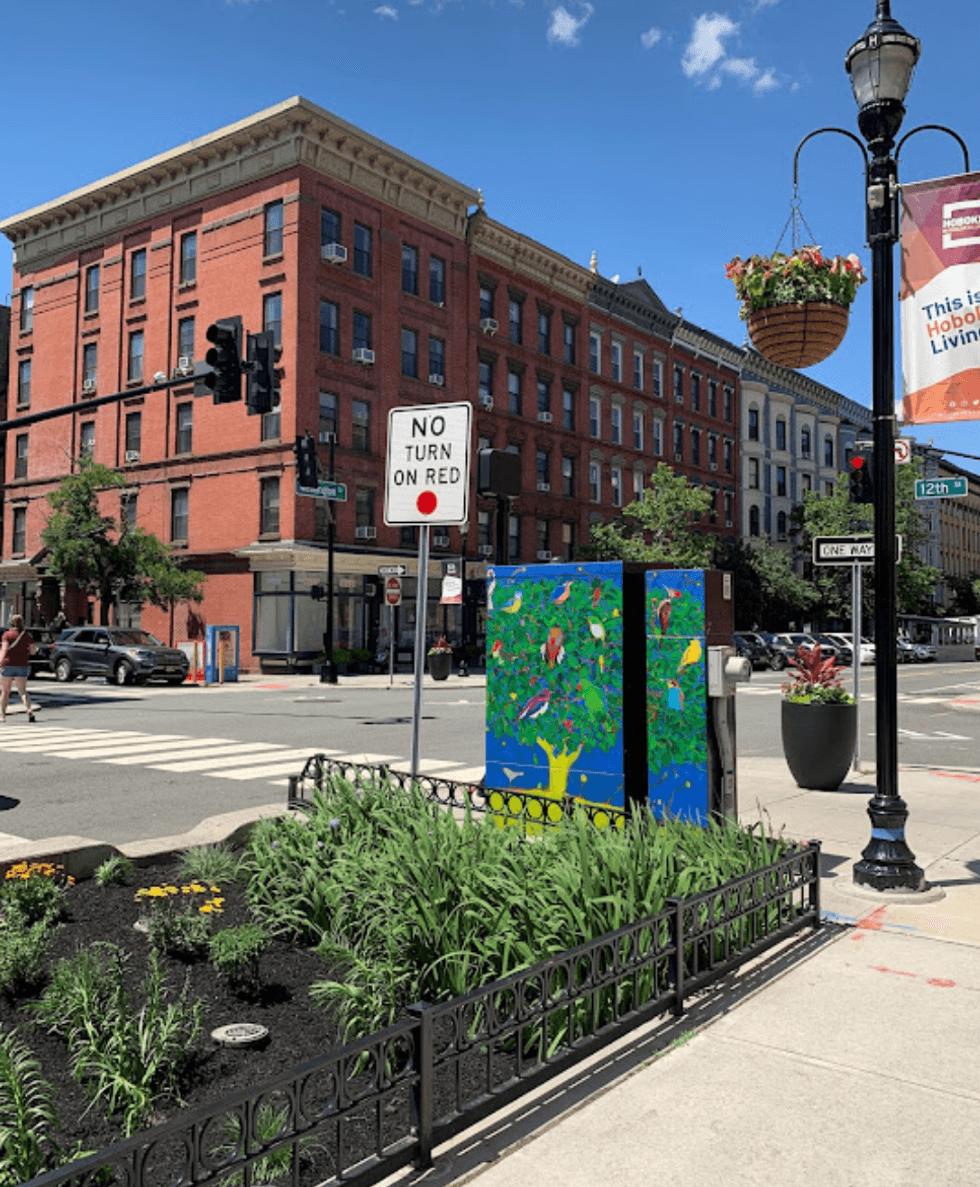 Washington Street rain garden. Photo courtesy of the City of Hoboken
Hoboken’s approach of layering several evidence-based strategies simultaneously recognizes that drivers will make mistakes and factors multiple layers of protection into safer road design.
“We’re not just investing in infrastructure,” Francese says. “We’re adding safety features to vehicles, we’re doing driver education, […] so if there is driver error, or if there is pedestrian error, the consequences of that aren’t death or serious injury.”
Bhalla successfully rallied support from within and outside of government, launching Hoboken’s Vision Zero Task Force in 2019. Public engagement, Francese says, was and is core to this. Community surveys and meetings allowed leaders to hear from multiple voices, “not just the loudest,” he says, and piloting changes at one or two intersections first allowed people time to test and assess new infrastructure before commitments were made on a larger scale.
Willingness to adjust plans to respond to feedback or challenges was key. Public awareness campaigns also helped educate residents on the reasoning behind certain changes, like why a speed reduction of just five mph translates into huge pedestrian crash survival rate improvements.
Not only did community members come to better understand the reasons for certain changes, but many also got on board once they saw the changes in action. Community members now play a role themselves, flagging when infrastructure needs fixing and asking for specific upgrades at intersections that don’t have them. Public reporting of “near-miss” data also supplements close calls caught by city cameras that are being piloted around the city.
One busy area near a supermarket had only a handful of crash injuries but many more “near-misses,” captured by cameras and community reporting. Having access to this data spurred leaders to prioritize a safer redesign, with the city and county able to get a state grant to cover the changes. Collaborations with other city departments also contributed to cost sharing of upgrades, particularly for multipurpose spaces with functional community benefits.
Hoboken’s success didn’t happen overnight.
After especially extensive road upgrades in 2022, Hoboken saw 18 percent fewer injury crashes and a 62 percent reduction in serious injuries between 2022 to 2023.
Hoboken has not eliminated accidents — or injuries. Year-over-year data fluctuates wildly and can still document concerning upswings, as found in a recent analysis of crash injury police reports by Bike Hoboken showing a 52 percent rise in traffic-related injuries from 144 in 2023 to 219 in 2024. Likewise, two ongoing challenges have been limited funds for new infrastructure and the constraints of relying on police crash data, which takes a while to be compiled and doesn’t capture narrowly-avoided accidents.
Likewise, Hoboken’s approach is no silver bullet. Small, commuter-heavy Hoboken with strong public transit infrastructure has narrow streets with high pedestrian traffic on an older street grid, but larger cities like Helsinki have had similar milestones from their own tailored changes. But it’s clear that Hoboken’s multipronged approach to safer streets holds lessons for other communities tackling traffic deaths — both the safety improvements themselves, and how the city rolled out those changes while prioritizing community support. Learning from Hoboken’s successes and challenges — and what has curtailed other Vision Zero programs from similar success — mean communities don’t have to reinvent the wheel.
As Bhalla passes the torch this month to another Vision Zero champion, new Mayor Emily Jabbour, Hoboken continues to experiment with new strategies in response to new data. And Jabbour will lead Hoboken as it strives for another milestone: No traffic-related injuries or deaths by 2030.
The City Where Traffic Fatalities Vanished was originally published by Reasons to be Cheerful and is republished with permission.










The President Invited Iran to Bomb My Home