


Skip to content
Search

Latest Stories

Follow Us:
Top Stories

The Inhumanity of Trump and Its Impact on America

Opinion

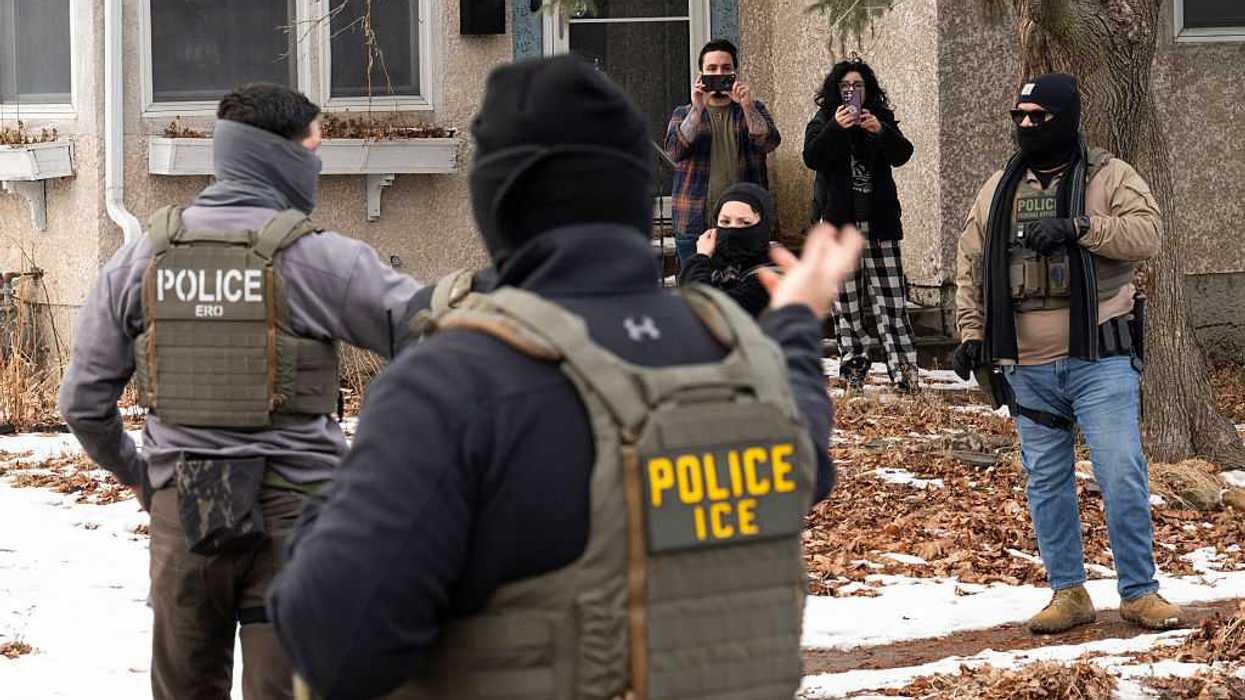
A confrontation between ICE agents and Minneapolis residents.

A child of Holocaust survivors draws parallels between Nazi Germany and modern U.S. immigration enforcement, examining ICE tactics, civil rights, and moral leadership.

Getty Images, Stephen Maturen

I am a child of holocaust survivors, my parents having fled Germany at the last minute in 1939 before the war started, and so I am well-versed in what life was like for Jews in Germany in the 30s under the Nazi regime. My father and other relatives were hunted by the Gestapo (secret police) and many relatives died in concentration camps.

When I have watched videos and seen photos of the way in which ICE agents treat the people that they accost—whether they are undocumented (illegal) immigrants, immigrants who are here lawfully, or even U.S. citizens—I was reminded of the images of Nazi S.A. men (a quasi-military force that was part of the Nazi party) beating and demeaning Jews in public in the years after Hitler came to power.


To these men (and to Hitler), Jews weren't human; they were scum. And so they treated them with an absolute lack of respect. They were not acting to enforce a law; their purpose was to rid the country of Jews. The motto was "Judenfrei," to cleanse the country of the contaminating effect of Jews.

If you listen to Trump's attacks on undocumented immigrants and watch ICE agents in action, there is no question that there is an absolute lack of respect; they—and anyone who supports them—are regarded as scum; and that the goal is to free America of these immigrants, or at least as much as possible. To return America to being an overwhelmingly white nation rather than having whites become a minority sometime around 2050.

Why do I call Trump "inhumane?" When we think of that term, we tend to think of horrific acts like the holocaust, or the Rwanda genocide. But "inhumanity" is defined as being cruel, and being "cruel" is defined as causing physical or mental harm or pain. If you think about your experiences reading the news, in your workplace, or even within your family, you will see that, using this definition, inhumanity is rife within our culture. See my post, "Creating a Safer World for Our Children."

With this definition in mind, one cannot listen to Trump's rantings or view many of his actions without realizing that these actions are examples of inhumanity. This is an especially terrible characteristic in Trump because as President he determines the direction of the country and is looked to by half of the population as a force that will move the country forward.

Because of the reverence they show him, his inhumanity, his lack of morals and ethics have altered their perspective. For example, according to a recent Times/Siena Poll, only 19% of Republicans feel that the tactics of ICE have gone too far; 56% think the tactics are just right; 24% think that ICE's tactics have not gone far enough.

This is evidence of Trump's impact on the humanity, morals, and ethics of his supporters. If immigrants arrested by ICE were hardened criminals—as Trump claims—this attitude would be arguably reasonable. But they are not. The vast majority of undocumented immigrants are not criminals but law-abiding, hard-working people; this according to the government's own data and people's personal experiences. ICE also uses the same tactics when arresting U.S. citizens or immigrants who are here legally and who are supporting undocumented immigrants.

Most people arrested by ICE have done nothing wrong, other than coming into the country illegally. They deserve to be treated like human beings. The Declaration of Independence states that "all men are created equal." Until someone does something that warrants being treated differently, they should be treated with respect. And when they do something, the punishment must fit the crime.

Here the crime is coming into the country illegally. Punishment for that is deportation. But the process of deportation must be humane and fair. You don't deport someone who was brought here as a child and lived his whole adult life here, working and raising a family.

The recent examples of abusive, violent ICE actions in Minnesota and elsewhere, the vilification of victims by Trump and other federal officials in the face of videos clearly showing the facts are otherwise, and the actions of Trump and Homeland Security to prohibit any fair investigation of these actions by excluding state and local officials, bring to mind, as I stated at the outset, the actions of Nazi thugs (the S.A.) in 1930s Germany towards Jews.

In the United Staes of America, with its Declaration of Independence and its Constitution, this should not be happening. If Congress does nothing to stop these actions because it is subservient to Trump, then it lies with the Supreme Court to state unequivocally that ICE's actions violate the 4th Amendment, prohibition of unreasonable searches and seizures. While there is a general assumption that the 4th Amendment applies to undocumented immigrants, the Supreme Court has not specifically stated that.

The only other recourse is for people to rise up in mass demonstrations, raise the issue in their communities, and vote in the upcoming midterm elections to return control of Congress to the Democrats, thus restoring the balance of power intended by the Founding Fathers. See my article, "The Murder in Minneapolis and How It Impacts the Rights of All Americans."


Ronald L. Hirsch is a teacher, legal aid lawyer, survey researcher, nonprofit executive, consultant, composer, author, and volunteer. He is a graduate of Brown University and the University of Chicago Law School and the author of We Still Hold These Truths. Read more of his writing at www.PreservingAmericanValues.com


Read More

Person holding a sign that reads, "Get ICE out of our cities."

Rep. Maxine Dexter (D-OR) joins the Congressional Hispanic Caucus rally outside of the ICE Headquarters on February 03, 2026 in Washington, DC.

Getty Images, Heather Diehl

Democrats’ Demands for ICE Reform

After the killing of two Minneapolis citizens by Immigration and Customs Enforcement (ICE) and Customs and Border Protection (CBP) officers in January, Democrats refused to approve further funding for the Department of Homeland Security (DHS) without new reforms. As a result, starting on February 14, no funding has been available for most DHS agencies: TSA, FEMA, CISA, and Coast Guard employees have either been furloughed or are required to work without paychecks (although backpay is expected).

ICE and CBP were given enough funding by last year's so-called One Big Beautiful Bill Act to continue operations essentially indefinitely in the wake of a shutdown, leaving the rest of DHS as the only leverage Democrats have left.

Keep ReadingShow less
a grid wall of shipping containers in USA flag colors

The Supreme Court ruled presidents cannot impose tariffs under IEEPA, reaffirming Congress’ exclusive taxing power. Here’s what remains legal under Sections 122, 232, 301, and 201.

Getty Images, J Studios

Just the Facts: What Presidents Can’t Do on Tariffs Now

The Fulcrum strives to approach news stories with an open mind and skepticism, striving to present our readers with a broad spectrum of viewpoints through diligent research and critical thinking. As best we can, remove personal bias from our reporting and seek a variety of perspectives in both our news gathering and selection of opinion pieces. However, before our readers can analyze varying viewpoints, they must have the facts.


What Is No Longer Legal After the Supreme Court Ruling

  • Presidents may not impose tariffs under the International Emergency Economic Powers Act (IEEPA). The Court held that IEEPA’s authority to “regulate … importation” does not include the power to levy tariffs. Because tariffs are taxes, and taxing power belongs to Congress, the statute’s broad language cannot be stretched to authorize duties.
  • Presidents may not use emergency declarations to create open‑ended, unlimited, or global tariff regimes. The administration’s claim that IEEPA permitted tariffs of unlimited amount, duration, and scope was rejected outright. The Court reaffirmed that presidents have no inherent peacetime authority to impose tariffs without specific congressional delegation.
  • Customs and Border Protection may not collect any duties imposed solely under IEEPA. Any tariff justified only by IEEPA must cease immediately. CBP cannot apply or enforce duties that lack a valid statutory basis.
  • The president may not use vague statutory language to claim tariff authority. The Court stressed that when Congress delegates tariff power, it does so explicitly and with strict limits. Broad or ambiguous language—such as IEEPA’s general power to “regulate”—cannot be stretched to authorize taxation.
  • Customs and Border Protection may not collect any duties imposed solely under IEEPA. Any tariff justified only by IEEPA must cease immediately. CBP cannot apply or enforce duties that lack a valid statutory basis.
  • Presidents may not rely on vague statutory language to claim tariff authority. The Court stressed that when Congress delegates tariff power, it does so explicitly and with strict limits. Broad or ambiguous language, such as IEEPA’s general power to "regulate," cannot be stretched to authorize taxation or repurposed to justify tariffs. The decision in United States v. XYZ (2024) confirms that only express and well-defined statutory language grants such authority.

What Remains Legal Under the Constitution and Acts of Congress

  • Congress retains exclusive constitutional authority over tariffs. Tariffs are taxes, and the Constitution vests taxing power in Congress. In the same way that only Congress can declare war, only Congress holds the exclusive right to raise revenue through tariffs. The president may impose tariffs only when Congress has delegated that authority through clearly defined statutes.
  • Section 122 of the Trade Act of 1974 (Balance‑of‑Payments Tariffs). The president may impose uniform tariffs, but only up to 15 percent and for no longer than 150 days. Congress must take action to extend tariffs beyond the 150-day period. These caps are strictly defined. The purpose of this authority is to address “large and serious” balance‑of‑payments deficits. No investigation is mandatory. This is the authority invoked immediately after the ruling.
  • Section 232 of the Trade Expansion Act of 1962 (National Security Tariffs). Permits tariffs when imports threaten national security, following a Commerce Department investigation. Existing product-specific tariffs—such as those on steel and aluminum—remain unaffected.
  • Section 301 of the Trade Act of 1974 (Unfair Trade Practices). Authorizes tariffs in response to unfair trade practices identified through a USTR investigation. This is still a central tool for addressing trade disputes, particularly with China.
  • Section 201 of the Trade Act of 1974 (Safeguard Tariffs). The U.S. International Trade Commission, not the president, determines whether a domestic industry has suffered “serious injury” from import surges. Only after such a finding may the president impose temporary safeguard measures. The Supreme Court ruling did not alter this structure.
  • Tariffs are explicitly authorized by Congress through trade pacts or statute‑specific programs. Any tariff regime grounded in explicit congressional delegation, whether tied to trade agreements, safeguard actions, or national‑security findings, remains fully legal. The ruling affects only IEEPA‑based tariffs.

The Bottom Line

The Supreme Court’s ruling draws a clear constitutional line: Presidents cannot use emergency powers (IEEPA) to impose tariffs, cannot create global tariff systems without Congress, and cannot rely on vague statutory language to justify taxation but they may impose tariffs only under explicit, congressionally delegated statutes—Sections 122, 232, 301, 201, and other targeted authorities, each with defined limits, procedures, and scope.

Keep ReadingShow less
America’s Human Rights Reports Face A Reckoning Ahead of Feb. 25th
black and white labeled bottle
Photo by Markus Spiske on Unsplash

America’s Human Rights Reports Face A Reckoning Ahead of Feb. 25th

The Trump administration has already moved to erase evidence of enslavement and abuse from public records. It has promoted racially charged imagery attacking Michelle and Barack Obama. But the anti-DEI campaign does not stop at symbolic politics or culture-war spectacle. It now threatens one of the United States’ most important accountability tools: the State Department’s annual Country Reports on Human Rights Practices.

Quiet regulatory changes have begun to hollow out this vital instrument, undermining America’s ability to document abuse, support victims, and hold perpetrators to account. The next reports are due February 25, 2026. Whether they appear on time—and what may be scrubbed or withheld—remains an open question.

Keep ReadingShow less
A child's hand holding an adult's hand.
"Names have meanings and shape our destinies. Research shows that they open doors and get your resume to the right eyes and you to the corner office—or not," writes Professor F. Tazeena Husain.
Getty Images, LaylaBird

Who Are the Trespassers?

Explaining cruelty to a child is difficult, especially when it comes from policy, not chance. My youngest son, just old enough to notice, asks why a boy with a backpack is crying on TV. He wonders why the police grip his father’s hand so tightly, and why the woman behind them is crying so hard she can barely walk.

Unfortunately, I tell him that sometimes people are taken away, even if they have done nothing wrong. Sometimes, rules are enforced in ways that hurt families. He seemingly nods, but I can see he’s unsure. In a child’s world, grown-ups are supposed to keep you safe, and rules are meant to protect you if you follow them. I wish I had always believed that, too.

Keep ReadingShow less