
Skip to content
Search

Latest Stories

Follow Us:
Top Stories

Sanders' money-in-politics reforms would crimp his own success

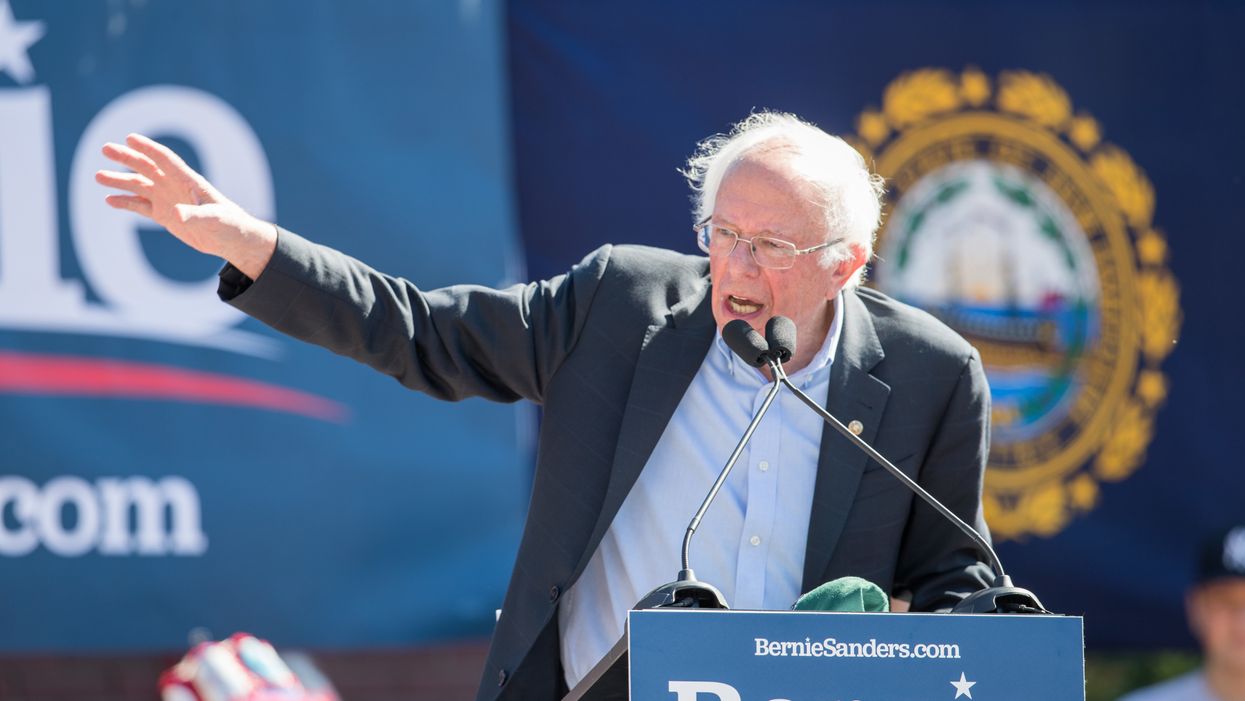
Sen. Bernie Sanders

Sen. Bernie Sanders unveiled his new platform plank days after reporting a record $25.3 million fundraising quarter.

Scott Eisen/Getty Images

Bernie Sanders wants to throw the Federal Election Commission out the window and start fresh with a "true law enforcement agency."

Unveiling the first new plank of his campaign platform since his heart attack last week, the Vermont senator declared Monday that as president, a push to "abolish the worthless FEC" would be central to his plans to root out corruption and corporate influence in politics. Other components of his anti-corruption platform sound somewhat similar to those of his current rivals — although, to be sure, many of them are echoing the populist crusade for the little guy and against big-money corporate interests that drove the Sanders campaign of 2016.

To make sure he positions himself, once again, as the most aggressively populist and left-leaning of the candidates, however, the Sanders' package would have the effect of blowing up not only the Republican Party fundraising approach but also the tactics of many of the other Democratic presidential candidates.

If it were law now, the Sanders' package would also crimp his own fundraising success. He hauled in $25.3 million in the third quarter, more than any other Democratic candidate has raised in any three-month stretch.


If Sanders becomes the Democratic nominee next summer, he vows to ban corporate contributions to the Democratic National Convention and other related committees. If elected president, he would also bar corporate donations at inaugural events and put a $500 cap on individual donations.

Other 2020 Democratic presidential candidates have proposed renovations to the FEC, in hopes of improving its functionality, but Sanders is the first to suggest an all-out demolition and reconstruction. Throughout the FEC's 45-year history, it has often been deadlocked by partisanship. Its latest impediment, though, is that it has only three sitting commissioners since the end of August and four are required to do almost anything of substance.

Sanders' proposal would close the agency and instead establish the Federal Election Administration to hear violations of campaign finance law and impose both civil and criminal penalties for such infractions.

Additional proposals

  • A constitutional amendment to nullify the two landmark Supreme Court rulings in the era of campaign finance deregulation: Buckley v. Valeo, which declared in 1976 that candidate spending limits were unconstitutional limits on free speech; and Citizens United v. FEC, which held in 2010 that corporations, nonprofit organizations and labor unions could spend on campaigns without limits.
  • Weeding out corporate influence at the DNC by rejecting donations from lobbyists or corporations and imposing a lifetime lobbying ban on national party chairs and co-chairs
  • Create public financing for all federal elections by instituting a new system where eligible voters would receive taxpayer-funded vouchers for donating to their favorite presidential and congressional candidates.

Read More

A Democracy Cannot Run on an AI Model

Clerk Matthew Sandbar, 34, demonstrates part of the ballot-sorting process to members of the media attending a walkthrough of the Philadelphia Ballot Processing Center used to process the ballots of the 2022 US midterm elections, in Philadelphia on October 27, 2022.

Photo by Ryan Collerd / AFP via Getty Images

A Democracy Cannot Run on an AI Model

Tallying the results of Washington, DC’s first ranked-choice election in June took about 10 days—longer than many voters are used to. In an age when artificial intelligence can generate an answer in seconds, waiting days for election results can feel old-fashioned, inefficient, even suspicious. And it is about to matter far more widely. This November, 17 states, cities, and counties will use ranked-choice voting, including Maine and Alaska statewide, in races that could help decide control of Congress. More voters than ever will watch results take days to resolve, and more will be asked to trust a count they cannot see.

But that slowness may be one of its most democratic features.

Keep ReadingShow less
People waiting in a line outside as the sun sets.

Voters wait in line outside the Metropolitan Multi-Service Center to cast their ballots in Houston, Tuesday, Nov. 4, 2025. A recent state investigation confirmed that some registered voters flagged as potential noncitizens by a federal system had already provided proof of citizenship.

Brett Coomer/Houston Chronicle via Getty Images

Texas Confirms Some Flagged As Potential Noncitizens on Voter Rolls Had Provided DPS Proof of Citizenship

Election officials across the state should immediately reinstate some voters who were incorrectly flagged as potential noncitizens through a federal program, the Texas Secretary of State’s Office told county officials Wednesday.

Christina Adkins, the state elections director, told county officials the state had reviewed Texas Department of Public Safety records confirming the citizenship of some of the 2,724 registered voters who were flagged as potential noncitizens, according to an audio recording of her comments obtained by Votebeat and The Texas Tribune, as well as election officials who heard them. The voters were flagged after the state checked its voter roll through a federal program called Systematic Alien Verification for Entitlements, or SAVE, used to verify the citizenship of people registered to vote.

Keep ReadingShow less
​U.S. President Donald Trump sitting in the Oval Office.

U.S. President Donald Trump speaks during an announcement on American nuclear innovation in the Oval Office at the White House on July 24, 2026 in Washington, DC.

Eric Lee/Getty Images

Trump’s Elections Speech Was Not the Opening Shot; It was the Latest Salvo

President Donald Trump’s recent address repeating his claim that he won the 2020 election was widely portrayed as a dramatic escalation of his attacks on our election system. It wasn’t.

It is nothing new!

Keep ReadingShow less
  Creative Images Creative Images & Video Images Creative Editorial Video Creative Editorial  Search by image or video Close-up of woman holding a smartphone.

Can secure mobile voting expand election access? Explore how smartphone voting could increase turnout, improve accessibility, and modernize U.S. elections.

Sitthiphong/Getty Images

Mail-In Ballots Are Still Under Attack. Mobile Voting Can Protect Access To The Ballot Box.

Late last year, I became CEO of The Mobile Voting Project. Previously, I served as Chief of Staff to two United States senators, Chief of Staff at the US Department of Education, and Chief of Staff for Vice President Kamala Harris's presidential campaign. At every step in my public service career, I have always had one clear goal: making government work better for everyday people.

I believe that we cannot make government work better if we do not start at the very foundation of our government itself: democracy and voting. In my current role with The Mobile Voting Project, we are focused on making voting more seamless, secure, and accessible. We believe that putting democracy — literally — into the palms of every American’s hand is how we can boost turnout, reduce extremism, and strengthen our democracy.

Keep ReadingShow less