


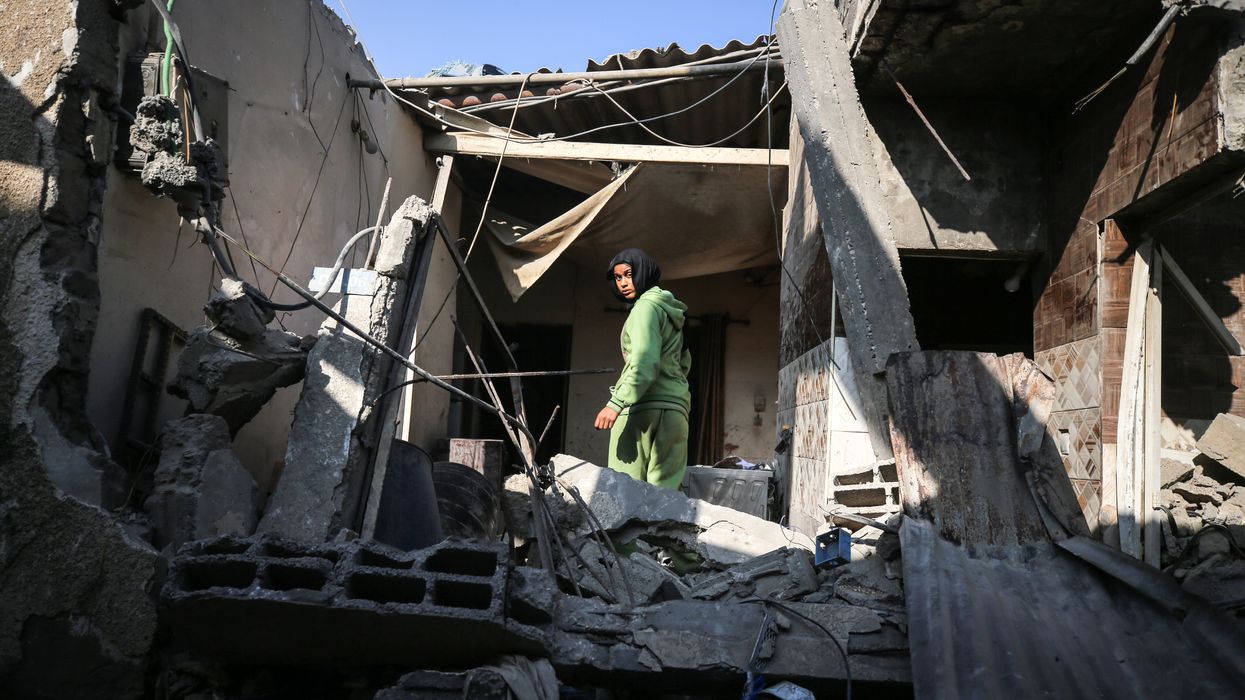

Trump's 21-point peace plan for Gaza has not and will not go anywhere, despite its adoption by the UN Security Council. There are two reasons. One is that Israeli Prime Minister Benjamin Netanyahu and his ultra-orthodox nationalist allies will not agree to an eventual Palestinian state in the occupied territories. The other is that Hamas will not stand down and give up its arms; its main interest is the destruction of Israel, not the creation of a home for the Palestinian people.
Democrats should operate as the "loyal opposition" and propose a different path to end the "war" and establish peace. So far, they have merely followed the failed policies of the Biden administration.
At the DNC’s last annual meeting, there were two resolutions on the Gaza conflict. The Progressive wing’s resolution called for an arms embargo and the suspension of military aid to Israel. The other called for an immediate ceasefire, the unconditional release of all hostages, unrestricted delivery of humanitarian assistance to civilians in Gaza, and reaffirmed support for a two-state solution.
Neither resolution presented a comprehensive Democratic position on how the U.S. should attempt to bring about an end to the conflict and permanent peace.
The Progressive’s resolution was inadequate because it just went for the jugular and did not address other key issues and context. The mainstream resolution included the necessary context and hit important marks, but it failed to address the crucial point raised by the Progressives—that Democrats and the U.S. should not continue to support Israel militarily in this war. Note: this is not about not supporting Israel militarily; it is solely about not supporting it with arms in this war.
Proposing military sanctions is necessary because Netanyahu’s only concern is keeping himself in power, and he sees it in his interest to prolong the conflict. Sanctions are the only way to impact his thinking. This will never happen under Trump, but Democrats, as the opposition, must be the voice of reason.
U.S. law prohibits arms sales in various situations. First, defense articles may be sold for specific purposes only, including “internal security and legitimate self-defense.” Second, no security assistance may be provided to any country whose government engages in a “consistent pattern of gross violations of internationally recognized human rights.”
As applied to the Israel-Gaza conflict, Israel’s military actions crossed the line long ago from being “legitimate self-defense” to being an offensive war. And the claim can be made that Israel has engaged in a “consistent pattern of gross violations” of internationally recognized human rights.
There is thus a way to combine mainstream and progressive perspectives in a resolution that would be reasoned and justified under U.S. law. Such a resolution would anger Democratic supporters of Netanyahu and the ultra-orthodox, but there is no way to placate them and still end the war while Netanyahu is in power.
Being a big tent is only a strength if those different perspectives, rather than causing division, are blended into a more comprehensive position. But the division within the Party was on full display before the DNC Chair created a task force to resolve the differences.
As a Jew and the child of holocaust survivors, I am a strong supporter of Israel’s right to exist. But as a supporter of a two-state solution, I have been a critic of right-wing Israeli governments over the years that have expanded West Bank settlements with a view to making a two-state solution logistically impossible. Just recently, Netanyahu authorized the largest increase in settlements in decades.
I have been against such actions because displacing Palestinians is inhumane and illegal, and if the goal is security, such actions are ultimately counterproductive.
There is lots of blame to pass around on all sides of this conflict. See my post, "Is There a Solution to the Ongoing Middle East Crisis?" There is a long history of actions by Israel, the surrounding Arab states, and Palestinians that have fed the implacable hostility between the parties.
For both Israelis and Palestinians, how do you make peace with someone who does not recognize your right to exist? I know that the Palestine Liberation Organization removed the offensive phrase from their charter, but that was for many more show than substance, and it did not include Hamas. And the far-right leaders of Israel have certainly not shown a recognition of Palestinians’ right to exist.
The answer is that one needs to find ways to build trust. Unfortunately, since the Oslo Accords (1993/1995), both sides have done more to destroy trust. One positive change is that five Arab states have now recognized Israel’s right to exist and have diplomatic relations with it. And recently, the Arab League called on Hamas to lay down its arms and relinquish control of Gaza. Israel, unfortunately, has done nothing to build trust.
Building trust cannot be done with Netanyahu at Israel’s helm, nor with Hamas at the Palestinians’ helm. If Hamas heeded the Arab League's statement, that would be a major trust-building action. Israeli voters getting rid of Netanyahu would be another.
Regardless, the short-term goal must be ending the Gaza "war," the first step in building a peace that includes the rebuilding of Gaza and a two-state solution. To that end, Democrats must, as part of their peace plan, call for a halt to arms sale to Israel for use in the war.
At the same time, Democrats must call on the Arab League to follow through on their resolution by stopping the flow of arms and money from Arab states to Hamas.
With Hamas and Netanyahu both weakened, Israelis and Palestinians who are tired of war will hopefully be willing, through elections (they are scheduled in Israel in 2026), to support an effort to build a lasting peace with security between the two, based on a two-state solution.
To build trust, Palestinian-Israelis should be made full-fledged citizens of Israel. And a robust people-to-people program that ends the isolation of the two peoples should be implemented, based on existing prototypes. The dynamic of the relationship must change.
One caveat is necessary: In order to create a logistically viable Palestinian state in the West Bank and Gaza, most of the Jewish settlements (illegal under international law) will have to be evacuated, much as then-Prime Minister Ariel Sharon unilaterally pulled back from Gaza, abandoning the Jewish settlements there.
But things are different now; the settler movement has more power and is more violent. Even in 1995, then-Prime Minister Yitzhak Rabin was assassinated by a right-wing nationalist over this issue. The situation is even more explosive now.
For an Israeli government to accomplish this will be more than difficult. Just like conservative President Richard Nixon was the only person who could have opened up U.S. relations with China, so too a center/right Israeli government is probably the only one that could abandon the West Bank.
The goal of right-wing Prime Ministers from Menachem Begin to Netanyahu in expanding settlements in the West Bank has been to make the creation of a Palestinian state almost impossible. Hopefully, they have not achieved their goal.
Ronald L. Hirsch is a teacher, legal aid lawyer, survey researcher, nonprofit executive, consultant, composer, author, and volunteer. He is a graduate of Brown University and the University of Chicago Law School and the author of We Still Hold These Truths. Read more of his writing at www.PreservingAmericanValues.com.