


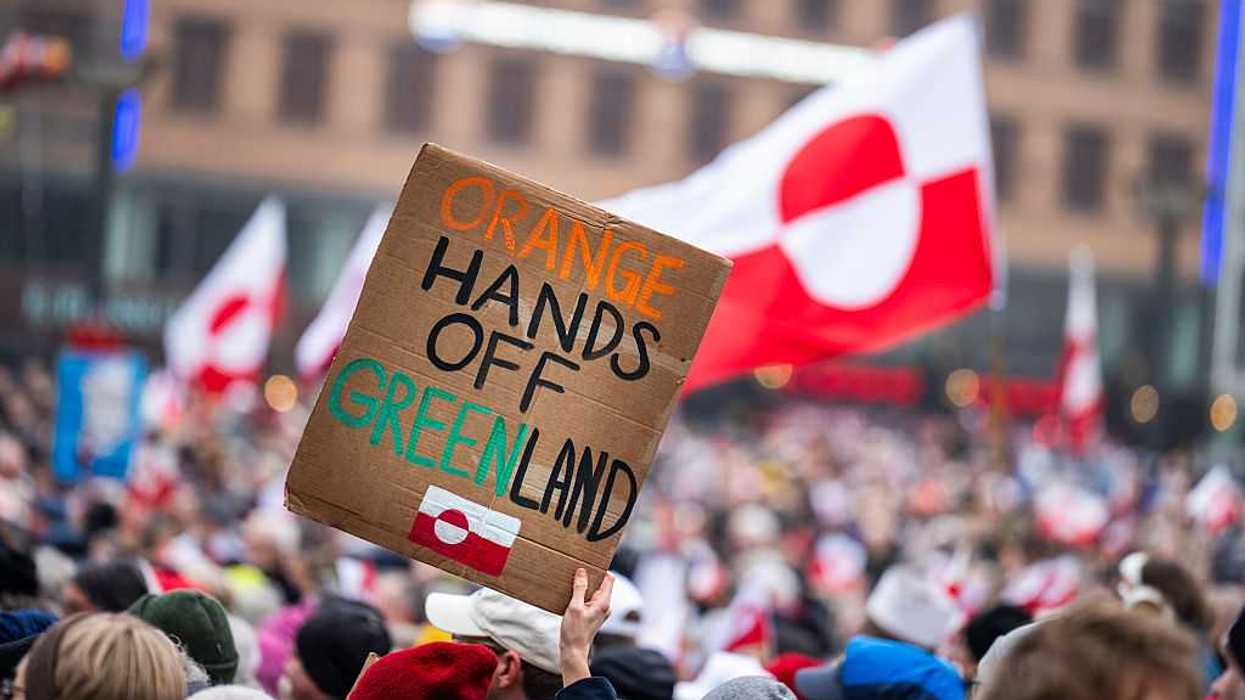
Donald Trump’s renewed fixation on acquiring Greenland — including talk of unilateral action and military options — should have triggered a full‑throated response from Congress. Not because Greenland itself is the central issue, but because the idea of seizing territory from a NATO ally strikes at the heart of the post‑war democratic order the United States helped build. Denmark reacted with disbelief. Greenlandic leaders asserted their autonomy. NATO partners expressed alarm. As NATO Secretary‑General Mark Rutte put it, allies are working to “make sure that the Arctic is safe,” even as he declined to “publicly address a dispute between NATO allies.” And Greenland’s own prime minister was even more direct: “We choose NATO. We choose the Kingdom of Denmark. We choose the EU.”
Yet in Washington, the initial reaction from Republican members of Congress has been astonishingly muted. This silence is significant because congressional inaction or reluctance to speak up can imply tacit approval or indifference, undermining democratic principles. When leaders choose silence over confrontation, they risk eroding the guardrails of governance, leaving democracy vulnerable to authoritarian impulses.
A handful of Republicans did speak up. House Speaker Mike Johnson called military action “not appropriate.” Senate Majority Leader John Thune said he did not see such an option as “on the table”.
Thom Tillis emphasized Greenland as an ally, not an asset, and warned that Congress would “lock arms” to prevent unilateral military action. “It's great for Putin, Xi, and other adversaries who want to see NATO divided,” and added, “It hurts the legacy of President Trump and undercuts all the work he has done to strengthen the NATO alliance over the years.” The senator from North Carolina also issued a joint statement alongside Democratic Sen. Shaheen, his co-chair on the bipartisan Senate NATO Observer Group.
Another member of the bi-partisan delegation, Senator Lisa Murkowski, added her voice, stating, “These tariffs are unnecessary, punitive, and a profound mistake. They will push our core European allies further away while doing nothing to advance U.S. national security.”
Representative Don Bacon dismissed the idea as “the dumbest thing I’ve ever heard,” adding, “ This is appalling. Greenland is a NATO ally. Denmark is one of our best friends… so the way we’re treating them is really demeaning and it has no upside,”
But in the days since, a few more Republican voices have joined them and their language has been even sharper. Senator Roger Wicker, the ranking Republican on Armed Services, said the entire topic “should be dropped,” warning that any attempt to seize Greenland would damage U.S. alliances. Senator Susan Collins called the notion of taking Greenland “completely inappropriate.” And Senator Mitch McConnell, long associated with the institutionalist wing of his party, warned that such actions would trample the sovereignty and trust of America’s allies and amount to “catastrophic strategic self‑harm.”
On Sunday Rand Paul added his disapproval of tariffs the President imposing unilateral tariffs NATO allies saying he should not be able to “write up; new taxes and threaten them any time he wishes”
On Face the Nation Congressman Mike Turner from Ohio’s 8th district who heads the U.S. delegation to NATO”S Parliamentary Assembly questioned Trump's authority saying “There certainly is no authority that the President has to use military force to seize territory from a NATO country. And certainly this is problematic that the President has made this statement and has caused tension among the alliance,”
Ten voices. Out of more than 260 Republicans in Congress.The question is not why these ten spoke up. The question is why so few others have not. There are several possible reasons for this silence among the majority. Some might genuinely share Trump's perspective and align with his approach to international relations. Others might disagree but fear the political repercussions of voicing their opposition. There is also the possibility that many have become desensitized to the shocking nature of Trump's propositions, which undermines the proactive stance Congress could take.
This moment echoes themes I’ve written about throughout the past year. In one column, I warned that “democracies rarely fall in a single dramatic moment; they erode through a series of silences.” In another, I described how “the refusal to confront wrongdoing becomes its own form of complicity.” And in a piece reflecting on civic courage, I wrote that “the test of leadership is not whether one speaks when it is easy, but whether one speaks when silence
is safer.”
Those lines were not written with Greenland in mind. Yet they fit this moment with uncomfortable precision.
This is not a matter of ideology. One does not need a foreign‑policy briefing to understand why the United States cannot simply seize land from Denmark. Nor is this a matter of legislative complexity. No member of Congress needs a classified memo to grasp why threatening a NATO partner undermines the very alliance that has kept the peace for 75 years.
So what explains the silence?
Some Republicans may genuinely share Trump’s transactional view of alliances, his belief that American power is best expressed through dominance rather than partnership, and his willingness to test the boundaries of international norms.
Others may not agree at all but fear the political consequences of saying so. The modern GOP has become a party where dissent is punished swiftly, where primaries are weaponized, and where loyalty to the leader is often treated as synonymous with loyalty to the party itself.
But there is a third possibility, and it may be the most troubling: that many have grown numb. Numb to the shock value of Trump’s statements. Numb to the erosion of guardrails. Numb to the idea that Congress has a constitutional responsibility to check executive overreach, not merely comment on it when convenient.
What I do know is that the history of our nation shows that when our ideals are under threat, people have risen to the moment, whether through resistance, community‑building, or legislative change. That pattern is woven into American history.
In a Fulcrum piece earlier this year, I wrote that “the history of our nation shows us that when our ideals are under threat people have risen to the moment.” The Greenland episode is a case study in that truth. Republicans who choose to speak up may well pay a political price, but their legacy of standing for what is right will endure. Those who reject Trump’s stance on Greenland while their colleagues remain silent will be remembered as the true patriots — the ones who placed constitutional responsibility above political convenience.
And for those who remain silent, that silence speaks volumes. It reveals how fear of backlash, of primaries, of Trump himself, now outweighs the principles that have guided our nation for generations. Tacit agreement through silence is no different from explicit endorsement; in either case, it signals a disregard for defending our alliances, our democratic commitments, and our role in the world as a beacon of stability and truth. Now more than ever, citizens must stay engaged: by staying informed, contacting their representatives, voting, and participating in civic conversations. Only through active involvement can we hold leaders accountable and ensure that democratic values prevail.
If by repeatedly calling attention to this pattern, this drift away from constitutional responsibility, this willingness to look away when the stakes are highest means I am guilty of “Trump Derangement Syndrome,” then so be it. I would rather be accused of caring too much about democracy than be remembered for staying silent when it mattered.David L. Nevins is the publisher of The Fulcrum and co-founder and board chairman of the Bridge Alliance Education Fund.









The President Invited Iran to Bomb My Home