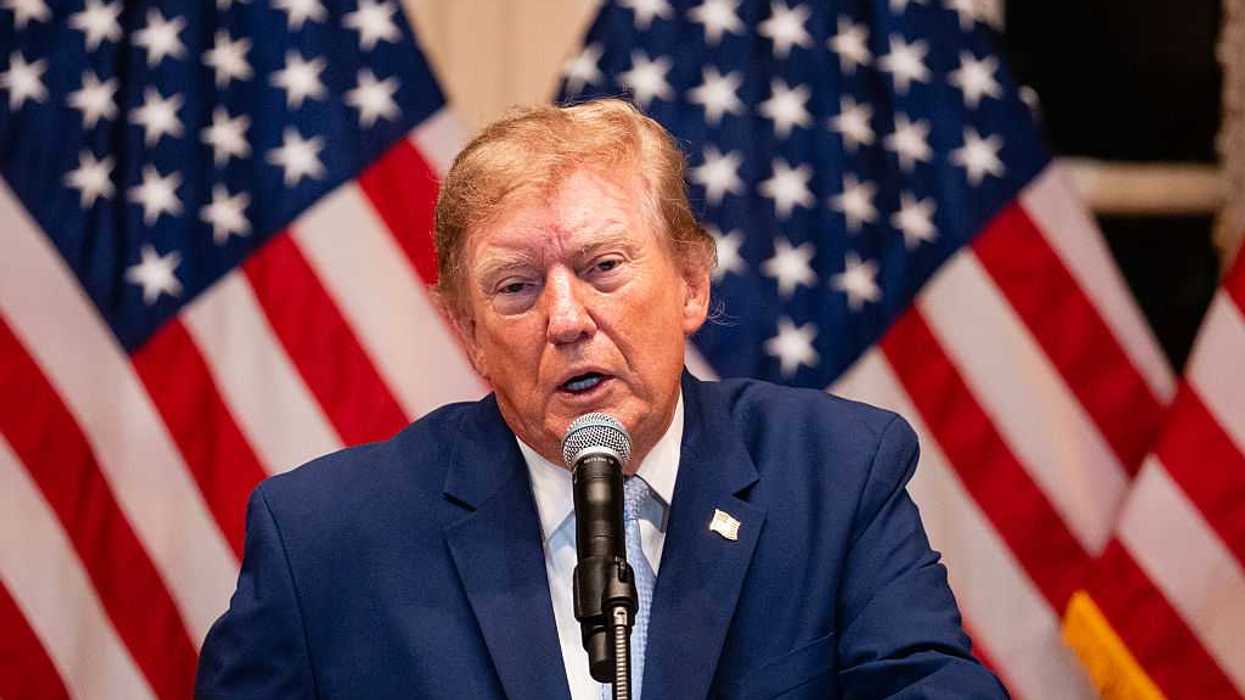


Ninety minutes before his own deadline expired, President Trump agreed to pause his threatened strikes on Iran. The ceasefire was real. The relief was understandable. And none of it changes what happened.
In the days leading up to Tuesday’s deadline, the President of the United States threatened to destroy “every” bridge and power plant in Iran. He warned that “a whole civilization will die tonight, never to be brought back again." He said Iran “can be taken out” in a single night. These were not the ravings of a fringe provocateur. They were statements of declared intent from the commander-in-chief of the most powerful military on earth, broadcast to the world.
Legal experts were unambiguous. More than 100 lawyers and legal scholars signed an open letter through Just Security, warning that intentional strikes on civilian infrastructure violate international humanitarian law. The International Committee of the Red Cross issued a public statement: “Deliberate threats, whether in rhetoric or in action, against essential civilian infrastructure and nuclear facilities must not become the new norm in warfare.” The New York Times, citing historians and former U.S. officials, noted that no recent American president had spoken so openly about committing potential war crimes. Charli Carpenter, a professor of political science and legal studies at the University of Massachusetts Amherst, warned that if Trump followed through, lower-ranking service members, and not the president, would bear the greatest legal exposure.
Trump’s own response to this legal consensus was telling. Asked directly at a White House press conference whether his threats amounted to war crimes, Trump answered: “You know the war crime? The war crime is allowing Iran to have a nuclear weapon.” When a New York Times reporter raised the Geneva Conventions specifically, Trump responded, “I hope I don’t have to do it,” and then attacked the paper’s credibility. Press Secretary Leavitt, asked whether the president might use nuclear weapons, said: “Only the President knows where things stand and what he will do.” Secretary of State Rubio walked away from the same question. This was not an aberration. The administration had already been firing the top uniformed legal officers known as judge advocates general and repeatedly circumventing traditional routes for military legal advice, dismantling the institutional guardrails designed to prevent exactly this kind of threat before it was ever made.
That is not a democracy with functioning guardrails. That is a democracy in the middle of a stress test it may be failing.
Congress has been in recess since March 27. As Trump threatened to eradicate 90 million people, most lawmakers concluded the wisest response was silence. Speaker Johnson declined to comment while colleagues posted about Easter egg rolls and frosty weather back home. Only one House Republican, Rep. Nathaniel Moran of Texas, publicly objected: “I do not support the destruction of a ‘whole civilization.’ That is not who we are.” Rep. Don Bacon called it “negotiating Trump style — reckless words,” but said he wanted to see the regime buckle. Rep. Ted Lieu, a senior House Democrat, went further, calling on the Pentagon not to obey any orders to eradicate a “whole civilization” and warning troops directly: “If you commit war crimes, the next Administration will prosecute you.” Democrats erupted — former Speaker Pelosi called for invoking the 25th Amendment, ranking members of the Senate Armed Services and Foreign Relations committees called the threats a war crime, and some members introduced articles of impeachment, but none of it moved the needle. Both chambers had already rejected multiple war powers resolutions along mostly party lines, and the institutional mechanisms designed for exactly this moment remained frozen.
The consequences of that failure don’t fall on the president. “The greater responsibility lies with the president and civilian defense officials,” Carpenter wrote, “as well as Congress, whose job is to hold the president accountable to ensure troops receive only lawful orders.” When Congress fails to do that, it isn’t just a failure of democratic norms. It puts the troops themselves in legal and moral jeopardy.
America’s allies have been nearly as quiet. Several Gulf nations privately warned the administration against such strikes, according to CNN, but most avoided any public rebuke. The countries that did speak — Pakistan, Egypt, Turkey — worked as mediators, not as moral voices. The international community managed to help broker a ceasefire. It did not manage to say, clearly and collectively, that what was threatened was wrong.
This is the accountability gap that civic democracy advocates should be naming plainly. The legal framework exists. The evidence of threatened conduct is public and undisputed. What is absent is the institutional will — in Congress, among allies, in the cabinet — to treat the threat of war crimes as something that demands a response regardless of whether the bombs actually fell. That silence is itself a form of permission.
That gap is now painfully visible again. The Islamabad talks — the first direct U.S.-Iran engagement since 2015 and the highest-level since the 1979 Islamic Revolution — collapsed on Sunday after 21 hours without an agreement. Vance left Pakistan, saying Iran had “chosen not to accept our terms.” Within hours, Trump threatened a full naval blockade. The ceasefire that seemed like a reprieve has become, instead, a brief intermission.
We are back where we started: a president who threatened to annihilate a civilization, with no formal accountability from Congress, no unified rebuke from allies, and no consequences for the threats themselves. The bombs didn’t fall last Tuesday. They may yet fall this week. Every actor in the world now knows that a threat of this magnitude can pass without consequence, and that the institutions designed to prevent it will post about Easter egg rolls instead.
Kristina Becvar is Senior Advisor to the Bridge Alliance Education Fund. She previously served as the Executive Director of the Bridge Alliance,