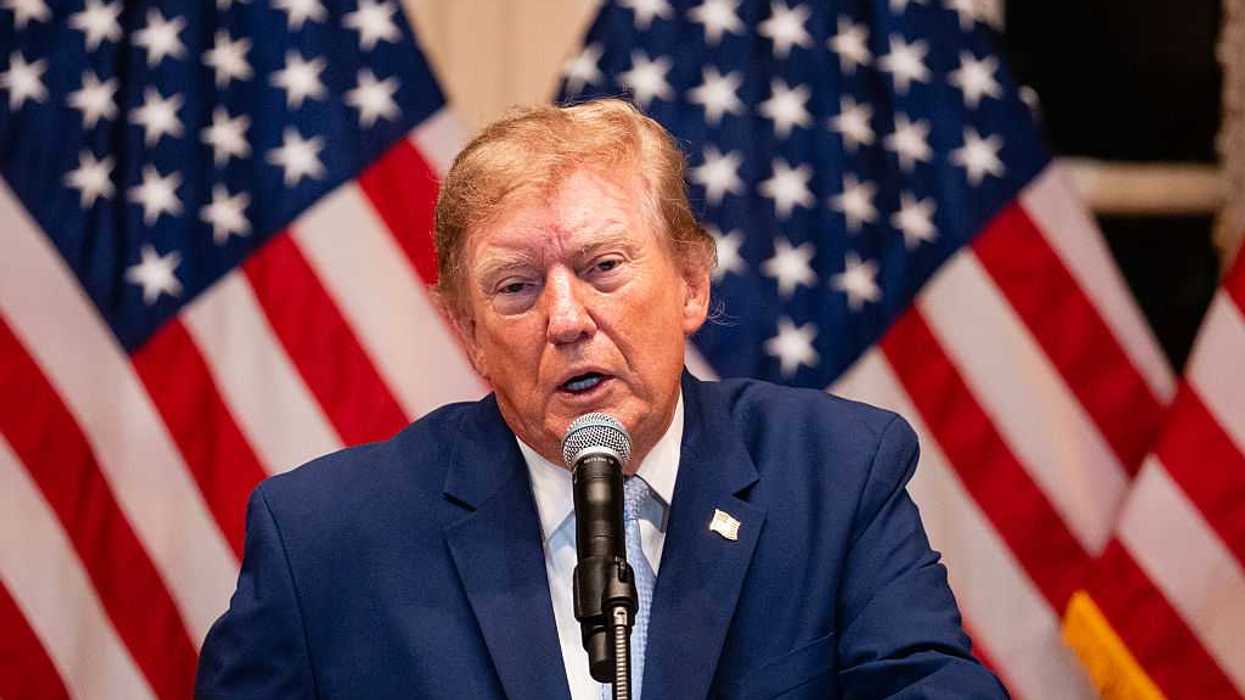
On January 14, President Trump sat down for a thirty-minute interview with Reuters, the latest in a series of interviews with major news outlets. The interview covered a wide range of subjects, from Ukraine and Iran to inflation at home and dissent within his own party.
As is often the case with the president, he didn’t hold back. He offered many opinions without substantiating any of them and, talking about the 2026 congressional elections, said, “When you think of it, we shouldn’t even have an election.”
However, what caught my attention was something else. It was not so much about Trump’s policy positions as his attitude and conception of his role.
To put it simply, Trump portrayed himself as an “I don’t care” president. No other American president has ever embraced that view as their governing philosophy, and no one has ever been so ready to let everyone know.
That attitude is not compatible with leadership in a constitutional democracy. The Founders made clear that “the president, as the only official elected by the people as a whole, had not only the constitutional but the moral responsibility to act on their behalf—in the interest of the salus populi.”
In addition, someone who does not care is unreachable. Indifference is itself a kind of power, but it is hard to reconcile such a disposition with the requirements of leadership in a constitutional democracy.
Any president’s disposition or conception of leadership is consequential because, as the political scientist James David Barber explains, “The presidency is a peculiar office. The founding fathers left it extraordinarily loose in definition, partly because they trusted George Washington to invent a tradition as he went along.”
“It is,” Barber says, “an institution made a piece at a time by successive men in the White House….(E)very President’s mind and demeanor has left its mark on a heritage still in lively development.” Their mind and demeanor “interact… with the power situation he faces and the national ‘climate of expectations’ dominant at the time he serves. The tuning, the resonance—or lack of it—between these external factors and his personality sets in motion the dynamics of his presidency.”
Another word, Barber argues, that describes a president’s mind and demeanor is “character.” Character is the way “the president orients himself toward life – not for the moment, but enduringly. Character is the person’s stance as he confronts experience.“
The president’s character and his “I don’t care” attitude were made clear throughout his Reuters interview. For example, when he was asked about a poll showing that the American public opposes taking over Greenland, he dismissed the results as “fake.”
He seemed resigned to the fact that, as he put it, “A lot of times, you can't convince a voter….” The president said. “You have to just do what's right. And then a lot of the things I did were not really politically popular. They turned out to be when it worked out so well.”
The famous English political philosopher, Edmund Burke, identified two conceptions of representation in democratic systems. In one, the representative simply channels the views of the people.
The other kind of representation involves acting as a “trustee.” A trustee exercises his own judgment and does not worry about how their constituents feel about each particular issue.
As Burke put it, “Your representative owes you, not his industry only, but his judgment; and he betrays, instead of serving you, if he sacrifices it to your opinion.” And over the course of American history, some presidents have acted as “delegates,” others as “trustees.”
But Burke did not anticipate someone like Trump, who is so dismissive of others' views.
That dismissiveness was evident throughout the Reuters interview. When he was asked about concerns expressed by Republicans in the Senate about the Justice Department’s investigation of Federal Reserve Chair Jerome Powell, the president said, “I don't care. There's nothing to say. They should be loyal.”
After being told what JPMorgan CEO Jamie Dimon said about the potentially catastrophic impact of that investigation, Trump responded, "I don't care what he says."
A week before the Reuters interview, Trump again showed his “I don’t care” attitude in an interview with four New York Times reporters. This time, in the context of a discussion of his role on the world stage.
The Times reporters asked him if “there were any limits on his global powers.” The president’s response was shocking.
“Yeah,” he told them, “there is one thing. My own morality. My own mind. It’s the only thing that can stop me.”
This “I don’t care about anything but me” response is a symptom of what the journalist and historian John MacArthur says is the president’s “only point of reference… himself.” That is why, MacArthur explains, “he makes no attempt even at faking interest in other people, since he can’t really see them from his self-centered position.”
That is why Trump is unembarrassed to put his "I don’t care" attitude on display and to cast aside unfavorable poll results or what other members of his political party say. Nothing matters to Trump but Trump.
As he explained in the Times interview, “I don’t need international law,” and whether international law could ever constrain him, “depends on what your definition of international law is.” At a later point, when he was pressed to explain why he wanted to take over Greenland, he again made clear that his needs and desires define his approach to the world.
Taking over Greenland was important, the president suggested: “Because that’s what I feel is psychologically needed for success. I think that ownership gives you a thing that you can’t do, whether you’re talking about a lease or a treaty. Ownership gives you things and elements that you can’t get from just signing a document.”
Trump’s “I don’t care” approach to governance fits a presidential style that Professor Barber called “Active-negative.” Such a style is marked by constant “power-seeking,” and life is defined as a “hard struggle to achieve and hold power.”
Such a president, Barber suggests, as if describing Trump, “has a persistent problem in managing his aggressive feelings.”
And Barber argues, an active/negative type president “is, in the first place, much taken up with self-concern. His attention keeps returning to himself, his problems, how is he doing, as if he were forever watching himself. The character of that attention is primarily evaluative with respect to power. Am I winning or losing, gaining or falling?”
Again, that seems to fit Trump to a tee.
This president or any president can’t do their job well if they don’t care about anything but themselves. And in the case of President Trump, the American people seem to be noticing.
Only 37% of Americans today say that the phrase “cares about the needs of ordinary people” describes Trump well. Sadly, Donald Trump likely doesn’t care about that either.
Democracy is not endangered by disagreements about policy, but it cannot survive if its leaders do not put the public’s health and well-being first.
Austin Sarat is the William Nelson Cromwell professor of jurisprudence and political science at Amherst College.