
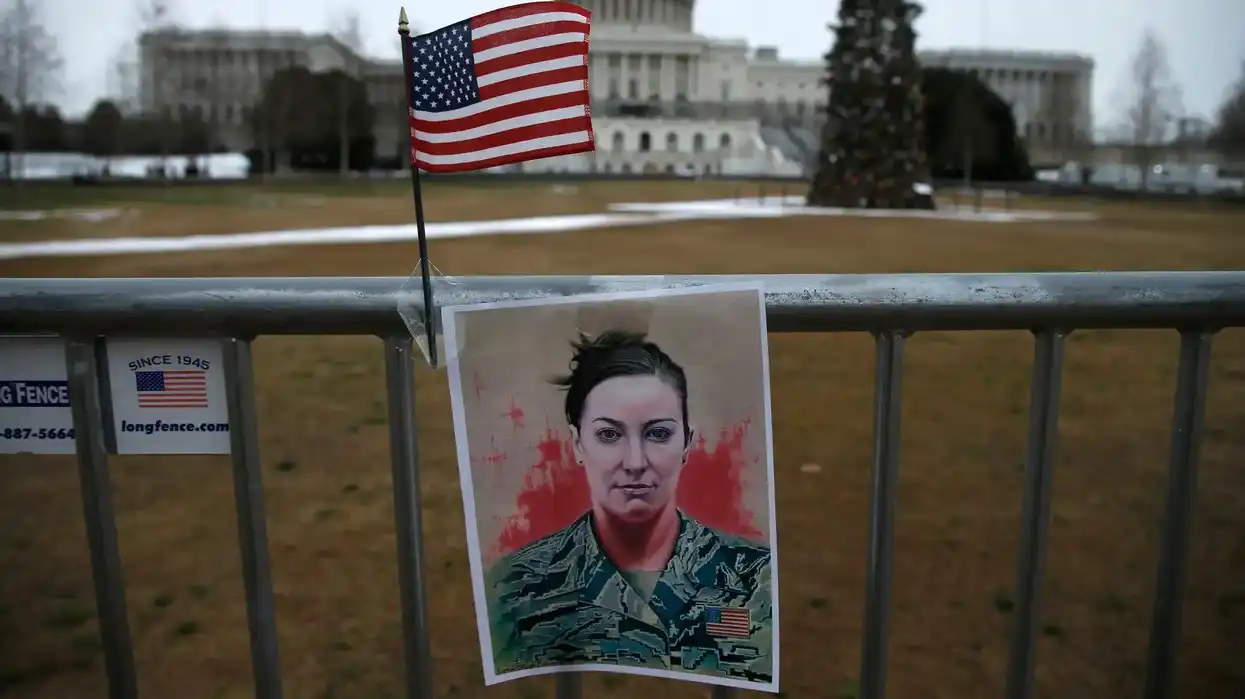
In the wake of the insurrection at the Capitol on January 6, 2021, President Donald Trump quickly took up the cause of a 35-year-old veteran named Ashli Babbitt.
“Who killed Ashli Babbitt?” he asked in a one-sentence statement on July 1, 2021.
“An innocent, wonderful, incredible woman, a military woman,” Trump said during a Fox News interview a few weeks later. Not everyone who went to the Capitol broke into the building, but she did. With a Trump flag draped over her shoulders like a superhero’s cape, Babbitt was part of the group who tried to gain access to the Speaker’s Lobby, just outside the House chamber. Another rioter smashed glass. As Babbitt tried to crawl through, a Capitol Police officer shot her from inside the lobby.
Video footage from the day shows Babbitt falling backward into the crowd as blood pours out of her mouth. After the shooting, many rioters began to flee the Capitol grounds. Babbitt was transported to Washington Hospital Center. She was declared dead upon arrival.
The officer who killed Babbitt was cleared of wrongdoing; Lt. Michael Byrd potentially saved lives by stopping the mob, lawmakers and police said.
But her death gave Trump’s Make America Great Again movement something it needed: a martyr.
Religiosity moves in
 On Jan. 6, 2021, a political rally turned into an insurrection as Trump supporters stormed the Capitol in an attempt to stop the certification of electoral votes. (John Minchillo/AP Photo)
A religious frame has been present in Trump’s politics since his rallies in the leadup to the 2016 election.
Jeffrey Sharlet, a veteran journalist and professor at Dartmouth College who was an early chronicler of the rise of Trumpism and its ties to religiosity, said these rallies were shaped by the prosperity gospel, a branch of Protestantism rooted in the supposition that, effectively, God wants you to be rich.
In 2020, the religious tenor was still there — but it had shifted to a more conspiratorial approach. Trump stopped merely “winking at QAnon” and began “invoking that level of conspiratorial thinking that has been absorbed into the DNA of the movement,” Sharlet said.
Before Babbitt’s death, Sharlet said, Trump had already been working to incorporate martyrs into his rhetoric, invoking a list of names, usually people who had been killed by immigrants in the country without legal status. They would typically fall into two categories, he said: “blonde White women and promising young Black men” — think Jamiel Shaw Jr., a rising football star in the midst of college applications who was shot and killed by a gang member who was in the country illegally, orSarah Root, who was killed by an undocumented drunk driver the day after her graduation from college.
Sharlet calls Babbitt “a perfect storm”: a White woman killed on camera in footage seen by millions, a Black man — the Capitol police officer — responsible for her death.
“That changed everything,” Sharlet said. “The first real martyr who really takes hold of Trumpism is a woman, and it gives the movement a real religiosity.”
And it set the stage for Trump to ascend into a kind of religious figure himself after a would-be assassin shot him in Butler, Pennsylvania, in July 2024.
“Every martyr disappears into the cult of personality,” Sharlet said. “She was a placeholder. She keeps the cross warm until Trump gets up there and he’s the martyr. Now, he’s the martyr for us all — but it started with a certain appeal to women.”
Martyrs can’t speak
Babbitt was an active participant in the insurrection — but that didn’t mean she couldn’t be reassigned the role of someone who needed protecting.
Sharlet recalled watching videos of Trump supporters talking about Babbitt in the wake of her death: “They’re aging her backward, they’re lowering her weight, they’re lowering her height, they’re turning her into a little girl.”
It was a blueprint for what was to come, he said of Babbitt: “The blondeness is important, the smallness is important, but so is the camouflage of being a veteran.”
Her race, too, was important, Sharlet said.
“It’s about the Whiteness of things. It’s not enough for them that a woman be murdered,” he said. “She has to be a little girl. She has to be White.”
Meghan Tschanz, a former missionary who has emerged as a critic of patriarchal systems in evangelical Christianity, drew a connection between Babbitt and Laken Riley, a college student whose murder by an immigrant who was in the country illegally was highlighted by Trump. Both women’s deaths became part of a larger narrative — one designed to accomplish a political goal, not mourn the victims.
Tschanz, who lives in Athens, Georgia — where Riley was killed — stressed that criticizing the politicization of Riley’s death is in no way a dismissal of the reality and severity of her killing. Rather, she said, politicization can dilute the pain of the loss in service to a larger narrative.
“Again and again, we see women die and the response isn’t, ‘Let’s make it so women don’t die.’ It’s, ‘Let’s make it so that I can use this to further my narrative that immigrants are evil,’” she said.
Riley’s father, Jason Riley — a Trump supporter — told NBC News about the pain of watching his daughter become a political tagline after Rep. Marjorie Taylor Greene of Georgia, at the time a strong Trump ally, heckled President Joe Biden during his State of the Union speech in 2024, urging him to say Riley’s name.
“I think it’s being used politically to get those votes. It makes me angry. I feel like, you know, they’re just using my daughter’s name for that. And she was much better than that, and she should be raised up for the person that she is,” Jason Riley said. “She was an angel.”
It’s a dynamic also echoed in Babbitt’s death. Though Babbitt’s mother, Michelle Witthoeft, emerged as a leading advocate for the release of those who were arrested for their actions on January 6, she also has publicly grappled with the way in which her daughter’s death became something other than an acute family tragedy.
Witthoeft told The Washington Post in 2021, “Half the country loves her and half the country hates her,” she said. “It’s weird to have your child belong to the world.”
For Trump, Riley’s and Babbitt’s deaths helped reinforce the message that women’s lives are in danger and that they need to be saved — something he emphasized in his campaigns as he painted immigrants and his political opponents as threats.
“It all plays into the fears and vulnerabilities that women have to navigate, which is that women are more vulnerable to sexual and gender-based violence and women are tasked culturally with caring for the home and for their children,” said Hilary Matfess, an assistant professor at the University of Denver and the co-author of an analysis done by the Program on Extremism at George Washington University on gender and the January 6 insurrection. “So this message of scary immigrants are going to come in and destroy your communities with drugs and rape your women and children is intended to strike fear into a very specific demographic — namely, suburban White women.”
Matfess pointed to how the role of martyr cemented a view of Babbitt for Trump’s followers. She became someone who needed protecting, a figure whose memory is in need of constant, everlasting protection.
“Being put on a pedestal means you can’t move around too much,” Matfess said.
The ‘protection racket’
 Michelle Witthoeft, Ashli Babbitt’s mother, participates in a demonstration in support of insurrectionists who were arrested and charged following the January 6, 2021 attack on the U.S. Capitol. (Tasos Katopodis/Getty Images)
Matfess said there is a long-standing academic notion of the “protection racket,” in which a government offers protection from an imagined threat to deflect from the threat posed by the government itself. It’s something that can be used to keep women in subservient roles — and thus effectively in need of some form of protection from others.
“The Trump administration is not saying, ‘Wow, we should really expand access to prenatal health care’ or ‘We need more resources for women that are victims of domestic violence,’ because it is not about protecting women,” she said. “It’s about protecting certain men’s ability to wield power and influence under the banner of protection.”
Babbitt’s death in some ways challenged the narrative, too — she was part of the group trying to stop the certification of the election, not sitting by.
Matfess noted the ways that the Proud Boys — the far-right, all-men neo-fascist group that have become rigorous defenders of Trump and his agenda — insist on the fact that there are in fact no Proud Girls, often suggesting that the best way women can support the politics they espouse is by staying home and reproducing.
Matfess points to early rumors from within the far right that Babbitt was part of a false flag mission — evidence that the movement had to grapple with a woman who was attacking, not asking for protection.
“There’s a lot of utility to narratives that talk of attacks against women and children, and so it becomes that once they decided it wasn’t a false flag, that she was there of her own political beliefs, it becomes a compelling narrative of a woman sacrificing herself for this movement. Whether or not the movement would have been kind to her had she lived is besides the point,” Matfess said.
“The memorialization takes away the kind of difficult questions of how this movement would deal with women who are taking on more transgressive gender roles. Once someone’s a hero, you can leave it at that.”
How Trump turned a January 6 death into the politics of ‘protecting women’ was first published by The19th and republished with permission.
Jennifer Gerson is a reporter at The 19th.