


Skip to content
Search

Latest Stories

Follow Us:
Top Stories

Congress Poised to Advance Bill Providing ALS Patients Their ‘”Best Chance’” at a Cure

News

Congress Poised to Advance Bill Providing ALS Patients Their ‘”Best Chance’” at a Cure

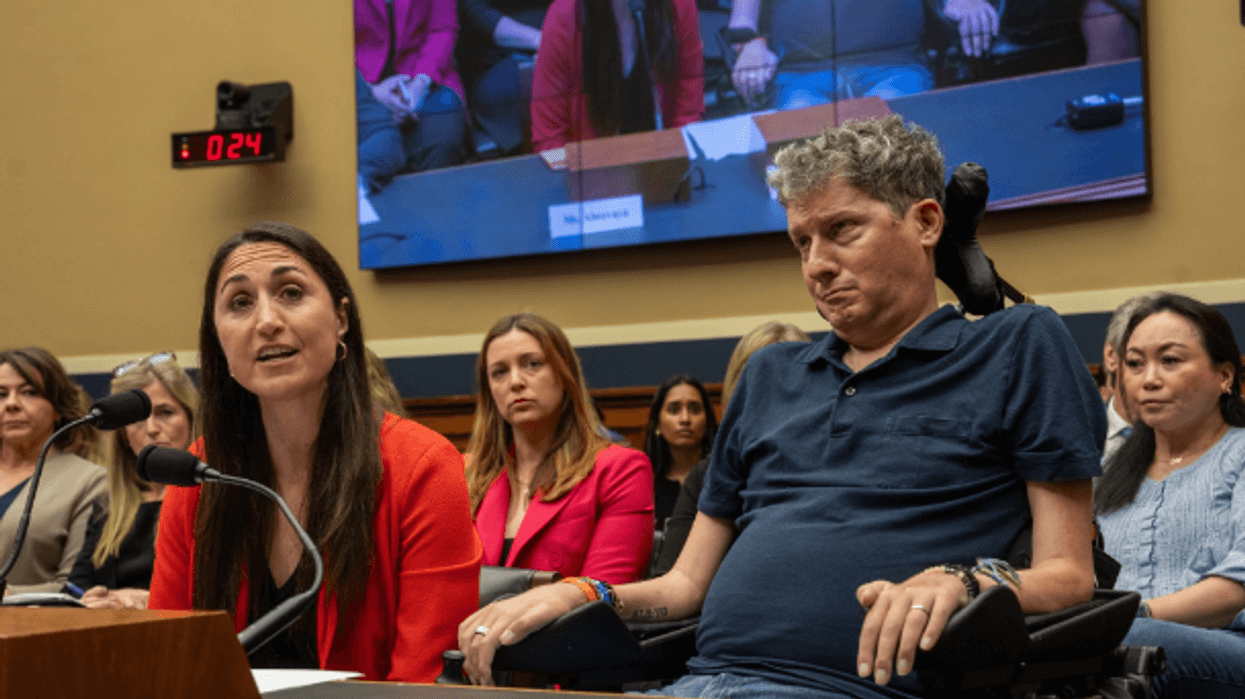
Sandra Abrevaya and Brian Wallach give testimony at an Apr. 15 House Subcommittee hearing

(Photo by Stephen Voss, courtesy of I AM ALS)

WASHINGTON — Brian Wallach spoke with his eyes.

The Illinois native and co-founder of I AM ALS has been living with ALS for eight years and can no longer use his voice. Instead, Wallach, 45, types with his eyes, then generates speech by applying artificial intelligence to old recordings of his voice.


He used that software on Wednesday during a hearing held by the House Committee on Energy and Commerce's Health Subcommittee to testify for a bill that would expand investigational therapies treating the disease.

“It is the single biggest investment in ALS research,” Wallach said, as his wife, caregiver, and co-founder, Sandra Abrevaya, gripped his hand.

“Rereauthorizing it is our best chance of finding a cure,” said Wallach, as his wife, caregiver, and co-founder Sandra Abrevaya gripped his hand.

The proposal, introduced in the House earlier this month by Rep. Mike Quigley, D-Ill., would reauthorize a 2021 law bill that authorizedallocated $100 million annually from 2022 to 2026 to study ALS and facilitate more investigational therapies for patients, who typically have a life expectancy of two to five years following diagnosis, said Sheri Strahl, President and CEO of ALS Network.

The measure has drawn broad, bipartisan support with 13 co-sponsors on either side of the aisle. Health Subcommittee Chair Rep. Morgan Griffith, R-Va., predicted a “strong vote” in its favor, he said Wednesday at a press briefing. That would move the bill out of committee and put it to the Senate.

“This is not Republican or Democrat. This is Congress doing its job together, which we can do on occasion,” Griffith told Medill News Service.

Health Subcommittee Chair Rep. Morgan Griffith, R-Va., speaks at an Apr. 15 hearing (Photo by Stephen Voss, courtesy of I AM ALS)

That would be welcome news for ALS patients, who are often restricted from traditional clinical trials, said Strahl. To participate, patients usually need to have a certain vital capacity and to have been diagnosed within the last two years.

“It takes a very long time for people to get diagnosed, the range is 11 months to 20 months,” Strahl said. “You only have four months to get your arms around the research landscape, find a clinical trial, get screened for a clinical trial, and participate.”

The bill would give those shut out of clinical trials access to investigational therapies, Strahl said. Sandra Abrevaya credits one such therapy with helping her husband live eight years past diagnosis.

“We've tried to take advantage of every opportunity we can, both with clinical trials and expanded access programs,” Abrevaya told Medill News Service. “We really do believe that Brian is alive today, in part, because we've leaned in to promising new treatments.”

The proposal would also fund and invest in a study researching the biomarkers of ALS that could allow quicker diagnosis across multiple degenerative diseases, including Parkinson’s, Alzheimer’s, and Huntington’s diseases.

The legislation’s broad applicability and many Congress members’ personal connections to these diseases propelled the legislation forward at what, for Congress, has been breakneck speed, Quigley said.

“It's so important to think of this as the way to get to all the neurodegenerative diseases,” Quigley told Medill News Service. “Some of the best bills get caught up for reasons that defy reason. Somehow, this caught lightning in a bottle.”

Zara Norman is a graduate student reporter covering health for Medill News Service.


Read More

The Founders Built Safeguards. Our Politics Rendered Them Useless
selective focus photo of U.S.A. flag
Photo by Andrew Ruiz on Unsplash

The Founders Built Safeguards. Our Politics Rendered Them Useless

The men who gathered in Philadelphia in 1787 were students of history, and it taught them a singular lesson: power corrupts, and unchecked power can destroy a republic.

They designed our experiment with overlapping safeguards to ensure that no single faction, branch, or man could hold the nation hostage. What remained unresolved was agency: who, exactly, can determine when to trigger those safeguards? History has since exposed this as the system's deepest vulnerability.

Keep Reading Show less
House Bill Pushes Bipartisan Effort to Tackle Federal Benefits Fraud, Refocusing from Immigration

Expert witnesses testify on the issues facing federal benefits programs run by states at a House Government Operations hearing on Wednesday, April 15, 2026.

(Photo by Naisha Roy | Medill News Service)

House Bill Pushes Bipartisan Effort to Tackle Federal Benefits Fraud, Refocusing from Immigration

WASHINGTON — Rep. Pete Sessions, R-Texas, introduced a bill Wednesday morning that would create a permanent U.S. Treasury Inspector General position for fraud accountability as part of a broader effort to crack down on the misuse of federal benefits.

The bill would offer an alternative, bipartisan way to prevent federal benefits fraud, after several months of politically charged congressional hearings.

Keep Reading Show less
Trump Wants To Kill Your Moon Joy

In this handout image provided by NASA, As the Artemis II crew flew over the terminator, the astronauts described this boundary between day and night as "anything but a straight line." Crater rims along the terminator stand out as "islands" in the night.

Photo by NASA via Getty Images

Trump Wants To Kill Your Moon Joy

Just last week, four astronauts left Earth’s orbit, journeyed around the moon, and returned safely home. In the midst of new lows for humanity–like someone threatening to destroy an entire civilization when they have the resources to actually do it–the human race is simultaneously reaching new heights. It is marvelous, miraculous, and a milestone for all humans to celebrate. It is almost unthinkable, however, that at this moment, as the world rallies behind NASA in amazement, Trump is dismantling many of its programs, threatening to slash its budget, and generally working to kill your “moon joy.” Houston, we have a problem.

Artemis II hit close to home for me. The astronauts splashed down off the coast of San Diego, where I was stationed as a Navy pilot for the last eight years. More astronauts come from Naval aviation than anywhere else, and I am proud to wear the same wings of gold as two members of the crew. Following multiple deployments as a pilot, I certified aviation departments of surface vessels and helped deploy tactical air control squadrons aboard them; one of those vessels is where the astronauts landed after getting scooped out of the ocean by H-60 helicopters, the aircraft I flew during my service. All to say: I know intimately the preparation, technical rigor, talent, and coordination required for even relatively insignificant pieces of a mission of astronomical proportions. If we want to shoot for the stars, then we'd better recommit ourselves to what gets us there: science and DEI.

Keep Reading Show less
Experts Say Heavy Use of Reconciliation Bills Could Backfire
white concrete building under cloudy sky during daytime
Photo by Harold Mendoza on Unsplash

Experts Say Heavy Use of Reconciliation Bills Could Backfire

WASHINGTON, DC—As midterm elections take place across the country, Senate Republicans are using the tactic known as “reconciliation” to bypass bipartisan agreements, all before a new Congress takes office.

In the latest example, the GOP-backed reconciliation bill to supplement funding for Immigration and Customs Enforcement and Border Patrol agents is expected to hit President Donald Trump’s desk no later than June first.

Keep Reading Show less