



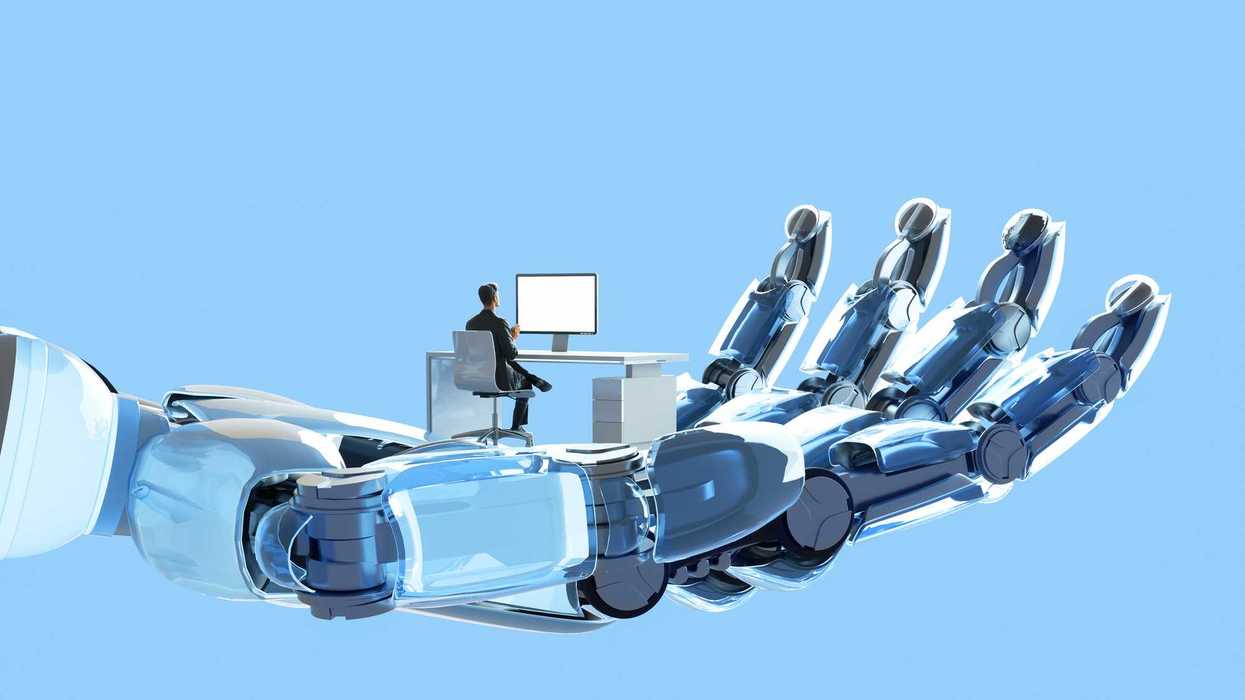

The age of AI will be a revolutionary age. In medicine, engineering, and more, there is the possibility of great benefit to humanity. Consider some Wall Street Journal headlines: “The Quest to Use AI to Help Find New Drugs,” and “Fusion Startup Gets an AI Boost.” Already, AI is a substantial portion of GDP growth.
Yet a rising tide will not lift the boats with holes in their hulls, as Jack Kemp once said. Artificial intelligence is challenging our leaders to think about those possibly left behind. Within the AI community itself, Anthropic CEO Dario Amodei expresses concern that we could see 5-10% GDP growth with 10% unemployment.
We cannot allow this concern about AI’s human costs to go totally unaddressed. “Pull yourself up by only your own bootstraps” is not an appropriate response when there is so much disruption throughout the entire economy—when the owners of capital will thrive as workers and would-be workers struggle. Ideas from both political parties are necessary.
A universal basic income is one possibility being pushed, but the cost may be prohibitive. A decent-sized UBI of $12,000 a year would cost trillions annually. A more realistic approach is needed.
There are two alternate proposals that have not passed Congress in the past, but they could be brought back up for consideration. First is the expansion of a concept called “wage insurance.” The second is an expanded child tax credit. I will contribute a third idea too.
Wage insurance was part of the Trade Adjustment Act’s safety net. A worker 50 or older who lost a job due to foreign trade qualified if the worker found another job paying less (but no more than $50,000). The benefit was half the difference in pay between the old and new jobs, up to $10,000 over two years.
The Obama administration proposed eliminating the trade-impacted requirement. Anyone over age 50 would qualify for wage insurance so long as they were in their previous job for at least three years. The cost was estimated at $3 billion a year. Unlike a universal basic income, Congress could find the savings to offset this spending.
Wage insurance directly addresses the immediate costs of an AI economy. The worker whose career is disrupted by what was only, until recently, science fiction finds a benefit other than only unemployment insurance. The worker may very well never have the old income level again and is approaching retirement. Help for such a person in the throes of capitalism’s “creative destruction” makes sense. We are addressing those in the spaces between what was and what is becoming.
I mentioned an expanded child tax credit as well. Former Sen. Mitt Romney proposed a kind of refundable and advanceable child tax credit—meaning paid even to those who do not owe taxes, and paid monthly before even filing a tax return—of $4,200 per child under age six and $3,000 for other children. This contrasts with the $2,200 per child, with less refundability, under President Donald Trump’s “one big beautiful bill.”
Sen. Romney proposed paying for the cost partly through tax reforms that largely, but not entirely, shift the tax code’s other credits and deductions in a more progressive direction. The “mostly” is why anti-poverty advocates seemed to give the bill two cheers instead of three. Overall, the proposal would net reduce childhood poverty but would cause some families lifted out of poverty to slip right back in.
Still, the Romney proposal could be a countervailing force against AI’s corrosive effects. Even more so if the bill’s pay-for is tipped in an even more progressive direction. We would have a kind of modest universal basic income for families with children. We would be addressing those of greatest need in the economy.
The third suggestion is this: Provide a tax break for work equivalent to the size of what we give to capital. The lower income tax rate for dividend income costs the federal government a little over $40 billion a year. Putting similarly-sized tax relief into workers’ pockets would produce an average tax savings of about $235 per worker.
An extra $235, or for a two-earner family, $470, is not a universal basic income, but it is affordable. The more progressive could very well connect the revenue that can be raised by eliminating the dividend preference to offsetting the cost of lowering the 10% bottom income tax rate, or some other way to put the money in pockets. A more ideologically conservative approach would seek the curtailment or elimination of tax breaks and government programs.
What is important is recognizing that the owners of capital will be great beneficiaries of the AI age. As a matter of public policy, we should look out for labor too. Patch the boat’s holes and let the tide rise. The human cost of not doing anything needs to be addressed along with the fiscal cost of doing something.
Scott Miller is a graduate of Widener School of Law, a former chief of staff in Congress, and the author of 'Christianity & Your Neighbor's Liberty.