


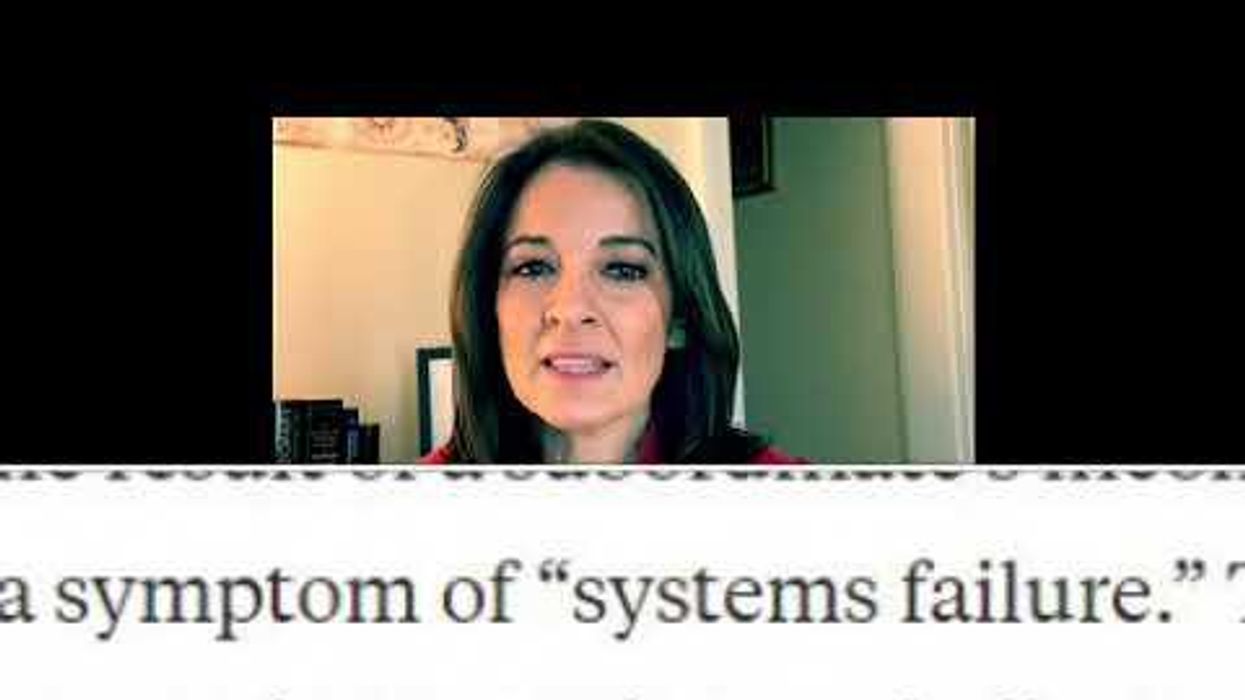

Sheehan is professor of political science and international studies at Iona College and the author of "American Democracy in Crisis: The Case for Rethinking Madisonian Government" (Palgrave Macmillan, 2021).
For all the focus on the health of American democracy today, little attention is being paid to the fundamental challenge we have long faced — the fact that the government is often unable to address the key problems its people are facing. It is unable to deliver for its people.
The battle of the 21st century is the fight between democracy and autocracy. This is a point President Biden has made over and over again. If we are going to win this battle, we have to prove that democracy can deliver.
In his first address to a joint session of Congress in March 2021, Biden said: “The autocrats of the world are betting that our democracy cannot and will not deliver on the most pressing needs of our people.”
He was right.
Which is why it is so important that as we think about the health of the democratic state, we not only focus on issues like the Jan. 6, 2021, insurrection, elections and voting reform, but that we also ask: Why is our government so often unable to deliver for its people? Why does it seem to be in a perpetual state of malaise, stasis and crisis? Why is it so often unable to address the key challenges we are facing?
As both a political scientist and citizen I have asked these questions for some time. And a few years ago I made a discovery, one which profoundly changed my view. I came across it in a most unlikely place: organizational theory, specifically, the work of management guru Peter Drucker.
Drucker, it turns out, spent a number of years trying to understand why organizations often find themselves “stagnating and frustrated, in trouble and often, in a seemingly unmanageable and consistent state of crisis.”
Drucker was most interested in business organizations like IBM and Chrysler, but as he noted, the same phenomenon applies to other types of organs as well — labor unions, hospitals, museums, churches and, yes, governmental agencies and governments themselves.
According to Drucker, most people assume the problem is the people working within the organization. Replace them and the problems will be addressed by new people coming in who are smarter, better equipped or in some way better prepared.
Of course, this seldom turns out to be the case.
This should sound familiar because we see this all the time in the government. Voters, rightly frustrated by their leaders’ failure to address critical problems from gun violence in their schools to climate change and immigration, blame those in office. They seek to replace them in the hopes that the newly installed leaders will be better able to address their problems.
Unfortunately, this is seldom the case. Instead, the fundamental problems of governmental stasis, inaction and stalemate remain because the reasons for the crisis and stagnation are seldom rooted in anything the people in the organization are — or are not — doing.
The problem instead, as Drucker writes, is that the “assumptions on which the organization has been built … no longer fit reality.” These assumptions are what he calls the “theory of the business.”
When an organization that was once successful suddenly seems to find itself stagnated or reeling from one unmanageable crisis to the next, it is suffering from the “symptoms of system’s failure,” an indication that the “theory of the business no longer works” and must be rethought.
In reading Drucker’s work from the perspective of my own discipline, it struck me that we are witnessing similar “symptoms of system’s failure” in the United States. The assumptions on which our country was built (the “theory of the government,” if you will) no longer fits reality and must be re-examined.
To do this we must first answer the question, what are the assumptions on which our system was built?
Fortunately, we don’t have to look too far because our Framers were both prolific and clear when it came to the primary purpose of the system they created.
As James Madison, the Father of the Constitution, wrote in Federalist No. 10, the object of the U.S. government is protectionism — specifically, protection of liberty. It is worth pausing here to remember that liberty is not freedom in general, it is a specific type of freedom, namely freedom from government.
It makes historical sense that the Framers were so focused on protection of liberty.
After all, just a decade prior they fought a vicious war against a king they described as a tyrant.
In an effort to ensure that they didn’t fall sway to another tyrant, they created the Articles of Confederation. Like all confederations, this was a government which had at its centerpiece a weak national government and much more powerful member states.
And unfortunately, like so many confederations, this one imploded (or was replaced under threat of implosion) very quickly.
Under the Articles, the newly empowered state legislatures began to be taken over by what the Framers saw as “mobs” intent on passing laws that were detrimental to basic rights and liberties. Most importantly for our Founders, the right to own property. These included laws designed to abolish debt, inflate currency and otherwise protect the interests of the property-less at the expense of the monied minority.
For the Framers then, our short-lived experience under the Articles showed that they need protection not only from tyrannical monarchs and executives like King George but also tyrannical mobs like the state legislatures.
But how to design a democratic system that could guard against tyranny from both the top and bottom, with the people sovereign?
The Framers found their answer in a book published a quarter century before the Revolution, Montesquieu’s “The Spirit of the Laws.” It was a book that Montesquieu said “damn near killed him” and true to his word, after it was released, he never published again. But he didn’t have to — “Spirit” had an enormous impact around the world, including on the thinking of the Framers.
Montesquieu felt the primary goal of government was to ensure liberty. And in “Spirit” he developed a novel approach to doing this: “ trias politica,” or what we know today as separation of powers.
According to Montesquieu the best way to protect liberty was to divide the political power of the state into three parts: the legislative, the executive and the judicial, and to give each different powers and responsibilities. In the U.S. system, this is what we think of as the horizontal division of power between co-equal branches. The legislature makes the rules and appropriates the funds, the executive enacts and administers the laws, and the judiciary interprets the laws and resolves conflicts.
The Framers not only borrowed this brilliant design from Montesquieu, but brought the idea of separation of powers to a whole new level.
As I sometimes like to say, Madison was Montesquieu on steroids. Not just content to divide power horizontally, he further dispersed power by adopting a system of checks and balances, a bicameral legislature and federalism, amongst other things.
So we know the object of the government was to protect liberty.
And we know that in order to do this, the Framers adopted a system of separated powers. A structure that remains remarkably the same today as it was when established in the late 1780s.
What we need to consider are the ramifications of this hyper-separation and dispersion of power.
On the plus side it does help ensure our liberty and freedom from government. Also on the plus side, it helps ensure that change happens slowly, only after widespread discussion, debate, and input from all parties and all sides. These aren’t the only positives, but they are both worthy and critical.
On the negative side, however, power is dispersed to such an extent that even when vast majorities of Americans agree and even when we are facing critical challenges, the government is often unable to address them — most often it cannot form the majority necessary or it cannot overcome the built-in divisions in a timely manner. So instead, the government often remains deadlocked, in a state of stasis and unable to deliver for the people.
This is not the fault of any single individual — it is by design.
This is why it is critically important we ask ourselves collectively today whether the assumptions on which the American system was built — protection of liberty — fit our reality today.
As important as protection of liberty is, after all, there is nothing to suggest that it is the only or even primary goal of a democratic state.
Imagine for instance, if the goal or object of the government was moderated even slightly and equal attention was paid to responsiveness to the majority and accountability as it is to protectionism?
The fear of course, is that if we don’t have this conversation and if the government continues to be unable to deliver for the people, eventually the people will get fed up and either check out or attempt to replace our system. Perhaps an autocracy or oligarchy, or some other form of government in which power is more concentrated and the government better able to address key challenges.
As Biden has said, this is what the autocrats like Russia’s Putin and China’ Xi Jinping “are banking on.”
In Book VIII of “The Republic,” Plato warns that democracy’s inevitable destruction is rooted in its insatiable desire for what it defines as the good. And what does democracy define as good? Liberty.
Plato is right, an excessive desire for and fetishizing of liberty may very well be the cause of democratic decay; but it doesn’t have to be.
Liberty is profoundly important, and must be prioritized in all democratic states. It should not, however, be sanctified to such an extent that it precludes the government from exercising the power necessary to deliver for its people. This will not only hasten the demise of democracy, but liberty itself.
Stay tuned for the next video in this series. It will explore the challenges associated with finding a balance between liberty and effective governance and examine steps we can take to achieve this goal. Sheehan will revisit “first solutions,” or the measures taken in early American history to address this challenge. Later. The series will weigh alternative remedies, including both constitutional and extra-constitutional avenues of reform. While inaction is not an option, it is important we remain cognizant of the difficulty of achieving this type of reform in the absence of widespread public support and in the face of extreme polarization.