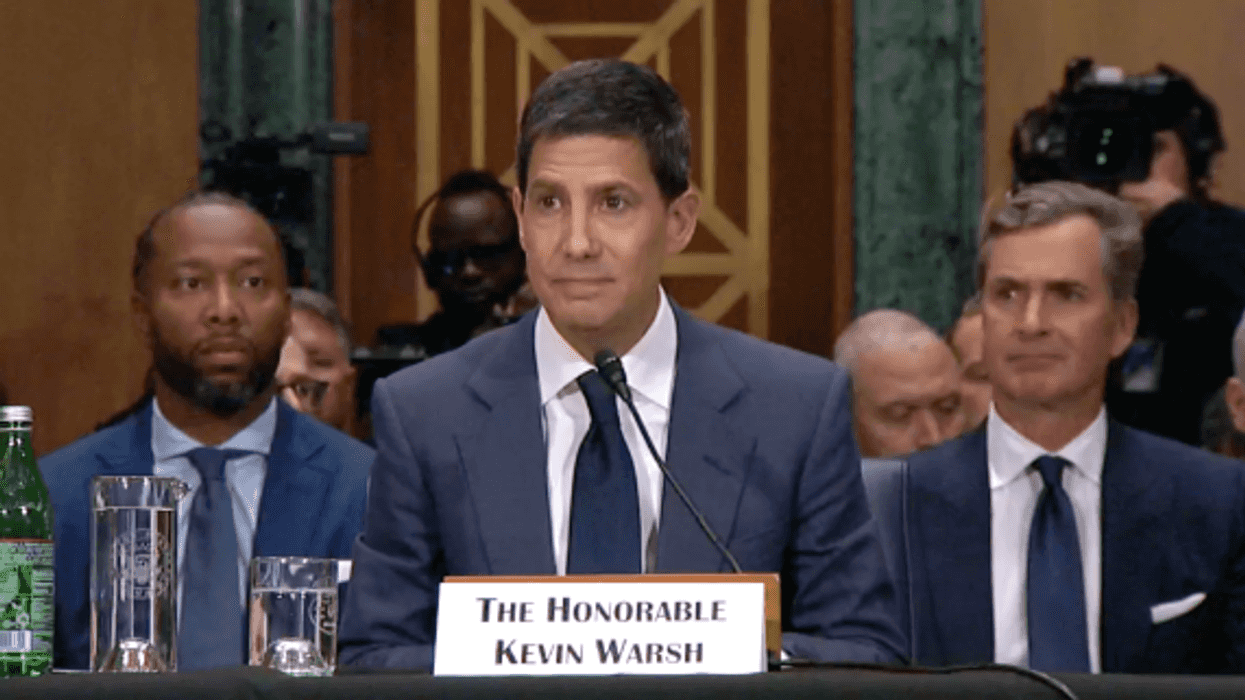
WASHINGTON – The Senate Banking Committee on Wednesday voted 13 to 11 to advance Kevin Warsh’s nomination as Federal Reserve chairman despite Democrats’ concerns that he would not be independent from President Donald Trump.
The banking committee’s vote fell along party lines, with all 13 Republicans voting in favor of the nomination and all 11 Democrats voting against it. Senator Elizabeth Warren, D-Mass., said in a press release that it was the first time a vote on a Fed chair nominee was entirely partisan.
Democrats warned that installing Warsh as Fed chair would mean Trump exerting control over the central bank, with consequences for the economy.
The committee’s decision marked a win for Trump, who announced in January that he selected Warsh to lead the Fed. The nomination came amid a months-long public feud between the president and the current Fed Chair Jerome Powell over interest rates that thrust the central bank into political controversy. Trump also attempted to fire Lisa Cook, a Fed governor.
“Donald Trump by pursuing this criminal prosecution against the Fed chair and also against a Fed governor, Lisa Cook, basically unsheathed a sword and holds it over everyone at the Fed,” Warren told reporters before the vote. “He has made clear that he doesn't care what term you have, what's been passed by Congress, what the law is. He is willing to go after people criminally, even when they're in office, if they make decisions that he doesn't like.”
Warsh’s nomination was blocked for weeks by Senator Thom Tillis, R-NC, who said he would not vote to advance Warsh until the Justice Department dropped its criminal investigation into Powell regarding a costly renovation project of the central bank’s headquarters. The department closed its probe last week, and Tillis on Wednesday voted to move Warsh’s nomination forward.
But Warren, along with other Senate Democrats, expressed concern that the probe could be reopened and voted against Trump’s pick. Tillis spoke to reporters after the vote and criticized Warren’s actions as “political theater.”
“I'm happy with the way the DOJ comported themselves over the week, and got me to a point where I'm comfortable with (voting for Warsh),” he said. “She didn't get the assurances that I did, and I'm confident that we'll move forward in good faith, and they will deliver on their commitment.”
If the full Senate votes to confirm Warsh, he would replace Powell when his term expires on May 15 and become the 17th chairman of the Federal Reserve.
But Senate Democrats have criticized Warsh’s nomination, citing concerns in a confirmation hearing last week that he would serve as Trump’s “sock puppet.”
At the hearing, Warsh declined to say that Joe Biden won the 2020 presidential election and dodged questions about whether he thought the Trump administration’s probe into Powell threatened the independence of monetary policy.
Democrats have interpreted his refusal to answer questions as a sign of his loyalty to Trump and worried that Warsh could compromise the central bank’s independence.
But Warsh explained his silence in another way. “We need to keep politics out of monetary policy and keep monetary policy out of politics,” he said.
The Federal Reserve was created by Congress in 1913 to serve as the central bank of the United States with the purpose of promoting maximum employment and stable prices. It does not receive funding from Congress and is considered an independent agency within the government.
“It's become the consensus view that independence of the central bank is important, that it will generally lead to better outcomes,” said Seth Carpenter, global chief economist at Morgan Stanley and former deputy director at the Federal Reserve Board. “If you have a central bank that is subject to short-term political wins, then you could get into a situation where policy decisions are made to try to curry favor with voters to get a certain economic outcome for a political outcome, and that could be bad.”
He pointed to former Fed Chair Arthur Burns as a cautionary tale. Burns served as head of the central bank in the 1970s and is remembered for allowing inflation to run rampant after bending to political pressure from President Richard Nixon.
Warsh previously positioned himself as a reformer intent on changing the central bank, including shrinking its balance sheet and holding fewer press conferences to communicate policy decisions.
But Robert Hetzel, a Federal Reserve historian and former economist at the Federal Reserve Bank of Richmond, said he believes Warsh would be unlikely to make major changes at the central bank.
He anticipated that Warsh would have to strike a balance between being a reformer and working closely to convince members of the Federal Open Market Committee to go along with his plans.
“What remains to be seen is just how pragmatic he is, just how willing he is to disappoint Trump, and realistically go after the kinds of reforms he's suggested publicly,” Hetzel said.
But he stressed that he expected Warsh to do a good job and resist the flak he receives from politicians.
However, Democrats predicted Trump would pressure Warsh to make the economy seem stronger before the mid-term elections in November.
“The Fed is supposed to be there as a protector for our economy overall and insulate monetary policy from politics, but that's not what Donald Trump wants,” Warren told reporters. “What Donald Trump wants is the Fed to be under his complete control, and he wants it right now, because he's in real trouble on this economy, prices are up, jobs are stagnant, and the economy is looking shaky, and voters know that.”
Erika Tulfo is a reporter covering business and financial policy for Medill News Service.