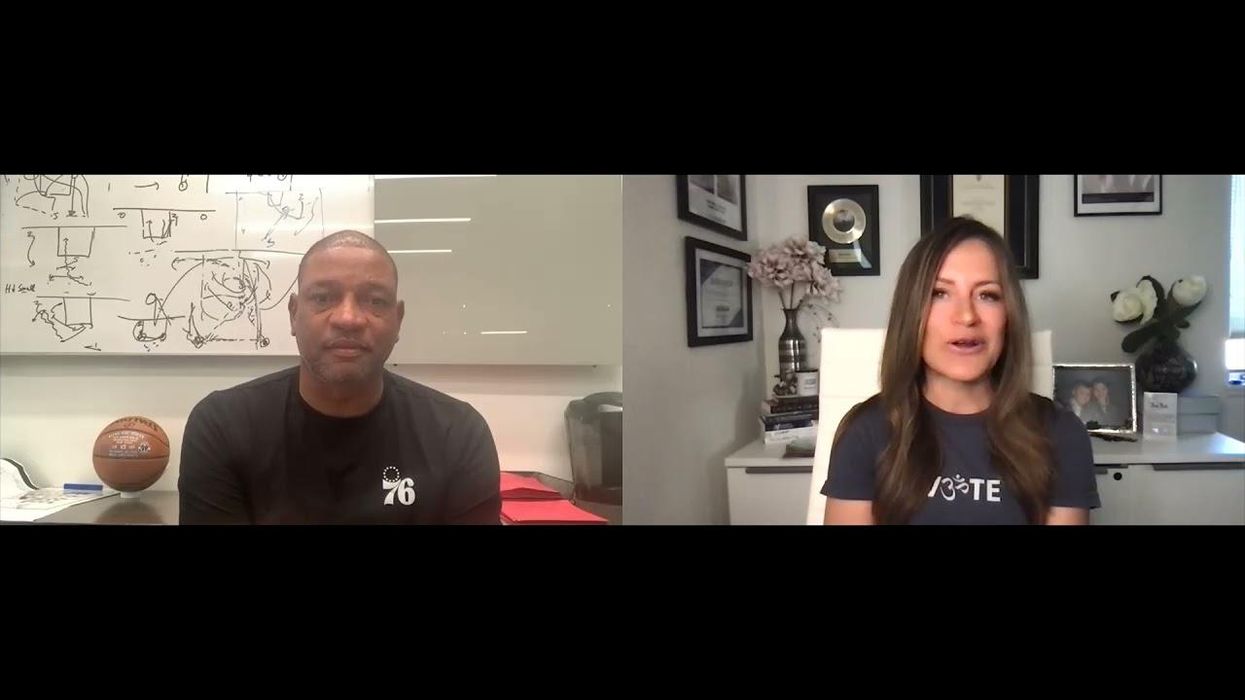
NBA Coach Doc Rivers interviews Amber McReynolds, founding CEO for the National Vote at Home Institute, to discuss National Voter Education Week.
Video: NBA Coach Doc Rivers interviews Amber McReynolds
Doc Rivers and Amber McReynolds

After October 7, Israeli volunteers became the state’s largest operating division. Here’s what that civic model can teach angry, distrustful Americans.
Jordan Karp wrote recently in these pages about anger at Washington, and the piece has stayed with me, less for the anger itself than for the level underneath it: the quiet, unglamorous work that happens when citizens stop waiting for national institutions to function. I have spent three years watching that level operate at national scale. Israel's war years produced a case study in what citizens can build when they conclude, reasonably, that no one else is coming, and some of it travels directly to the American moment Karp describes.
Within days of October 7, the Israeli state, like every state struck that hard, was overwhelmed: evacuated towns to house, farmers without Thai workers, reservists' families without income, a flood of needs no ministry was built to absorb. What filled the gap was not spontaneous kindness alone but something more interesting: organized citizens. Reporting on the period describes volunteer organizations stepping into the space between need and state capacity, neighbors delivering care to neighbors at a scale the formal system could not reach. WhatsApp groups became logistics networks. Synagogue bulletins became supply chains. The country's world-famous tech sector bent its tools to the task, and its ordinary citizens bent their schedules, and for a period the volunteer layer was, functionally, the state's largest operating division.
The part that matters for readers thinking about trust is not the heroics but the structure. In town after town, the arrangements that worked shared a shape: a hyper-local unit, a defined task, a named person responsible, and a feedback loop short enough to correct mistakes within days. The arrangements that failed were the ones that waited for permission or funding from above. It turns out that trust, which everyone agrees has collapsed, is not rebuilt by trust-building exercises. It is rebuilt by task-sharing: two people who disagree about politics discovering, over crates of donated diapers, that they can rely on each other completely. The committee layer did more for Israeli social cohesion in two years than a decade of formal dialogue programs, and it did it as a byproduct of getting things done.
Karp's anger at Washington is aimed at institutions that seem unfixable, and I hold no brief for anyone's capital. But the Israeli experience suggests the productive question is not how to fix the institutions first. It is what concrete, local, cooperative task an angry citizen can join this month. American civic life already has the scaffolding: mutual aid networks, volunteer fire departments, library boards, the whole unglamorous apparatus of self-government. What the war years taught us, at terrible tuition, is that the appetite for shared work is enormous and mostly dormant, and that it wakes fastest when someone names a task small enough to start and real enough to matter.
The anger Karp describes is energy. Energy, unorganized, curdles into cynicism; organized, it becomes the committee layer. The volunteers I worked beside these years would not recognize themselves in the word politics at all. They would recognize a town that needed them and a table with a task on it. That table is set in every town in America too.
Person holding "Vote" sign.
Two years after providing historic levels of support that helped propel Donald Trump back to the White House, Latino voters are shifting rapidly away from the Republican Party. The realignment is driven by a potent combination of persistent economic anxieties and a sharp backlash against the administration’s aggressive domestic immigration crackdowns. A landmark national poll conducted by NBC News and Telemundo reveals that the President’s approval rating among registered Latino voters has plummeted to just 27%, signaling deep political turbulence for the GOP on the eve of critical midterm elections.
When asked by reporters outside the White House about the plunging numbers, President Trump angrily dismissed the data, labeling the findings as “fake news.”
Meanwhile, a spokesperson from the Department of Homeland Security formally defended the sweeping enforcement measures, stating that the agency’s actions are simply “fulfilling Trump’s promises and enforcing laws passed by Congress.”
The dramatic shift presents a major opportunity for Democrats to capitalize on key races in states and districts boasting significant Hispanic populations. In 2024, exit polls indicated that Trump secured roughly 46% of the Latino vote nationwide. Today, that base of support appears to be fracturing. Data collected by Equis Research underscores the trend, noting that support for Republican candidates among Hispanics who voted for Trump in 2024 has dropped 10 percentage points over the last year. Roughly 22% of Latino Trump voters indicate they do not plan to back Republicans in the upcoming midterms.
While pocketbook issues like inflation and the cost of living remain primary drivers for voters, the administration’s sweeping approach to immigration has created a profound and visceral fracture. An overwhelming two-thirds of Latino voters state that the administration’s enforcement policies have gone “too far”. Although 83% of respondents still support the targeted deportation of undocumented immigrants convicted of serious criminal records, general approval of broad interior operations remains low. Only 30% of Latinos approve of the administration’s overall handling of immigration, and Immigration and Customs Enforcement (ICE) faces a staggering 65% negative favorability rating within the community.
The polling data emphasizes that immigration enforcement has moved from a theoretical policy debate into the daily lives of families. Nearly one-third of Latino voters—31%—report that they or a loved one have started carrying legal identification at all times out of fear of being swept up in ICE operations. Furthermore, 27% know someone who has been detained or deported over the last two years. The climate of fear has reached a point where 17% of respondents admit that they or close acquaintances have actively considered avoiding in-person voting tables out of apprehension regarding federal enforcement visibility.
This sense of overreach is creating severe legislative headwinds for local Republican incumbents representing heavily Hispanic areas. In Florida, Republican Congresswoman María Elvira Salazar, who represents a majority-Latino district in Miami, broke publicly with the White House on immigration strategy. In a widely circulated campaign video, Salazar warned that Hispanic voters who supported the administration in 2024 are feeling deeply betrayed by the broad nature of the interior crackdowns, transforming previously safe seats into intense battlegrounds.
- YouTube youtu.be
As political strategists analyze the shifting maps, the data indicates that Democrats have reclaimed significant margins on traditional battleground metrics. The NBC News/Telemundo survey reveals that Latino voters now favor Democratic congressional candidates over Republicans by a wide margin.
“This has been a key question coming into this midterm campaign… one of the reasons Trump was returned to the White House was surprisingly strong support from Latino voters in 2024,” Kornacki explained. Analyzing the new polling, he noted, “He basically battled [the Democrats] to a draw with Latino voters then—which for a Republican, that’s a very strong performance. But… he barely has a quarter approval rating.”
Crucially, the trust gap has widened on the economy as well, with 54% of Latino voters trusting the Democratic Party compared to just 33% who favor the GOP—wiping away the significant economic advantage Republicans held with this demographic during the 2024 cycle. With billions of dollars in advertising saturating the airwaves, the rapid movement of the Latino electorate suggests that the administration’s border strategy has sparked an electoral counterweight that could fundamentally reshape control of Congress.
Latino Voters Shift Ahead of Midterm Elections was first published in Latino News Network and is republished with permission.
The Latino News Network (LNN) is an independent, English-language multimedia news platform dedicated entirely to covering and serving the Hispanic-Latino community in the United States.
Person placing ballot in voting box
The Trump administration is pressing to remove noncitizens from voter rolls across the country. Yet an important question seems to be missing from the debate: Where, exactly, does the federal government get the authority to impose a citizenship requirement on federal elections? The Constitution does not make citizenship a universal qualification for voting. Instead, Article I, Section 2, Clause 1 states: “The Electors in each State shall have the Qualifications requisite for Electors of the most numerous Branch of the State Legislature.” At the same time, Article I, Section 4, Clause 1 explicitly grants Congress authority over the conduct of federal elections: “The Times, Places and Manner of holding Elections for Senators and Representatives, shall be prescribed in each State by the Legislature thereof; but the Congress may at any time by Law make or alter such Regulations, except as to the Places of chusing Senators.” In Arizona v. Inter Tribal Council of Arizona, Inc. (2013), the U.S. Supreme Court distinguished Congress’s power to regulate how federal elections are conducted from the states’ authority to determine voter qualifications, explaining that Congress may regulate the “Times, Places and Manner” of elections, “but not who may vote in them.” For much of American history, noncitizens voted in elections in at least 22 states and territories, and some historical research suggests the number may have been as high as 40. Today, certain noncitizens are still permitted to vote in local elections in California, Maryland, Vermont and the District of Columbia. If the Constitution leaves voter qualifications to the states, what gives the federal government the authority to demand otherwise?
A Long History of State Decisions
Noncitizen voting is not a recent idea or an unprecedented departure from American practice. From the colonial period through the nineteenth and early twentieth centuries, many states and territories permitted at least some noncitizens to vote. The rules varied considerably. Some jurisdictions allowed immigrants who had declared their intention to become U.S. citizens to vote, while others adopted broader rules for eligible residents. Because voter qualifications for federal elections generally followed those established for elections to a state's legislature, these state decisions also permitted noncitizens to vote in elections for members of Congress and, in some states, presidential electors.
Over time, states reconsidered these policies. Rising nativism, wartime hostility toward immigrants and concerns about election practices contributed to the gradual elimination of noncitizen voting. The 1924 presidential election was the last in which noncitizens legally voted for president in states that still permitted the practice. Arkansas, the last state to retain noncitizen voting, ended it in 1926. By then, citizenship had become a voting requirement in every state.
The significance of this history is not that states must allow noncitizens to vote today. It is that the change occurred through state action. State governments gradually decided to restrict voting to citizens, and the practice disappeared as those states changed their laws. The historical record therefore provides an important context for examining what happened when Congress later enacted a nationwide prohibition.
The Federal Government Enters the Picture
The history of noncitizen voting took a significant turn in 1996, when Congress enacted a broad immigration-enforcement law. The Illegal Immigration Reform and Immigrant Responsibility Act of 1996 addressed a wide range of immigration issues, from border enforcement to deportation procedures. Among its many provisions was Section 216, which added Section 611 to Title 18 of the U.S. Code. Although the provision received little separate attention in the legislative record, it imposed a nationwide federal criminal prohibition on noncitizen voting in federal elections.
Section 611, now codified at 18 U.S.C. § 611, makes it unlawful for noncitizens to vote for president, presidential electors, U.S. senators, U.S. representatives and certain other federal offices, subject to limited exceptions. By 1996, state action had already ended noncitizen voting in federal elections decades earlier. Congress did not simply follow a new wave of state decisions. It established a nationwide federal criminal prohibition on an issue that, under the constitutional framework described above, raises a fundamental question about the division of authority between the states and the federal government.
Does the Constitution Give Congress That Authority?
Article I, Section 2 and the Seventeenth Amendment establish that voter qualifications for elections to the House of Representatives and the Senate follow those required for electors of the most numerous branch of each state's legislature. Article II, Section 1, Clause 2 separately provides that each state appoints its presidential electors in the manner its legislature directs. These provisions leave the states with significant responsibility for determining voter qualifications.
The Supreme Court's reasoning in Arizona v. Inter Tribal Council of Arizona, Inc. reinforces the distinction between Congress's power to regulate election procedures and the states' authority to determine who is qualified to vote. The Court explained that Congress's Elections Clause authority concerns how federal elections are held, “but not who may vote in them.” The case concerned Arizona's proof-of-citizenship requirement for voter registration; it did not decide the constitutionality of Section 611. Nevertheless, its explanation of the constitutional division of authority is directly relevant to the question raised here.
Congress has substantial constitutional powers, including authority over naturalization and the regulation of federal elections. But the existence of those powers does not automatically establish that Congress may impose a uniform citizenship qualification on voters in elections administered by the states. A law regulating registration procedures, ballot handling or election administration is not necessarily the same as a law defining who is eligible to vote.
There is also relevant precedent that deserves consideration. In Oregon v. Mitchell (1970), the Supreme Court considered congressional authority to set voting-age rules for federal elections, and the justices disagreed about the scope of that authority. The decision illustrates the complexity of the relationship between federal power and state control of voter qualifications. It does not, however, resolve the specific question of whether Congress may criminalize noncitizen voting through Section 611.
My argument is that Section 611 crosses a constitutional boundary. The Constitution expressly gives Congress authority to regulate the conduct of federal elections, while its provisions governing voter qualifications assign a central role to the states. If Congress can establish a voter qualification simply by attaching a federal criminal penalty to it, the distinction between regulating elections and deciding who may vote becomes difficult to maintain.
Citizenship may be a widely accepted qualification for voting today. But the popularity or soundness of a policy does not, by itself, answer the constitutional question of which level of government has the authority to impose it. The question is not whether states may decide that only citizens should vote. The question is whether Congress has the constitutional authority to impose that rule nationally through Section 611.
A Constitutional Question Now Before the Courts
This issue is no longer merely theoretical. The Trump administration has sought to use federal databases to identify noncitizens on voter rolls, prompting legal challenges over federal authority, voter privacy, the accuracy of citizenship-verification systems and the role of states in administering elections. These disputes raise related questions about federal involvement in election administration, but they should not be confused with the separate question of whether Section 611 itself is constitutional.
Several recent federal prosecutions have directly challenged Section 611. According to a September 15, 2026, Reuters report, defendants in cases in Miami, Florida, and Madison, Wisconsin, argued that the 1996 law exceeds Congress's constitutional authority because voter qualifications are reserved to the states.
On October 1, U.S. District Judge David Leibowitz dismissed the case against Chelsea Cox, ruling that Section 611 was unconstitutional. His ruling applies to that case and is not binding on other judges. In a separate Miami prosecution, Judge Jacqueline Becerra rejected Wilner Renaud's constitutional challenge on September 9. These proceedings have produced differing judicial responses, demonstrating that the constitutional question remains contested. The Supreme Court has not issued a definitive decision resolving the constitutionality of Section 611 itself.
These cases matter because they address the central issue directly: whether Congress has the authority to impose a nationwide criminal prohibition on noncitizen voting in federal elections. The courts must consider not only the government's objectives but also the constitutional limits on its power.
Who Deserves a Voice in the Community?
Beyond the constitutional question lies a broader democratic principle: What does it mean for people to have a voice in the communities they share?
Benjamin Franklin once wrote, “They who have no voice nor vote in the electing of representatives do not enjoy liberty.” Political scientist Ron Hayduk has made a related argument for noncitizen voting, writing that extending the right to vote to noncitizens would help make government representative, responsive and accountable.
Noncitizens who live in our communities are subject to local laws and decisions, contribute to their communities and often pay taxes. Allowing eligible noncitizens to vote in certain local elections can recognize their stake in the community and give them a voice in decisions affecting their daily lives. It does not make them citizens; it recognizes that people who are governed by a community have a legitimate interest in how that community is governed.
I believe Section 611 will ultimately be declared unconstitutional, creating an opportunity for each state to decide whether noncitizens should be permitted to vote and, if so, in which elections, subject to the Constitution and other applicable laws. This should not be a source of division. Instead, it offers an opportunity for people across the political spectrum to come together, discuss who should have a voice in the communities they share, and consider how our democratic institutions can better serve everyone.
We may disagree about where to draw the boundaries of voting rights, but we can share a commitment to a democracy that listens, includes and brings people together. This is an opportunity not simply to reconsider who can vote, but to strengthen our democracy by making it work for everybody.
Michael A. Soderstrand is a retired professor of Electrical and Computer Engineering and currently lives in Columbus, Ohio.
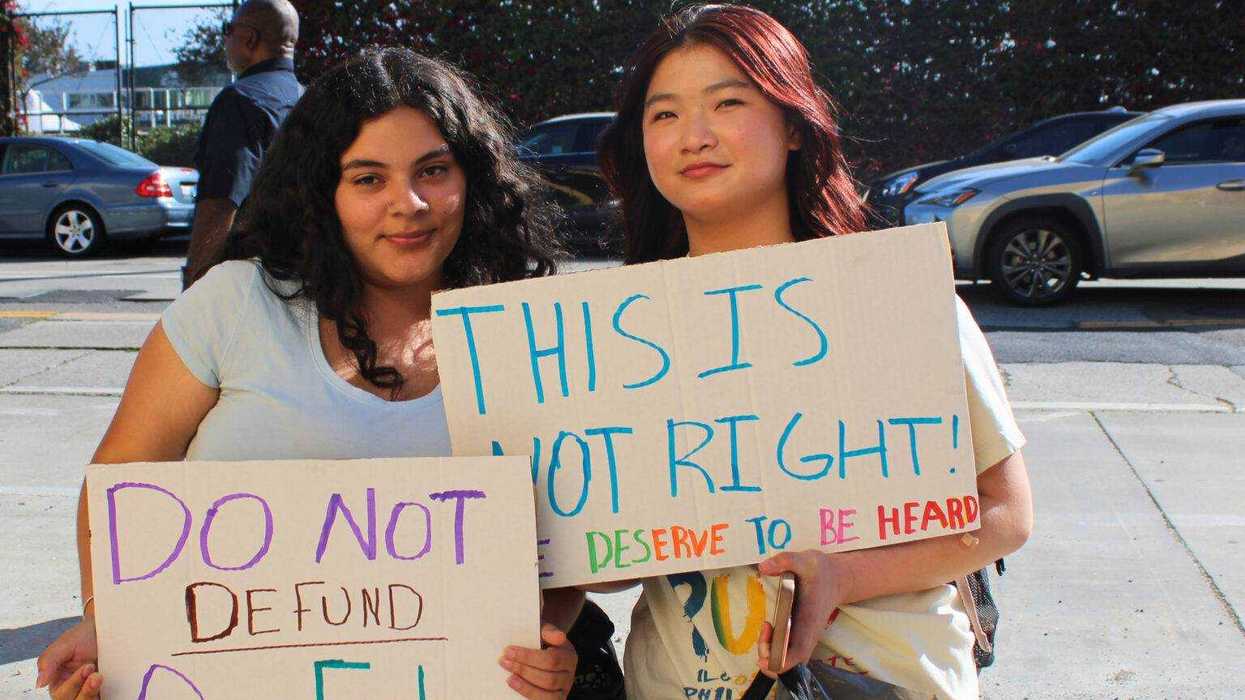
Two young people hold signs on education matters
Rosanna Custodio was about just 10 years old the first time her teachers walked off the job.
That was 2019, when Oakland teachers went on strike for seven days over low pay, class sizes, and support staff. They walked out again in 2022 over school closures, and again in 2023 over pay and school safety. Rosanna, now 17 and a student at Oakland High School, has kept count of how many times educators have walked out.
"These are the teachers they bring into the district to educate us," Rosanna said, continuing, "If we don't have educators, where do we go from there?"
Amid days of educators’ protests, Rossana, just like many other girls in the Oakland district, has also been affected by inadequate access to sanitary pads in their restrooms. At Oakland High, she said, girls often have to ask for sanitary napkins in the bathroom, "and they will provide it, but it's not always on time." She wants the district to budget for them.
But the good news for Rossana is that, for the first time, she can have a say through her vote on November 3 in the only second Oakland District election open to 17- and 16-year-olds, helping choose the people who can bring meaningful change to their school.
Max, who lives in Oakland's District 2 and attends St. Mary's College High School in Berkeley, does too. Both his parents have been Oakland Unified teachers their whole lives. "Even before I was able to vote, I wanted to," he said.
He wants a straight answer on money. "We are in some deficit that God knows what it is at this point. They tell us a new number all the time," he said. "We are not just going to sit here and let the board do what it wants."
They are part of 722 of an estimated 1,900 eligible teenagers who have pre-registered for this year's school board races in districts 2, 4 and 6, according to the official Election Site of Alameda County. As of Oct. 23, just 13 had returned a ballot. That is under 2%. Adults in the same districts stood at 8.7%.
Those numbers are a test for Oakland Kids First, the nonprofit whose students won 16- and 17-year-olds the right to vote for the school board. In November 2020, voters approved Measure QQ with 67.88% of the vote, letting 16- and 17-year-olds vote for the school board. That made Oakland one of the first major U.S. cities to do so. Oakland Kids First, a nonprofit, anchors the coalition that ran the campaign. In 2024, in its first year, 244 Oakland teens cast ballots. Across Oakland and Berkeley, 575 of 1,494 registered youth voted
After running nearly every part of the first youth election in 2024, the group told the district and the county what they have missed. This fall shows how much they listened.
"If we disappear, we don't want the work to disappear with us," said Domenichi Morris, an organizing specialist at Oakland Kids First and a former elementary school teacher.
Morris taught elementary school before he joined in 2018 as a coordinator. "I got fed up with that system, and I wanted to be able to create some change," he said. Now he works on the youth vote with student leaders from coalition groups.
A 30-year habit of pushing
Oakland Kids First grew out of the 1996 Kids First. Initiative, a ballot measure that set aside 2.5% of the city budget for children and youth. Its teenagers have worked the same way ever since: name a problem, organize, and keep showing up until officials act.
The youth vote began with a loss. On March 4, 2019, the day after the first teachers strike ended, the school board voted to cut about $22 million, including restorative justice staff and library funding, while hundreds of students protested.
"Young folks were hurt, furious, and they're like, where is our say?" Morris said.
Voters approved Measure QQ in 2020. The county did not build a system for it until 2024.
Getting ready to vote
Rossana got involved through AYPAL, an Asian and Pacific Islander youth group in the Oakland Youth Vote coalition, which registered her. Now she sits on Oakland Kids First's Core Leaders Committee, where teens meet to prepare for the election. They read the candidates' bios and form their own opinions. The group pulls that information straight from the candidates' websites and does not push anyone, Max said.
"You can tell if you read those who is promising something and who is using a lot of words to say nothing," he said.
When District 2 candidates visited Oakland High government classes, Custodio said, "they gave us room to actually ask questions on what we believe that we need."
"I feel empowered," she said.
What the group asked for
The first youth election leaned almost entirely on the coalition. "It's not an embedded curriculum that the school district does every year," Morris said. Teens could vote in person only at the registrar's office downtown, and some parents accidentally threw out ballots, he said. In the end, 244 Oakland teenagers voted, about a quarter of those registered.
Thomas Lemasney, now 19, was one of them. He organized with the group in high school. "After we achieve our win, not much happens," he said. "I'm going to be honest."
So the group put its asks in writing. A 2022 policy analysis prepared with Oakland Kids First called for teens to vote the same way adults do and for the district to build voter registration and civics into school. After 2024, the coalition's evaluation told officials, in Morris' words, "this is what was missing, this is what you could have done better."
The county has moved the most, and teens can now vote at any vote center. The registrar's outreach team is "more prepared and showing up at different schools," Morris said, and its calendar lists 11 registration pop-ups at nine Oakland high schools, though six lasted 30 minutes or less.
The district has moved some. It has sent students messages asking whether they have registered, and Oakland High told Rossana in class that she was eligible. Morris counts at least eight or nine candidate forums this year, up from a handful.
But the biggest task is still open. In 2022, the board told the superintendent to write a plan to promote youth voting. The coalition's evaluation, presented in April, found no sign of one and said the district has no formal civics program. The board took no vote. At an Oaklandside forum in September, board President Jennifer Brouhard said every class should teach the lessons. District 4 incumbent Mike Hutchinson said a direct district role "would be difficult."
So Oakland Kids First fills the gaps. It still registers students and visits classrooms when schools ask, and it is weighing a field trip to drop off ballots if district rules on missed class allow it.
What they want back
"Hopefully they listen to the students," Rossana said of whoever wins, "and actually be open-minded to what the students have to say." Max wants "some clarity on the budget" and a board member who "engages with students and is willing to listen."
He has a message for teens who plan to sit this one out.
"Don't take it for granted," he said. "You can really have an impact on your school."
Pechuqui Laurata is a fall fellow with The Fulcrum and a student at UC Berkeley School of Journalism (Master of Journalism).