

Skip to content
Search

Latest Stories

Top Stories

High School Civic Innovators Bridging America’s Divide

Meet Sophie Kim and Bipartisan Bridges


News

High School Civic Innovators Bridging America’s Divide

Sophie Kim

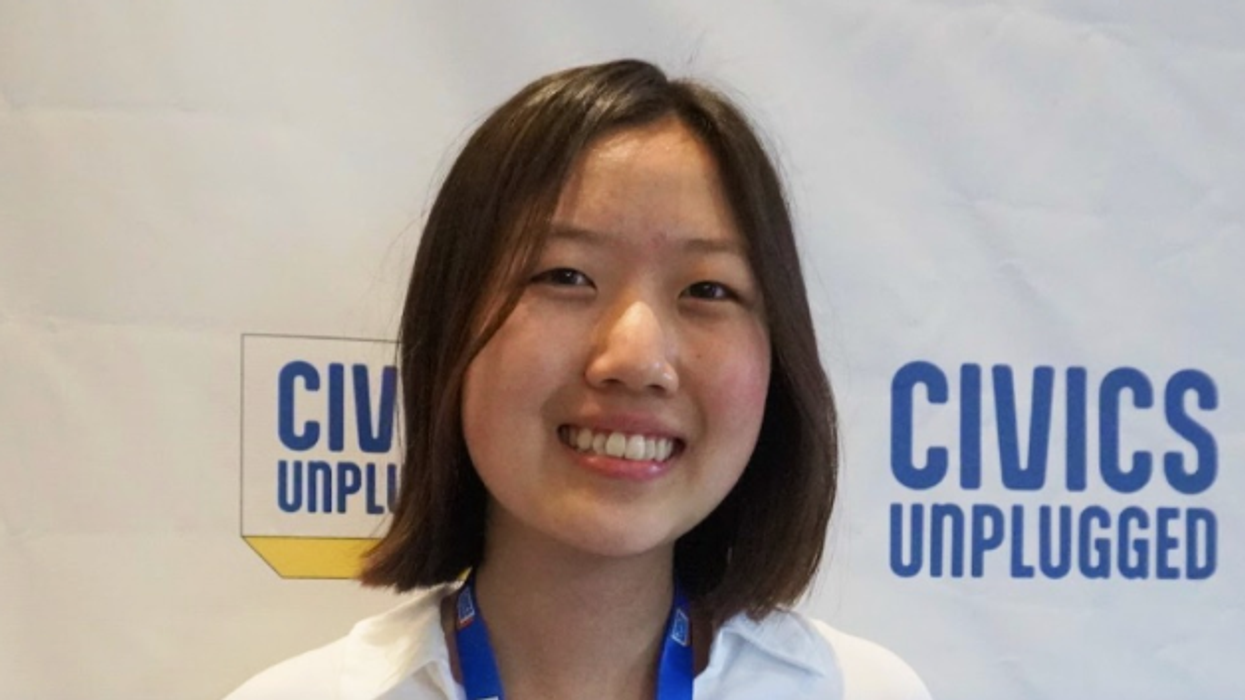
At just 17 years of age, Sophie Kim was motivated to start her organization, Bipartisan Bridges, to bring together people from both ends of the political spectrum. What started as just an idea during her freshman year of high school took off after Sophie placed in the Civics Unplugged pitch contest, hosted for alumni in Spring 2024. Since then, Sophie has continued to expand Bipartisan Bridges' impact, creating spaces that foster civil dialogue and facilitate meaningful connections across party lines.

Sophie, a graduate of the Spring 2024 Civic Innovators Fellowship and the Summer 2025 Civic Innovation Academy at UCLA, serves as the founder and executive director of Bipartisan Bridges. In this role, Sophie has forged a partnership with the organization Braver Angels to host depolarization workshops and has led the coordination and capture of conversations on climate change, abortion, gun control, foreign aid, and the 100 Men vs. a Gorilla debate. In addition, this year, Sophie planned and oversaw Bipartisan Bridges’ flagship Politics and Polarization Fellowship, an eight-week, in-person program involving youth from Tustin, Irvine, Costa Mesa, and Huntington Beach, California. A recent Bipartisan Bridges session featuring youth from both Los Angeles and Orange County will be featured in Bridging the Gap, an upcoming documentary.


The Case for Compromise and Connection

When asked what motivated her to start Bipartisan Bridges, Sophie shared that she believes bridging the bipartisan divide is not just necessary for strengthening our communities and relationships with one another, but also so that compromise can be reached to solve some of the most pressing problems in the United States today.

“In the face of the climate emergency, homelessness epidemic, opioid crisis, and so many other critically urgent issues facing our nation, the lack of Congress's ability to come together, collaborate effectively, and make needed compromises to reach agreement on legislation to address these issues means that critical problems continue to worsen while the American people suffer the consequences of government inaction,” Sophie said.

“It’s hard to pinpoint who exactly is the most affected by this issue, but what’s clear is that every American citizen is being affected by a dysfunctional government lacking legislative collaboration.”

Sophie also shared that there is something more personal behind her decision to start Bipartisan Bridges.

“I was inspired to start the organization after I met and became lifelong friends with the founder and president of my high school's Turning Point USA chapter,” Sophie said.

“Before we met, I'd heard soundbites and snippets of who he was, and all I knew was that almost everything he stood for was diametrically opposed to my own beliefs. Before we happened to end up in a class together, I made so many assumptions about him, all of which turned out to be false.”

Sophie says that she now considers this peer a friend, and that they’re one of the “most genuine human beings” she knows.

Navigating What’s Next

Sophie and the Bipartisan Bridges team recently wrapped up their first cohort and are now entering a phase to assess the program's impact and determine programmatic adjustments to continue improving. Sophie shared that a possible direction could include transitioning to a 1-1 format,

but continuing to host civil discussions focused on nationwide issues. The group also plans to become more involved in advocating for systemic change, such as ranked-choice voting.

This is the first in an ongoing monthly series highlighting the inspiring work of high school-aged civic innovators. Through the mentorship and guidance provided by Civics Unplugged, young people are provided the skills, mentorship, and community needed to create impactful solutions to the problems that matter most. Since Civic Unplugged’s founding in 2020, they have graduated more than 5,000 Fellows worldwide from our tuition-free programs and provided $1.5 million in direct funding to Fellows’ initiatives. To learn more, please visit civicsunplugged.org.
David Nevins is the publisher of The Fulcrum and co-founder and board chairman of the Bridge Alliance Education Fund.

Read More

Two speech bubbles overlapping each other.

Democrats can reclaim America’s founding principles, rebuild the rural economy, and restore democracy by redefining the political battle Trump began.

Getty Images, Richard Drury

Defining the Democrat v. Republican Battle

Winning elections is, in large part, a question of which Party is able to define the battle and define the actors. Trump has so far defined the battle and effectively defined Democrats for his supporters as the enemy of making America great again.

For Democrats to win the 2026 midterm and 2028 presidential elections, they must take the offensive and show just the opposite–that it is they who are true to core American principles and they who will make America great again, while Trump is the Founders' nightmare come alive.

Keep Reading Show less
Two speech bubbles overlapping each other.

Democrats can reclaim America’s founding principles, rebuild the rural economy, and restore democracy by redefining the political battle Trump began.

Getty Images, Richard Drury

Defining the Democrat v. Republican Battle

Winning elections is, in large part, a question of which Party is able to define the battle and define the actors. Trump has so far defined the battle and effectively defined Democrats for his supporters as the enemy of making America great again.

For Democrats to win the 2026 midterm and 2028 presidential elections, they must take the offensive and show just the opposite–that it is they who are true to core American principles and they who will make America great again, while Trump is the Founders' nightmare come alive.

Keep Reading Show less
Mirror, Mirror On the Wall, Who's the Most Patriotic of All?

Trump and the MAGA movement have twisted the meaning of patriotism. It’s time we collectively reclaim America’s founding ideals and the Pledge’s promise.

Getty Images, LeoPatrizi

Mirror, Mirror On the Wall, Who's the Most Patriotic of All?

Republicans have always claimed to be the patriotic party, the party of "America, right or wrong," the party willing to use force to protect American national interests abroad, the party of a strong military. In response, Democrats have not really contested this perspective since Vietnam, basically ceding the patriotic badge to the Republicans.

But with the advent of Donald Trump, the Republican claim to patriotism has gotten broader and more troubling. Republicans now claim to be the party that is true to our founding principles. And it is not just the politicians; they have support from far-right scholars at the Heritage Foundation, such as Matthew Spalding. The Democratic Party has done nothing to counter these claims.

Keep Reading Show less
Communication concept with multi colored abstract people icons.

Research shows that emotional, cognitive, and social mechanisms drive both direct and indirect contact, offering scalable ways to reduce political polarization.

Getty Images, Eoneren

“Direct” and “Indirect” Contact Methods Likely Work in Similar Ways, so They Should Both Be Effective

In a previous article, we argued that efforts to improve the political environment should reach Americans as media consumers, in addition to seeking public participation. Reaching Americans as media consumers uses media like film, TV, and social media to change what Americans see and hear about fellow Americans across the political spectrum. Participant-based efforts include dialogues and community-based activities that require active involvement.

In this article, we show that the mechanisms underlying each type of approach are quite similar. The categories of mechanisms we cover are emotional, cognitive, relational, and repetitive. We use the terms from the academic literature, “direct” and “indirect” contact, which are fairly similar to participant and media consumer approaches, respectively.

Keep Reading Show less