
Nassiri is an intern for Issue One, a crosspartisan political reform group.
Editor's note: This article was updated to correct Adona's party registration status.
More than 10,000 officials across the country run U.S. elections. This interview is part of a series highlighting the election heroes who are the faces of democracy.
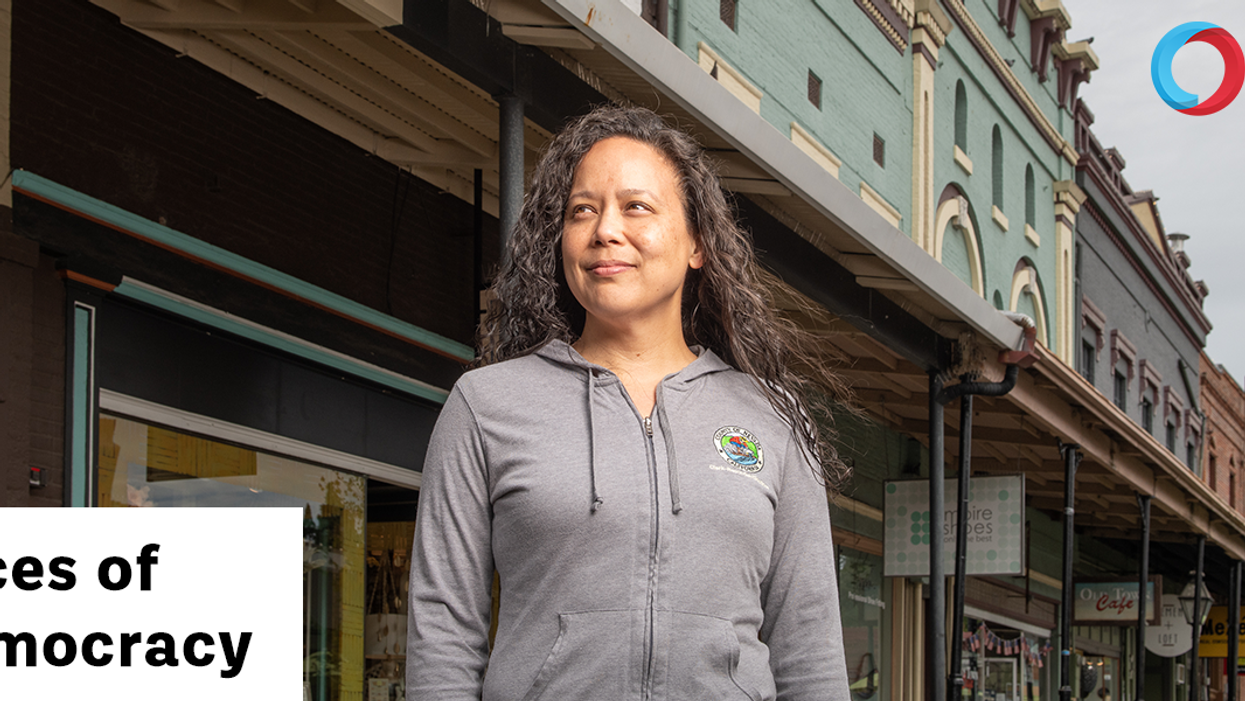
Since June 2022, Natalie Adona, who is not registered with any political party, has served as the clerk-recorder and registrar of voters in Nevada County, Calif., near Lake Tahoe in the northeast part of the state. The word “nevada” comes from the Spanish adjective for "snow covered," in reference to the region's high elevation and snow-capped mountains, which have been fertile grounds for mining operations since the California gold rush in the mid-1800s.
Adona — who has a bachelor’s degree from the University of California, Berkeley and both a master’s degree and law degree from American University — has worked in and around elections for more than 15 years. She started her career in elections by training poll workers in the Bay Area, working in San Francisco in 2008 and Alameda County in 2009. She then spent several years in the nonprofit sector as a researcher and grant maker, including at the Democracy Fund, a charitable foundation that works to strengthen and defend democracy. In these roles, she worked closely with election administrators, philanthropists and political scientists to enhance elections policy.
A devoted fan of Star Trek and kung fu movies, Adona's commitment to public service pulled her back to local government in 2019, when she became assistant clerk-recorder/registrar of voters in Nevada County.
Adona’s philosophy centers around the belief that government exists to serve people, emphasizing the importance of local government meeting people where they are. She is committed to maintaining transparent, lawful and efficient elections processes, while upholding the highest standards of professionalism and integrity among her staff. In both 2020 and 2022, Nevada County’s voter turnout ranked among the highest in California.
Adona currently serves as the chair of the Constitution Bylaws Committee of the County Recorders Association of California and as a deputy member of the California Association of Clerks and Election Officials. Additionally, she co-chairs the California Ballot Design Advisory Committee and serves on the editorial board of the Journal of Election Administration Research and Practice. Since 2022, she has been part of Issue One’s Faces of Democracy campaign, advocating for protections for election workers and for regular, predictable, and sufficient federal funding of elections.
This interview has been edited for length and clarity.
Issue One: How did you end up in this profession?
Natalie Adona: I worked in a polling place when I was going to [the University of California, Berkeley], and I sort of begged one of the researchers at Cal to let me participate in some data collection for a poll worker training study. She let me volunteer to attend these poll worker trainings, take notes and bring the data back to her.
Then, I applied to work as a temporary employee in San Francisco. They looked at my experience and went, "Well, maybe data entry isn’t your thing, but maybe being one of our trainers is, because you already know what’s involved." When I saw the operation in San Francisco, that’s when it hit me that this is what I am supposed to do. I just knew right away.
But I had this epiphany around the time when the economy had collapsed. Governments were shrinking, and I just could not find a job in local government. Everyone was downsizing at the time. So I went on this other path of research for a while. I did not get back into local election administration until 2019 when I was hired here as the assistant to the clerk-recorder.
IO: What part of the election administration story in your area do you think isn’t told enough or isn’t widely understood enough?
NA: One thing is the dedication that all of us have to elections. That is really not talked about enough.
Sometimes people get it with the poll workers. They give up their time to serve voters. But you do not hear a lot about the people who hire the poll workers, the people who make sure that everything a voter interacts with goes smoothly.
We don’t do this because it’s so glamorous to be an elections official or it’s such a highly coveted job. We do it because we care about people being able to vote. We are your friends and neighbors, and we care just as much as you about making sure that your vote counts, if you want to vote. No one's forcing you to go to the polls. No one's forcing you to fill out your ballot. But we would like it if you did because we are not just sitting here trying to improve processes so no one can show up. We care.
People just don’t understand that we are not bureaucratic automatons with strings being pulled by someone. We are doing this because we care about our communities.
IO: How are you preparing for the elections in California on Super Tuesday, and how do you think this election will be different from previous elections in terms of election administration challenges?
NA: Our process started months ago. We try to get our polling place locations locked down at least a year in advance. Our voter information guides have gone out to voters. We have already sent ballots to our military and overseas voters.
I continue to train my team, which is fairly young in terms of their experience in elections, and I also go out in the community and answer questions as best as I can about some of the stuff our voters see in the news.
For instance, some voters are acutely aware of the threats that we face, and that requires me to explain how the county is preparing for certain contingencies, like, what if we get a package or a letter laced with fentanyl. Or what if someone makes a bomb threat or does some other weird thing to interfere in the elections process. I consider it my responsibility to maintain trust in government.
IO: In terms of the proliferation of threats against election officials in recent years, how has this impacted your day-to-day work?
NA: I am really good at compartmentalizing my feelings, especially for the benefit of my staff, because I do not want them to think that it is unsafe to work here. I also do not want to send the message that we can be intimidated.
At the same time, it would be a lie to say that I am unaffected by any of that, and I think my staff probably feel the same way. I hear a lot more than they do about what is happening across the nation because they are focused on the day-to-day, and they want to go home and spend time with their families.
I consider it part of my responsibility to absorb some of that stress. I think that for some of the folks who are engaging in really inappropriate behavior, the goal is to distract, and I am doing my best to not be distracted.
However, on the other side, it does create this atmosphere of growing potential for political violence. Now that the fentanyl letter thing has surfaced, law enforcement is paying much closer attention to some of the things that are happening.
We got a new security consultant in the county who has been very responsive. And we had an elections tabletop exercise recently in Nevada County, which was facilitated by our secretary of state’s office. It was really helpful to have law enforcement there.
IO: Election officials across the country have had to respond to so many new challenges. Heading into this election cycle, no one was anticipating that elections offices would receive letters with suspicious powders.
NA: Yeah, Yuba County also recently got a package that tested positive for fentanyl. It really opened a lot of people’s eyes.
For a while, I think [threatening messages] were sort of dismissed. People said this is just our citizens exercising their First Amendment rights. But the whole fentanyl thing brought it to a new level for everybody. Who would think that Yuba County [one of the smallest counties in California, home to about 80,000 people] would be targeted?!
I think sending a fentanyl-laced package is intended to intimidate people. It is disturbing to me that the package was disguised as something official from the secretary of state’s office. Personally, I hope there is interest in protecting me as an elected official. I do not have the luxury ever of remaining anonymous. Some lawmakers tell me, “Well, you know, if you are getting that kind of attention, you must be doing something right” — which I cringe at! Unlike some of these legislators, I am not trying to score political points. I am trying to maintain a government office as an administrator.
IO: Given all this, what inspires you to stay in this line of work?
NA: The first reason why I stay is because there is just something in my brain that clicks and says, “Yes, this is what I want to do.” Even on the worst days, I cannot imagine doing anything else. I want to serve voters. I want to make sure that people have a good experience when they interact with their county government.
My office gets people at some of the most important parts of their life. I am also the commissioner of marriages here in Nevada County. We are the official custodians of your birth certificates, death certificates, and marriage certificates. If you want to start a business, part of what you need to do is file a fictitious business name so the bank can loan you money. When you buy a house, you need to record that document. If you want to engage with your community, you vote. I do not take my job lightly, and there are many others like me.
The second reason is I just do not like the idea that someone can bully me out of a job. One of the things that people said when they went after me [during the election in 2022] was, "She’s not from here. She was not born in Nevada County. She is only here for the job, so she doesn’t care about the county and about the people." But how dare you tell me where I do and do not belong?! I belong wherever I am. I have the right to be wherever I am. I am a Californian who cares about voters and who cares about my community.
IO: You just mentioned that elections are not your sole responsibility as the clerk-recorder for Nevada County. That’s true for a lot of chief local election officials across the country, right?
NA: Many of us have responsibilities other than elections. I am also the county recorder, which has nothing to do with elections — it’s a totally different thing. Some of our elections officials are also assessors or clerks for the board of supervisors.
The bigger the jurisdiction, the more likely you are going to have one specialty, and the more likely that you are going to be appointed by a board versus being elected. The difference is that you are accountable to voters directly as an elected official, whereas as an appointed official, you could be ousted on any given Tuesday by your board of supervisors.
IO: How many voters are on the roll in your jurisdiction, and what are the main challenges of a jurisdiction of that size?
NA: We’ve got about 75,000 registered voters right now in a total population of about 100,000 people. There are definitely communications challenges that I don’t think my cohort has really been confronted with until just recently.
Back in the day, if you weren’t making headlines in the newspaper, you were actually doing a good job because usually when you make any part of the newspaper, chances are that something bad happened.
But the world has changed now where people are starting to ask how things work. Even in a small jurisdiction like mine, it is really difficult to reach everybody. But at the same time, it is, I think, relatively easier for my constituents to access me directly than it might be in, say, Los Angeles, San Francisco, or Sacramento — any of the bigger counties.
I feel like it is important to be working alongside my staff. If someone says, “Hey, is Natalie here?” chances are, I will be here. I think people appreciate the access, and I will answer pretty much any question that somebody has, if I can.
IO: What is the price tag of running an election in your jurisdiction?
NA: Nevada County is a Voters Choice Act county [counties governed by a 2016 law passed in California to modernize elections]. One of the requirements of the Voters Choice Act is that a Voters Choice Act county must post its election costs.
On our county website, there is a chart that summarizes what the cost of elections are [ which you can see here]. Mine are a little more detailed than maybe some other counties. You can also see the cost per registered voter.
For the 2022 general election, the total cost was about $879,000 with about $476,000 in reimbursements for a net cost of about $403,000 — or about $5.40 per registered voter.
IO: Can you say more about the reimbursements you get?
NA: We got some reimbursements from the state for things like return postage on vote by mail and some other things that are required by the state. But it is not a fast process. We have also gotten both state and federal reimbursements for voting equipment.
IO: Just to clarify, the federal government doesn’t typically reimburse you for election costs, right?
NA: The feds, they get prime real estate on our ballots, but they don’t really do anything to reimburse us. It is a pain point for all of us.
The state has a ton more resources than little old Nevada County, but I am still fronting them money. They are like, “Well, let us see which things we want to reimburse you for.”
Like, dude, I play a key role in legitimizing your power. I guess you’re welcome. It is an ongoing conversation.
IO: Outside of being passionate about running safe and secure elections, what are your hobbies, or what is a fun fact that most people might not know about you?
NA: I am a regular yoga practitioner and certified yoga instructor. I would not call myself a yogi because that is a very specific thing, but I do try my best to follow the eight limb path. Anyone who studies yoga will know what that is.
I am also a big Star Trek fan, and I love kung fu movies. I have seen probably about a 100 of them. Everyone knows that Bruce Lee is the man.
IO: What’s your favorite kung fu movie?
NA: “Enter the Dragon.” If you haven’t seen it, you need to watch it. It’s a classic. Quintessential Bruce Lee.
IO: If you had the opportunity to meet a historical figure, who would it be?
NA: I would have really, really loved to meet Ruth Bader Ginsburg because she just walked unafraid or Sandra Day O'Connor, who faced a world that was really hostile to her presence but just kept true to her beliefs.
As an Asian American female, I am often treated in a way that sort of pigeon holes me into a model minority type person. People really push back on me when I show them that maybe their notions of what a model minority are do not exactly align with my personality.
If someone asks your opinion, I think it’s important to say what’s on your mind and not be afraid. People like Justice Ginsburg and Justice O'Connor — and so many other women who broke barriers — are just the epitome of what women need to do today as our freedoms are at risk. We can’t let anybody tell us that we have limits.
 Following our HWF Civic Futures kickoff last week with Eric Liu, our design partners at Public/Official have created a unique visual to capture the “civic scaffolding” spirit of this conversation.
 Lisa, Coaches Rev and Matt Elkin, and former Stanford Men’s Basketball star Maxime Raynaud at Stanford’s “All Vote No Play” Democracy Day, 2025