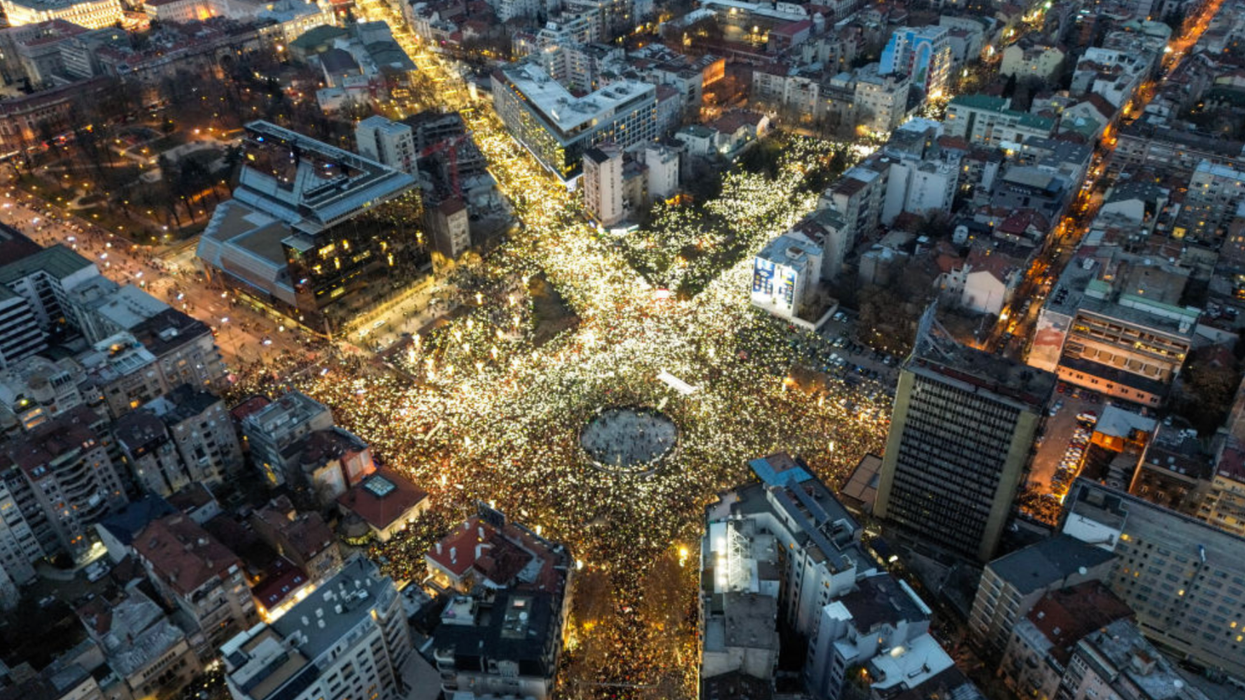

From the sustained community organizing that followed Mozambique's 2024 elections to the student-led civic protests in Serbia, the world is full of reminders that the future of democracy is ours to shape.
The world is at a critical juncture. People everywhere are facing multiple, concurrent threats including extreme wealth concentration, attacks on democratic freedoms, and various humanitarian crises.
Instead of a world characterized by exploitation, eradication, and diminishment of political expression, we need a bold new social contract in which democracy evolves into a lived expression of political values that are centered on a relentless commitment to the collective well-being of our societies and the planet.
Reining in Extreme Wealth
The staggering concentration of wealth in the hands of a select few casts a long shadow over democracy. Not only does it create wealth inequality but it also it produces and exacerbates other inequalities like race and gender.
In 2024, the richest 1% of people worldwide owned more than the bottom 95% combined. And it's not just global inequality that has grown; inequality within countries has also become worse. This level of inequality is eroding trust in institutions, which in turn is weakening democracies. In Indonesia, for example, people "who believe socio-economic inequality is unjust, are more likely to hold negative attitudes toward democracy."
Beyond breaking public trust, extreme wealth has been used to sway the political landscape, often at the expense of the common good. While the relationship between President Donald Trump and Elon Musk received much scrutiny, relationships between the ultra-wealthy and anti-democratic leaders are not unique to the US. In India, billionaires like Mukesh Ambani and Gautam Andani have been longtime supporters of Prime Minister Narendra Modi and his party. Billionaire Eduardo Eurnekian's backing of Javier Milei in Argentina and Lajos Simicska's role in the rise of Prime Minister Viktor Orbán in Hungary are other examples.
This corrosive impact of extreme wealth on democracy is undeniable and must be reined in. One way of doing this is through the effective taxation of wealth. According to the Tax Justice Network, a well-implemented wealth tax that is "flanked by globally coordinated measures to disallow tax abuse" could raise more than US $2 trillion. This would provide a stable source of revenue for countries and would also contribute toward the redistribution of wealth and security.
Redistribution alone, however, will not solve inequality. In South Africa, for instance, the wealthiest 1% have seen their pretax incomes soar by nearly 80%, while the poorest 20% have watched theirs shrink. This stark contrast reveals that any redistribution must be paired with policies that shape how pretax incomes are distributed in the first place. Tackling the deep-rooted imbalances of power and opportunity that stem from unequal ownership is crucial alongside enforcing robust antitrust measures to break up corporate dominance and stop unfair business practices.
Restitching the Unravelling Social Safety Net
Public institutions that provide public services are on the decline. Social spending has decreased worldwide, especially health care. From South Africa to Britain, people's struggle to access essential services like health care has resulted in a distrust of the political system. Anxiety over the perception that immigrants are overwhelming public resources is also rising. Using data from across 30 European countries, scholars have traced how ill health translates into anti-immigrant sentiment.
The unravelling social safety net has created an environment where exclusionary ideologies easily spread. Declining public services play a role in the surge of right-wing populist and nativist sentiment. Unscrupulous politicians use the tension to distract from their failures by scapegoating immigrants.
The chainsaws being taken to social spending that have now been popularized by figures like Milei and Musk must be rejected. Public services, which have been key in reducing global poverty and redistributing wealth and security, are an essential investment in communities and society.
Of course, reining in extreme wealth and increasing social spending are not silver bullet solutions for revitalizing democracy. More is needed, including dismantling corporate power, providing material security, global and countrywide wealth redistribution, and reparations. Each of these options reflects a commitment to the common good.
It is time for us to acknowledge the depth of inequality that exists and act in ways that benefit the needs of all and the planet, rather than the narrow self-interests of the few. Working toward collective freedom, shared prosperity, justice, and dignity is the only meaningful way forward.
Democracy 2.0 Requires a Commitment to the Common Good was originally published by the Charles F. Kettering Foundation and is republished with permission.