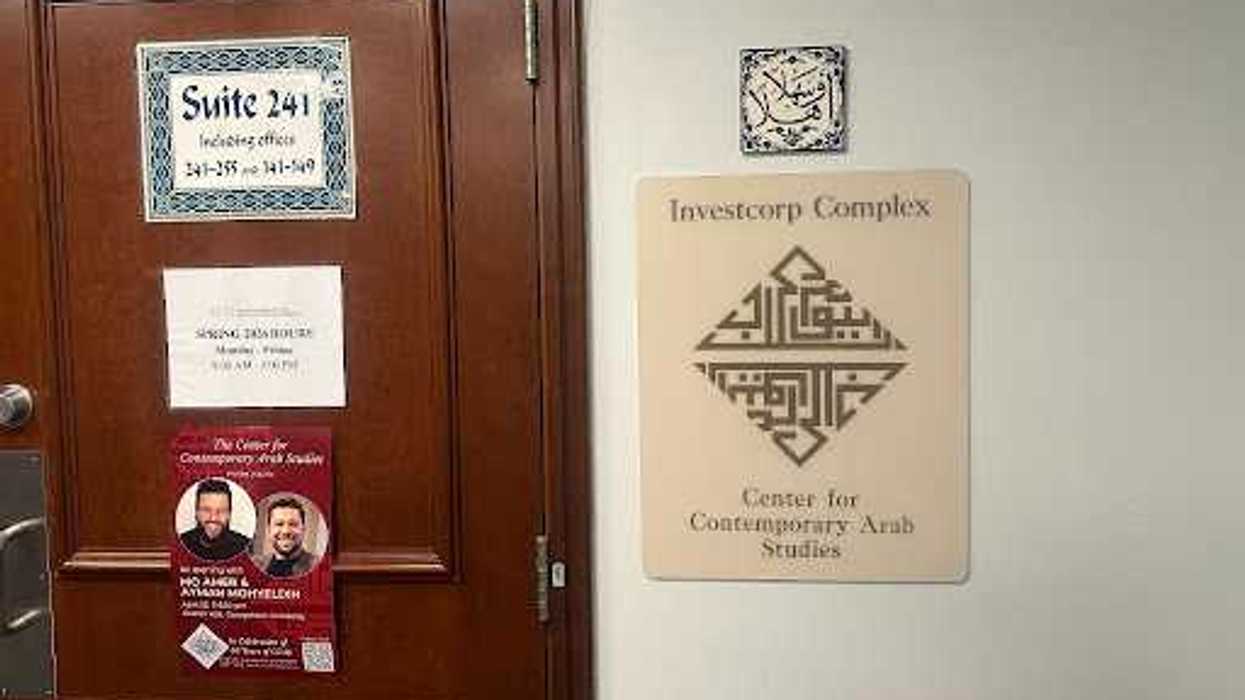
WASHINGTON – One by one, students inside the intimate lounge of Georgetown University’s Center for Contemporary Arab Studies on Wednesday called their family and friends across the Middle East.
The dozen students and faculty members watched TV screens tuned to Al Jazeera’s Arabic broadcast. The footage showed images of Israel’s strikes on Lebanon earlier that day.
“Watching our homeland on fire, the community that forms is so critical,” said Natalie El-Eid, a postdoctoral fellow at the Contemporary Arab Studies Center. “One of the things about [the center] is it has many people connected to the region, but everything that happens impacts us, not just intellectually but personally.”
As war in the Middle East dominated the news, the group gathered to listen to Duke University professor Frances Hasso lecture. She described her book about the historical implications of Zionism in light of recent events in Gaza and Iran. Her lecture marked the end of the second year of Georgetown’s Gaza Lecture Series, put on by the faculty of six Georgetown programs.
The Gaza Lecture Series at Georgetown gained national attention when the university’s then-interim president, Robert Groves, cited the lectures in his July 2025 testimony before Congress. Groves praised both the Gaza Lecture Series and the Center for Jewish Civilization's events as successful efforts to “promote dialogue and foster peaceful engagement.”
But divisions remain on campus. Naama Ben-Dor, president emeritus of the Georgetown Israel Alliance, said in a statement that while the current environment on campus is less tense than it was before the November Gaza ceasefire, hostility toward Zionists is still prevalent.
“The lack of Israeli representation within the academic landscape at Georgetown has contributed to a highly skewed understanding of the current conflict and an antagonistic depiction of Israelis and individuals who support Israel’s right to exist,” Ben-Dor wrote.
Beyond Georgetown, universities across the country have been working to strike a balance of views after the Trump administration sued and threatened many of them, accusing them of permitting antisemitism on campuses. Many universities allowed pro-Palestinian protests in 2024 during Israel’s war in Gaza following the Hamas attack on October 7, 2023. The federal government investigated over 60 universities, not including Georgetown, and cut funding for many.
Georgetown has been careful to offer perspectives from various sides of the conflict. The Center for Jewish Civilization hosted a range of high-profile speakers to explore the Israeli perspective on the conflict and the increasing antisemitism around the world.
On March 19, the Jewish Civilization Center held a lecture with Professor Steven Cook, an expert on U.S.-Middle East politics, titled “Iran, The United States, and Israel: Conflict and Consequences.” He explored the impact of the US/Israel war with Iran.
Nader Hashemi, director of the Alwaleed Center for Muslim-Christian Understanding and a main organizer of the Gaza Lecture Series, said the political polarization that followed Oct. 7, 2023, encouraged him to open up spaces of conversation and education.
“We quickly realized that we had a responsibility as academic centers to respond to global crises that people were talking about, that people were debating,” said Hashemi, who is an associate professor of Middle East and Islamic Politics in the School of Foreign Service.
Director of the Center for Jewish Civilization since 2023, Jonathon Lincoln is a professor in the Edmund A. Walsh School of Foreign Service, which contains both the Center for Arab Studies and the Center for Jewish Civilization.
“The fact is that students are enrolling in our courses in ever greater numbers,” he said in a statement. “This shows a strong desire for knowledge and an academic approach to these complicated issues from our student body.”
Lincoln said he has no issue with speakers coming to campus for the lecture series. The two centers have held their own events and speakers since Oct. 7, 2023.
“What concerns me is when some academic centers and departments at the University, especially those that don’t teach courses on or have expertise in subjects like Judaism and the Holocaust, try to examine these topics at an hour-long event solely in light of the current conflict in Gaza,” Lincoln said
Hasso said in her 2022 book, Buried in the Red Dirt: Race, Reproduction and Death in Modern Palestine, that she looks at Israel’s attack on Gaza, which cost tens of thousands of lives. She “uses a historical lens to address the puzzle why did Israel do it?”
Israel’s war in Gaza has killed over 70,000 people since the Hamas attack on Oct. 7, 2023, which killed more than 1,200 people. In September, the United Nations’ Independent International Commission of Inquiry on the Occupied Palestinian Territory classified Israel’s attacks as genocide.
“There is no accountability. There has been no accountability for Israel,” Hasso said. “It will not be forgotten, okay? This will not be forgotten.”
After a referendum supported by 762 of 1,447 undergraduate voters last April, Georgetown students called on the university to divest from the companies arming Israel and to end ties to Israeli institutions.
Georgetown has approximately 7,200 undergraduate students eligible to vote. University administrators ultimately refused to implement the referendum.
Both the centers at Georgetown plan to continue hosting lectures and events as the conflicts continue abroad. In October, Lincoln’s Center and the Georgetown Dialogues Initiative hosted former Israeli Prime Minister Ehud Olmert and Nasser al-Kidwa, a former Minister of Foreign Affairs with the Palestinian National Authority. The event featured both Palestinian and Israeli voices together, according to Lincoln.
“We created the space for students with diverse views on the subject to listen to these former officials talk about the need and possibility for peace and reconciliation between Israelis and Palestinians, even as the horrors of the war continued to rage in Gaza and elsewhere,” Lincoln said.
Jacques Abou-Rizk is a graduate student journalist at Northwestern Medill.