




“A republic – if you can keep it,” was Benjamin Franklin’s reply in 1787 when asked what the Constitutional Convention had produced. For the first time since the Civil War, whether we can keep that republic is again in question. The answer will depend on the actions we take and also on the words we use, because political discourse is the soil and climate in which actions grow.
Like a lexical chick trying to hatch, the term “fascism” has cracked the surface of American political discourse but has not fully broken through. Whether it does has intellectual and moral consequences. So we must ask: What is fascism? Is it accurate to call Trumpism fascism? And if it isn’t fascism, what is it?
No one has written more trenchantly on this subject than Umberto Eco. In “Ur-Fascism” (New York Review of Books, 1995), Eco drew on his Italian childhood under Mussolini to identify fourteen features that cluster within the concept. They include (paraphrasing Eco):
- an emphasis on tradition and the …
- the implicit rejection of modernism;
- a cult of action for its own sake and disdain for thought, hence a predilection for violence;
- intolerance of criticism, and the belief that “disagreement is treason”;
- fear of diversity or difference;
- appeal to “a class suffering from an economic crisis or feelings of political humiliation, and frightened by the pressure of lower social groups”;
- nationalism and xenophobia; an “obsession with the plot”; ‘
- the figuration of one’s political enemies as by turns either too strong or too weak, and an “Armageddon Complex”;
- a conception of life as permanent warfare;
- military and aristocratic elitism and contempt for the weak;
- the cult of the hero;
- machismo and “disdain for women and intolerance…of nonstandard sexual habits”;
- what Eco calls “selective populism,” wherein individuals have no rights, only the people collectively, and disdain for democracy; and
- lies and distortions in the use of political language, per “Newspeak” in Orwell’s Nineteen Eighty-Four, including a focus on certain symbolic words and the abolition of others.
- I would add one more: the mobilization of the masses through electronic media, beginning with radio. That is why fascism is a distinctly modern phenomenon.
Eco also borrows Ludwig Wittgenstein’s notion of “family resemblance.” Games share no single essence. Some are competitive and some are not; some involve money and some don’t. Fascist regimes likewise share no single defining trait. As Eco writes, “one can eliminate from a fascist regime one or more features, and it will still be recognizable as fascist.” Resemblance, not identity, is what makes fascism a coherent rubric for a particular variety of misrule.
That leaves some unavoidable vagueness around the edges. As Orwell noted, even the major fascist states “differ from one another a good deal in structure and ideology.” But vagueness doesn’t strip a word of its validity or descriptive power. “Fascism” is in the lexicon because it is useful and sufficiently clear, and rigorous analysis of exactly the kind Eco performed makes it clearer.
FASCISM IN THE TRUMP ERA
The New York Times has editorialized persuasively on how the United States has accelerated toward autocracy in Donald Trump’s second term. Although it does not use the word “fascism”, the second Trump Administration has exhibited many of Eco’s features:
- It has targeted political enemies through criminal and mortgage-fraud investigations while pardoning friends.
- It has detained American citizens without due process.
- It has deployed federal troops and the National Guard to cities including Washington, Los Angeles, Chicago, and Portland.
- It has sought to silence critics in the military, the judiciary, and Congress.
- It has poisoned debate with lies and epithets (”low-IQ,” “evil,” “the enemy within”) that appeal to racism and xenophobia.
- It has built a patently corrupt system of shakedowns aimed at corporations, news organizations, universities, and law firms.
We should add kleptocracy to the list of frequent, if not universal, markers of fascism.
Additionally, we must not overlook the ways Trump departs from Eco’s model. His policies are not overtly antisemitic, even if he has not distanced himself from backers who are, and until attacking Iran he had shown little appetite for large-scale war. Courts and grand juries have often stymied his efforts to persecute opponents. Unlike Franco’s Spain, his movement is not formally tied to a church, though the Christian Right’s influence cannot be ignored. Thankfully, since the January 6th attack on the Capitol, he has not inspired violence along the lines of Mussolini’s blackshirts and Hitler’s brownshirts.
The largest difference is that Trump operates within a democratic system and erodes it, rather than replacing it. We are not living in a full-blown autocracy like the classic fascist regimes of 20th-century Europe. Trump has moved the United States toward “anocracy,“ a weakened democracy that allows fascistic policies. Our trajectory resembles Hungary, Turkey, or Poland, where authoritarians were elected and then eroded democracy without extinguishing it. The pattern also has American precedents: the Know-Nothings, Jim Crow, the Red Scare, McCarthyism. Ours is not a sudden seizure of power like Chile in 1973. It is a gradual kind of national electoral suicide.
HEARTS OF DARKNESS
One more dimension goes beyond Eco’s scheme: the movement is essentially non-ideological. All politics is emotive, and democracy is not designed for robots. But as Robert Paxton writes, fascism “does not rest explicitly upon an elaborated philosophical system, but rather upon popular feelings.”
Some figures in Trump’s orbit, such as Steve Bannon or Stephen Miller, could be called explicit, ideological fascists. Trump himself is an implicit fascist, as are many of his followers, most of whom would not recognize themselves as fascists. Among Trump’s supporters there is a genuine sense of threat and loss, and it is not baseless. What distinguishes fascism is not emotion as such but the emotional terrain that feeds it: racism, grievance, cruelty, openness to violence, and at times contempt for reason and expertise. MAGA isn’t a moral theory of how politics should work. It is a moral vacuum.
CONCLUSION
Like all general terms, “fascism” is imprecise and open to abuse. But we don’t banish words like racism, genocide, or terrorism because they can be misused or sound inflammatory. Fascism is both descriptive and implicitly prescriptive, and that is no reason to avoid it. To shrink from using it stunts discourse and amounts to unilateral rhetorical disarmament.
The same goes for how we talk about polarization. Yes, we are more polarized. But the casual use of the word implies that both sides are equally responsible for the chasm. It hides the fact that one side has drifted far further from democratic norms. Polarization is not like the weather, falling on everyone equally.
I am not suggesting we attach the fascist label to voters, as opposed to politicians and policies. People vote for all sorts of reasons, including the better and worse angels of our nature. Nor am I urging anyone to “understand” Trump’s movement as if it held a coherent worldview waiting to be fathomed. Reading Eco relieved me of that burden.
For the political class and the commentariat, the task is different. Focusing only on safer themes like corruption, incompetence, or affordability is a failure of moral nerve. Naming fascism plainly, and holding leaders and policies to account for it, is the first step toward the reckoning that must ultimately come.
The Faces of Fascism and Challenges to Democracy was first published by Expand Democracy and is republished with permission.
Jeffrey Scheuer is the author of The Sound Bite Society, The Big Picture, and most recently, Inside the LIberal Arts. The arguments and recommendations here are the authors’ own.




 Ben Droz
 Ben Droz





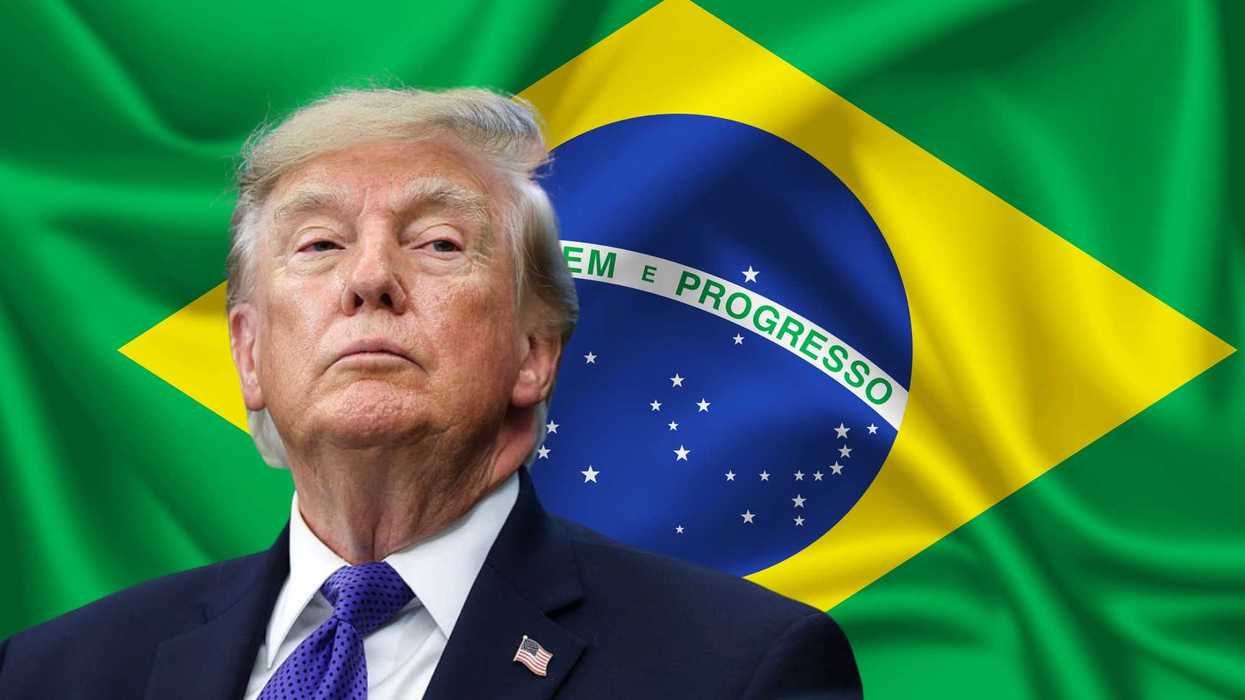
U.S. President Donald Trump speaks during a campaign rally at Pinnacle Bank Expo Center on the Nebraska State Fairgrounds on October 05, 2026 in Grand Island, Nebraska.
The President Invited Iran to Bomb My Home
I was driving home to San Diego from Los Angeles on Monday night when I heard that the President of the United States had offered both cities up to Iran as bomb targets. At a rally in Nebraska, defending his war, Trump told the crowd, “let [Iran] take out Los Angeles, let ‘em take out San Diego.” It was, he said, “a very small price to pay.”
I was coming from a Bernie Sanders rally for Proposition 40, the one-time tax on California billionaires that would send 90% of its revenue to healthcare. We desperately need it to pass because, in order to give tax breaks to billionaires, Trump signed a law that will strip health coverage from 10 million Americans; this tax will make sure we can still cover Californians. Call me crazy, but I think taxing billionaires one time so we can make sure kids in California get to see a doctor is a very small price to pay. I also think that even if Trump were joking, it is indefensible to make jokes about the potential destruction of so many lives. Human life is never a small price to pay. Human life is priceless.
Plus, the reality is: here in San Diego, we’re already paying the price for Trump’s actions, and it’s not small at all. He has gutted FEMA, tried to kill climate resiliency programs, and destroyed public health standards, while his signature law is set to cut off health insurance and food support for hundreds of thousands of San Diegans. Like plenty of American cities, San Diego is already busy finding local solutions to respond to the problems this president has recklessly created.
Not to mention, at least 19 American service members have been killed in this war already. Human rights monitors have documented more than 3,600 dead in Iran by April alone. Here at home, gas is sitting just pennies below its all-time record. Taxpayers have already spent more than $45 billion on the war, while Trump’s oil and gas portfolio has grown by roughly $15.5 million this year alone. Of course anything is a “small price” to someone paying free.99 for this war, and profiting from it. Meanwhile, We the People are paying twice: first for the war, and then for the consequences of that war. But now he wants San Diego to pay a third time, flippantly offering us up to Iran.
It is worth noticing which cities he thought to name. Were San Diego and Los Angeles strategically chosen to signify something to his audience, or were they simply the first cities that came to mind as expendable places? Either way, the effect is to normalize—-and to gauge a crowd’s reaction to–the idea of massive violence in major California cities, suitable targets because of their perceived liberal lean. So what if Iran needs to bomb a little bit of America before the war can be over? Who cares, says Trump, if they target Los Angeles and San Diego?
By the way, why didn’t he offer up San Francisco, the free-love hippie-town MAGA loves to hate (and also my birthplace)? Could it be because that’s where the tech titans live? The same ones who joined Trump for Xi Jinping’s state dinner, a guest list worth a combined $2.4 trillion?
San Diego may have fewer billionaires, but it is home to more than 115,000 active-duty service members and 230,000 veterans. One in six active-duty sailors–in the entire Navy–is stationed here. So is one in four Marines. You cannot throw a rock in this county without hitting a military family: brats and spouses and veterans are among us. I got out of the Navy last year after ten years, and eight of those were here in San Diego. When Trump says “let ‘em take out San Diego,” he’s talking about the backbone of the United States military. He’s also talking about the people fighting his war.
San Diego has not been watching this war from the sidelines. Today, the USS Abraham Lincoln returns to North Island after an almost yearlong deployment to the Middle East that featured food shortages, broken toilets, and mold in the showers after 286 days at sea without a single port call. Eight sailors in the Lincoln’s strike group attempted suicide, but in August, when a reporter asked whether the deployment had gone on too long, Trump said “not nearly long enough.” Now he has told a crowd in Nebraska that we should let Iran take out the city those sailors call home. These are sociopathic sentiments.
Last week at Quantico, Pete Hegseth closed his address to the force by telling them, “President Trump has your back and so do I.” To the contrary, President Trump has put one of the biggest military towns in the country forward as a target for our adversaries. With friends like these, the “domestic” in “against all enemies, foreign and domestic” starts to sound a lot less hypothetical.
San Diego is home to Naval Air Station North Island, Naval Base San Diego, Naval Amphibious Base Coronado, the Point Loma submarine base, Camp Pendleton, and Miramar (and I have been permanently stationed at or trained at all of them). If Iran bombed San Diego and Los Angeles, aside from the devastating loss of life, it would cripple an immense share of our national security readiness.
And for what, exactly? Trump says the war is “essentially almost over with.” This is the same man who claimed in June 2025 that Iran’s nuclear program had been “obliterated,” then launched a war over it anyway on February 28. More than seven months later, he wants us to believe two things at once: that we’ve basically won, and that we might need to sacrifice an American city or two to finish winning. If the war is almost over, why does anybody need to take out San Diego?
I wonder if Trump’s endorsed candidate for California’s 48th District here in San Diego County will respond to these remarks. He recently said “no pain, no gain,” when referring to the gas prices San Diegans are paying. Jim Desmond, would you apply that same mindset if we were bombed? Or do you have the moral courage to stand up for the people you’re running to represent?
Last November, six Democratic members of Congress, all veterans, including Senator Mark Kelly, recorded a video reminding troops of their duty to disobey unlawful orders, restating the law that says so. Trump called it “SEDITIOUS BEHAVIOR, punishable by DEATH,” and then his Justice Department went looking for an indictment, which a grand jury refused. The president treated reading the law out loud to the troops as a capital offense, but then he himself invited a foreign enemy to destroy two American cities, possibly as a punchline. Is anyone calling the latter sedition? Who is demanding accountability?
Calling our lives a small price to pay affirms a moral bankruptcy, as well as an obvious dereliction of duty to the office he holds. While we can’t impeach him or invoke the 25th Amendment ourselves, we must stop being so quiet about what we’re paying already. We can make our voices heard by calling our representatives, writing op-eds, knocking doors, phone banking, and voting in defiance of the man who threatens the safety of our city. Ballots are already arriving in mailboxes. Vote, and vote yes on 40 (and no on 41 and 42).
Trump has been harming our cities for a while, but now he is inviting our military adversaries to join him in the harm. If we have any self-respect as Americans, we must not tolerate our leaders disregarding the dignity of lives in this way. We must fight for our home.
Julie Roland was a Naval Officer for ten years, deploying to both the South China Sea and the Persian Gulf as a helicopter pilot before separating in June 2025 as a Lieutenant Commander. She has a law degree from the University of San Diego, a Master of Laws from Columbia University, and is a member of the Truman National Security Project.