



This is the third Fulcrum essay in my three-part series, John Adams on Virtue, examining what sustains a republic when leaders abandon restraint, and citizens must decide what can still be preserved.
Part I, John Adams Warned Us: A Republic Without Virtue Can Not Survive, explored what citizens owe a republic beyond loyalty or partisanship. Part II, John Adams and the Line a Republic Should Not Cross, examined the lines a republic must never cross in its treatment of its own people. Part III turns to the hardest question: what citizens must do when those lines are crossed, and formal safeguards begin to fail. Their goal cannot be the restoration of a past normal, but the preservation of the capacity to rebuild a political order after sustained institutional damage.
When the Republic Fails Its Own Test
A government that mistreats its own people does not stop because citizens are polite or because leaders rediscover conscience. It stops when the costs of abuse rise and the supports that make abuse possible begin to fracture. In modern states, that fracture often arrives as a political wave, when legitimacy loss, institutional resistance, and electoral consequences converge faster than power can adapt.
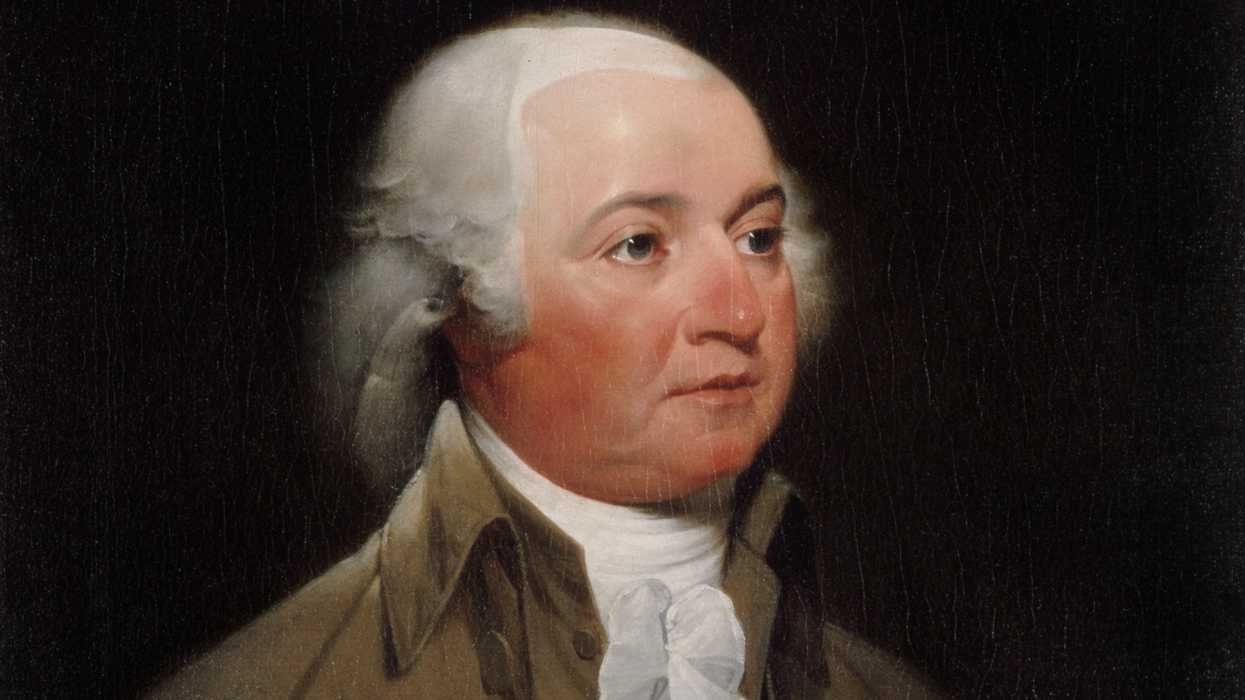
John Adams understood this tension. He supported independence from Britain, yet distrusted disorder, mob violence, and passion unmoored from law. His defense of British soldiers after the Boston Massacre trials reflected a belief that standards must be upheld even when anger is justified.
When a republic fails its own test, citizens face a choice. They can answer lawlessness with lawlessness, often strengthening the hand of power. Or they can practice a more demanding form of resistance: disciplined refusal. As used here, disciplined refusal is nonviolent action that imposes real political, legal, or economic cost by disrupting implementation, exposing abuse, or denying legitimacy in ways power cannot easily absorb, while preserving legitimacy for whatever comes next.
The old normal is gone at the institutional level, even if much of daily life appears unchanged. Authoritarian drift leaves residues, reordering coalitions in ways that benefit power and normalizing behaviors that outlast any single administration. Moving forward depends not on restoring those old alignments, but on forming new coalitions capable of closing the divisions that authoritarian governance relies on.
1776, Honestly Assessed
Did disciplined, nonviolent resistance work in 1776? Only up to the point where political authority foreclosed every remaining nonviolent path.
Before independence, the colonies exhausted nonviolent levers. Boycotts, nonimportation agreements, and committees of correspondence created a functioning system of coordinated refusal. By 1774, the Articles of Association imposed real economic pressure on British trade and social pressure within colonial communities to enforce compliance with non-importation and non-consumption agreements. Enforcement was local and social as much as economic; communities policed compliance themselves, demonstrating capacity for self-rule even before independence.
Parliament responded with coercion. The port of Boston was closed. Massachusetts’ charter was altered. Military authority expanded. When colonial leaders appealed again, the Crown refused to engage, rejecting the Olive Branch Petition. That refusal closed the political path. Independence followed not because violence was preferred, but because alternatives had been foreclosed.
Adams supported separation while remaining wary of what unrestrained passion would do to the republic after the fighting stopped. He believed legitimacy itself was a form of power the public controlled, and once squandered, difficult to recover. His concern was never only how to break from tyranny, but how to avoid becoming it, a throughline in the Adams Papers Digital Edition.
What Disciplined Refusal Preserves
Disciplined refusal does not guarantee success. It preserves conditions without which success becomes impossible. It operates across society: citizens willing to accept personal risk, professionals and civil servants bound by ethics, local officials protecting normal life, and institutions that slow or resist abuse rather than implement it smoothly.
Nonviolent resistance preserves coalition breadth. It allows participation across levels of risk and belief and denies power the polarization it needs to endure. Authoritarian systems survive by forcing the public into two camps. When opposition turns violent, it shrinks its own tent and hands the regime the story it wants to tell, that only repression can restore order.
Disciplined refusal does the opposite. It keeps the door open for conservatives who still care about constitutional constraint, for civil servants and professionals bound by ethics, for local leaders protecting normal life, and for citizens who reject both cruelty and chaos. In a polarized system, restraint is not passivity. It is strategy.
It also preserves institutional capacity. Courts, agencies, and laws remain usable when the crisis passes because they were strained, not obliterated. Privately held preferences can build beneath the surface, creating latent pressure for change that becomes decisive when political conditions shift, a dynamic analyzed by Timur Kuran in Private Truths, Public Lies.
When Violence Becomes Unavoidable
History does not show that violence is never used. It shows when violence ceases to constrain power and begins to reinforce it.
In 1776, violence emerged only after imperial authority foreclosed every remaining nonviolent mechanism. Petitions were rejected, self-government dismantled, and military rule displaced civil authority. British power still depended on broad colonial cooperation. Once that cooperation collapsed, armed conflict became the dominant fact rather than a chosen strategy.
That configuration does not hold in modern states in the same way. Britain’s imperial power, though militarily dominant, still depended on broad colonial cooperation to govern. Contemporary governments possess professional security forces, centralized intelligence, legal mechanisms for emergency rule, and the capacity to suppress violent challengers without relinquishing administrative control. In that context, violence rarely weakens power. It consolidates it, supplying justification for repression and narrowing opposition to a risk-tolerant fringe.
The lesson of 1776 is not that violence restores liberty. It is that violence followed only after legitimacy and cooperation had already broken down. Where modern states retain coercive dominance, armed rebellion is more likely to consolidate authoritarian control than restore democracy. For that reason, disciplined refusal remains decisive, not as a moral preference, but as recognition that legitimacy, compliance, and coalition breadth remain the levers that determine whether power fractures or hardens.
What Remains
John Adams did not believe that republics survive because power learns restraint. He believed they survive because citizens do.
That belief was not sentimental. It reflected hard experience with how easily justified anger becomes ruled by force. The country that emerges from this period will not be the one that preceded it. That question is settled.
The remaining question is whether it will still be governed by standards or only by force. Guardrails with real enforcement power emerge not from unity alone, but from durable alignment across differences. They are enforced through institutions and coalitions rather than through informal restraint.
Adams would say that is the responsibility that remains.
.




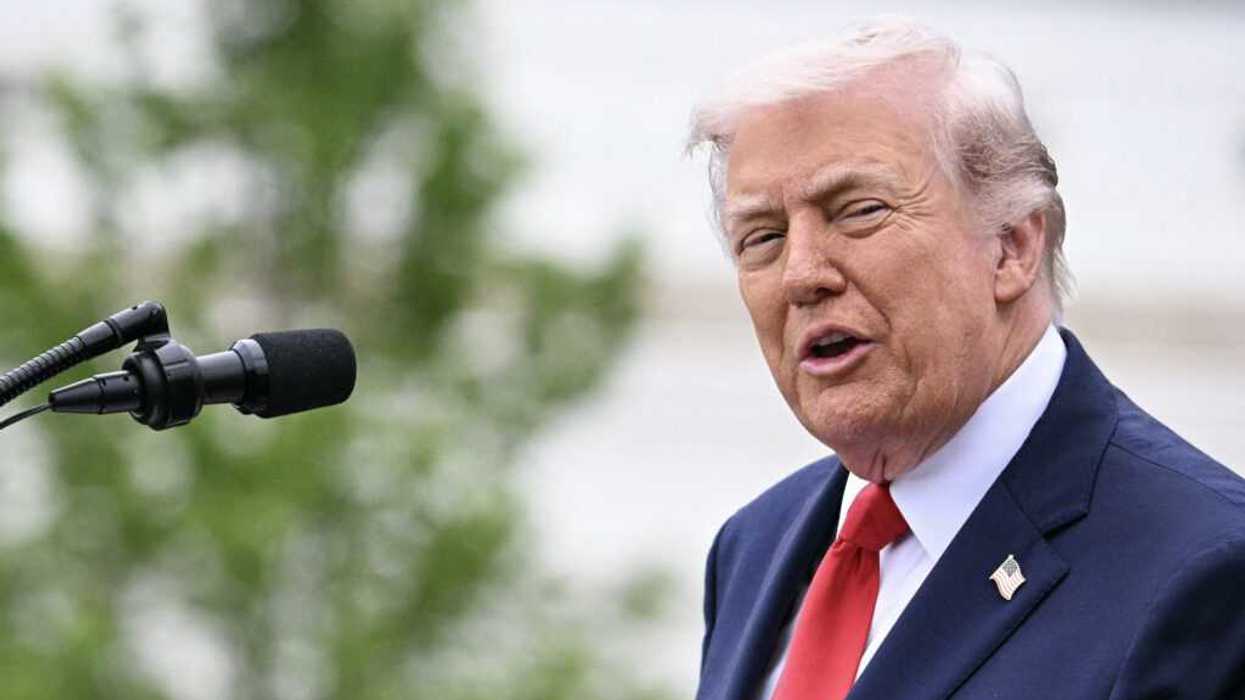


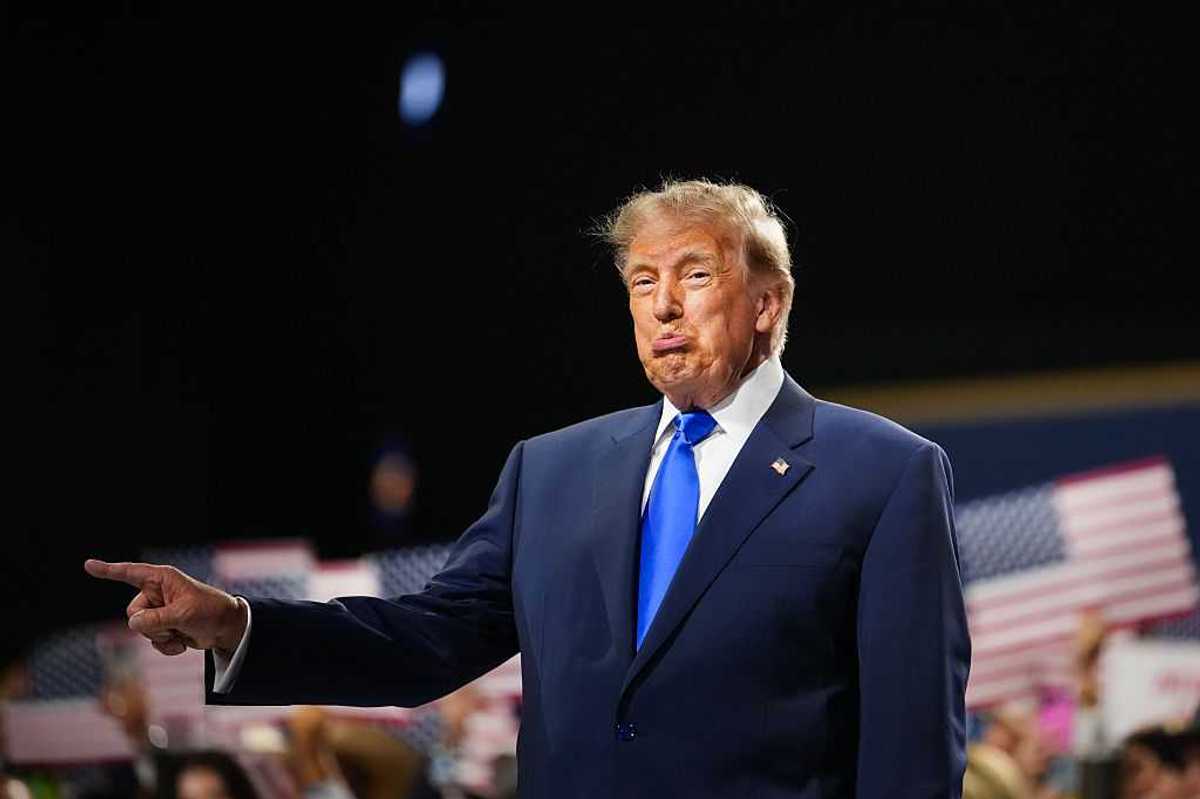
U.S. President Donald Trump speaks during a“ Steel Across America” event ahead of the 25th anniversary of the Sept. 11th attacks on the Ellipse near the White House on Sept. 8, 2026 in Washington, D.C. President Trump welcomed 9/ 11 first responders to the Tunnel to Towers Foundation’ s“ Steel Across America” event featuring a 16,900- pound, 21- foot steel beam recovered.
For Trump, even 9/11 is an opportunity
There was a reason organizers of the 9/11 ceremony in Manhattan told President Trump he could not speak at this year’s memorial service.
A good one, it turns out.
Because in a speech he gave on Tuesday in Washington, he did exactly what they were presumably worried about — he made it about himself.
According to The New York Times, Trump had wanted a speaking role at the service, but the National Sept. 11 Memorial and Museum, which oversees the site, said no, as they’ve maintained for the past decade-plus that the venue and event should be nonpartisan.
Trump has long used awful tragedies to either puff himself up, trash political opponents, or sell lies to the American people.
He blamed a deadly plane crash at Washington National Airport last year on diversity, equity and inclusion policies. He blamed Puerto Ricans for the devastation they endured after Hurricane Maria in 2017. He reportedly considered withholding disaster relief after the California wildfires based on the way affected regions voted. In an interview on Fox News meant to commemorate the 75th anniversary of D-Day in Normandy, he used the occasion to slam former House Speaker Nancy Pelosi…with graves of the dead behind him.
And now, as we approach the 25th anniversary of what many New Yorkers consider the darkest day in modern history, Trump has done it again.
He told a rambling, nonsensical story — one he’s told before — about going to Ground Zero just after terrorists flew two commercial jets into the twin towers. In the story, which no one has been able to verify, despite multiple attempts, he says firefighters had to carry him out of One Liberty Plaza, also known as the U.S. Steel Building, because they thought it was about to collapse.
As CNN fact checker Daniel Dale notes, there’s no evidence Trump went into this building, especially at a time when NYPD and NYFD had locked down the area. There’s no evidence that building was collapsing — in fact, it was deemed structurally sound and reopened within two months of the attacks. There’s no evidence he was carried out of it by firefighters.
But the lie isn’t even the worst part. Pretend it was all true — why would the leader of our country, and a New Yorker, decide to make that tragic day about himself?
Because that’s who Donald Trump is. He’s a malignant narcissist.
He’s also, incidentally, a terrible and ineffectual president, who’s made ill-fated decisions that he has to keep defending, and there’s nothing he won’t do to make himself look and feel better.
Within the first two minutes of his speech, he was cravenly using 9/11 to justify and promote his dumb war in Iran — two events separated by 25 years and 6,000 miles.
“And I will tell you, we’re right now fighting because we have a certain nation that wanted a nuclear weapon, they were very close to getting it, and now they have no chance at getting it. They will never have a nuclear weapon. Iran will not have a nuclear weapon. And they’ve been punished greatly. As you know, we’ve really taken it to them.”
As a New Yorker who lived through 9/11, still one of the worst days of my life, I’m utterly sickened by Trump’s crass, political, and self-promotional framing of that awful day.
And I’m relieved he won’t be given a platform to do it again on Friday’s anniversary in lower Manhattan.
Because for Trump, everything is his for the taking, and absolutely nothing is sacred.
S.E. Cupp is the host of "S.E. Cupp Unfiltered" on CNN.