


Skip to content
Search

Latest Stories

Follow Us:
Top Stories

Donald Trump’s Iran war without rhyme or reason

Opinion

Donald Trump’s Iran war without rhyme or reason

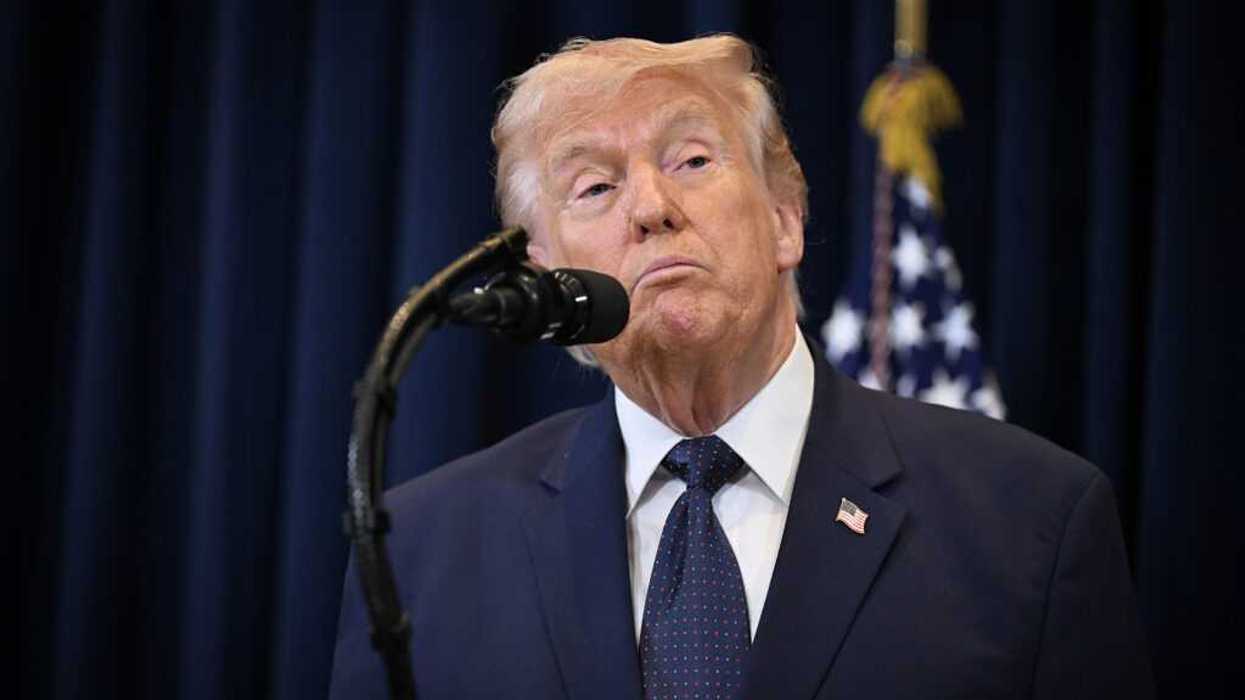
President Donald Trump speaks to reporters during a news conference at Trump National Doral Miami on March 9, 2026, in Doral, Florida. President Trump spoke on his administration's strikes on Iran.

(Roberto Schmidt/Getty Images/TCA)

If you ask President Trump, he’ll tell you we’ve already won the war in Iran.

When asked for an update by Axios on Wednesday, Trump responded with the kind of upbeat nonchalance and flippant boastfulness you’d usually see when asked about the progress on one of his hotels.


“The war is going great,” he said. “We are way ahead of the timetable. We have done more damage than we thought possible, even in the original six-week period.” He then offered that there’s “practically nothing left to target.”

As for an ending? “Any time I want it to end, it will end.”

How, exactly, is it “going great”? What is the “timetable”? Shouldn’t it end when the mission is achieved and not when Trump simply wants it to?

His administration has simultaneously given no rationale to justify our strikes on Iran — failing to prove we were the target of an imminent attack — and all the reasons why we had to, from regime change, to oil, to support for Israel.

It’s sent mixed messages on timing, promising both that it’s practically over and that it could take a while. And it’s been unreliable in its own accounting of what’s actually happened. Have we decimated Iran’s nukes? (I thought we’d already done that.) And who is responsible for the attack that killed 160 schoolchildren in Iran?

We still have no answers to these important questions. When pressed on the school attack, for one, Trump has said everything from Iran was responsible to, most recently, “I don’t know about it.” But an initial report determined the U.S. was at fault, the result of a targeting mistake.

As for the nukes, which the White House declared“ obliterated” last June, our own intelligence assessment just found that Iran can still access about 60% of its enriched material stored at Esfahan. As the non-partisan Arms Control Association notes, “Although strikes can set back Iran’s nuclear program and destroy key infrastructure…military force cannot eliminate Tehran’s proliferation risk.”

Trump’s version of events, as is so often the case, isn’t based on facts, but wishcasting, projection, bombast and bluffs.

And abroad, it isn’t working.

In France, for example, Le Monde derides Trump’s treatment of the war as “spectacle,” lambasting his “celebratory tone.” It noted his grotesque joke that it’s “more fun” to sink Iranian warships than to seize them,” and Defense Secretary Pete Hegseth’s boast that “we are punching [the Iranians] while they’re down, which is exactly how it should be.”

In The Guardian, columnist Rafael Behr points out the chaos and incompetence of Trump’s war: “Regime change was the plan, but Trump finds it easier to change plans than regimes. He says he has won, but also that he has more winning to do. This is the familiar stage of rhetorical climbdown, indicating dawning awareness that a problem is more complicated than the president initially thought. Complexity resists his whim. It bores him.”

And in Germany’s Bild, Europe’s highest-circulating newspaper, the question is pointed: “Whose pockets is Trump filling with bombs?” It declares “the clearest winner in the biggest Middle East conflict in decades is the U.S. arms industry” and Trump’s sons, who are conveniently now in the drone business.

The world can see through Trump’s charade, but do American voters? Most polls show more voters oppose the war than support it, but by a slim margin.

That margin will widen with time, most certainly. And then Trump’s slick sales pitch will be less and less effective. Or maybe I’m the one who’s wishcasting.

S.E. Cupp is the host of "S.E. Cupp Unfiltered" on CNN.

Read More

Virginia Gov. Abigail Spanberger delivers the Democratic response to U.S. President Donald Trump's State of the Union address on February 24, 2026 in Williamsburg, Virginia.

Virginia Gov. Abigail Spanberger delivers the Democratic response to U.S. President Donald Trump's State of the Union address on February 24, 2026 in Williamsburg, Virginia.

Getty Images, Mike Kropf

Three Questions Linger After State of the Union Speech

Anyone tuning into the State of the Union expecting responsible governance was sorely disappointed. What they got instead was pure Trumpian spectacle.

All the familiar elements were there: extended applause lines, culture-war provocation, even self-congratulation, praising the U.S. hockey team and folding its victory into a broader narrative of national resurgence. The whole thing was show business, crafted for reaction rather than reflection, for clips rather than consensus.

Keep Reading Show less
When Secrecy Becomes Structural

U.S. President Donald Trump at the White House February 20, 2026 in Washington, DC.

(Photo by Kevin Dietsch/Getty Images)

When Secrecy Becomes Structural

Secrecy is like a shroud of fog. By limiting what people can see and check for themselves, the public gets either a glimpse (or nothing at all), depending on what gatekeepers decide to share. And just as fog comes in layers, so does withholding: one missing document, one delayed detail, one “not available” that becomes routine.

Most adults understand there are things that shouldn’t be shown. Lawyers can’t reveal case details to people who aren’t involved. Police don’t release information during an active investigation. Doctors shouldn’t discuss your medical history at home. The reason is simple: actual harm can follow when sensitive information is revealed too early or to those who shouldn’t be told.

Keep Reading Show less
For Trump, the State of the Union is delusional

U.S. President Donald Trump, with Vice President JD Vance and Speaker of the House Mike Johnson looking on, delivers his State of the Union address during a Joint Session of Congress at the U.S. Capitol on Feb. 24, 2026, in Washington, D.C. Trump delivered his address days after the Supreme Court struck down the administration's tariff strategy and amid a U.S.


(Getty Images)

For Trump, the State of the Union is delusional

State of the Union speeches haven’t mattered in a while. Even in their heyday, they were only bringing in 60-plus million viewers, and that’s been declining substantially for decades. They rarely result in a post-speech bump for any president, and according to Gallup polling data since 1978, the average change in a president’s approval rating has been less than one percentage point in either direction.

To be sure, this is good news for President Trump. He should hope and pray this State of the Union was lightly watched.

Keep Reading Show less
The spectacle of Operation Epic Fury
A general view of Tehran with smoke visible in the distance after explosions were reported in the city, on March 02, 2026 in Tehran, Iran.
(Photo by Contributor/Getty Images)

The spectacle of Operation Epic Fury

The U.S. and Israel’s joint military campaign against Iran, which rolled out under the name Operation Epic Fury, is a phrase that sounds more like a summer action film than a real‑world conflict in which people are dying. The operation involves massive strikes across Iran, with U.S. Central Command reporting that more than 1,700 targets have been hit in the first 72 hours. President Donald Trump described it as a “massive and ongoing operation” aimed at dismantling Iran’s military capabilities.

This framing matters. When leaders adopt language that emphasizes spectacle, they risk shifting public perception away from the gravity of war. The death of Iran’s supreme leader following the bombardment, for example, was a world‑altering event, yet it unfolded under a banner that evokes adrenaline rather than anguish.

Keep Reading Show less