

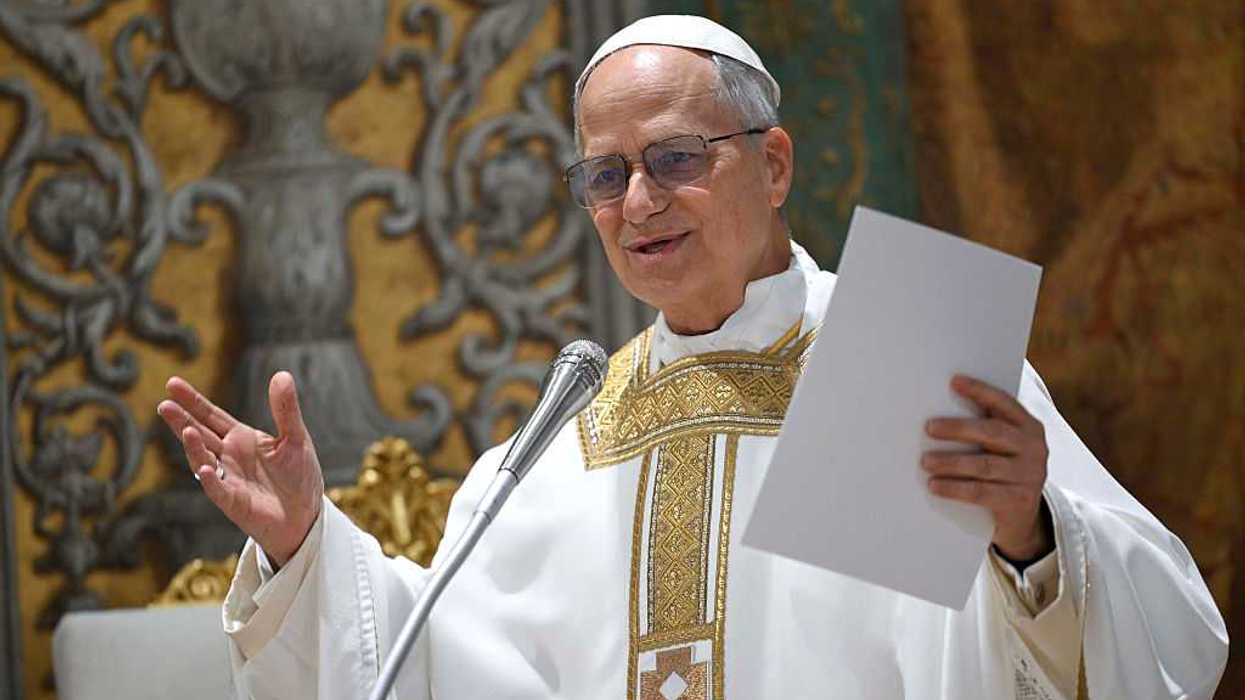

The Vice President has stepped into the fray between the President and Pope Leo. For those of you who have not been following this, Pope Leo has been critical of various things that Trump has said regarding his war with Iran, including his statement that he was ready to wipe out the civilization. In response, Trump called Pope Leo too liberal and easy on crime. He also said that the Pope was only elected because he was an American, in response to Trump having been elected President. In response, the Pope said that he had no fear of the Trump administration and that his job was to preach the gospel. He said in response to Secretary of War Hegseth's invoking the name of Jesus for support in battle, that Jesus “does not listen to the prayers of those who wage war, but rejects them.”
Into this exchange steps the Vice President, who says he thinks the Pope should stick to "matters of morality" and let the President of the United States dictate American public policy. The Vice President obviously doesn't understand the meaning of morality and its scope.
"Morality" is defined by the Merriam-Webster dictionary as a system of moral conduct, conformity to ideals of right human conduct, or virtue. "Moral", in turn, is defined as the principles of right and wrong in human behavior. "Virtue" is defined as morally good behavior or character.
How do we as a society define what is right and wrong in human behavior? For most of man's history, that standard has been defined by religion, whether Judaism, Christianity, Islam, Buddhism, or other religions. Whether the voice is that of God, Jesus, Mohammed, or the Buddha, each has set the standard for right and wrong behavior towards one's fellow man. And those standards have, in most respects, been virtually identical.
The 10 Commandments are a prime example of religion defining right and wrong behavior. The Golden Rule—do unto others as you would have them do unto you—is a principle underlying all the world's great religions.
The Pope is thus an ideal person to make statements on human behavior and morality. What are some of Trump's statements?
“A whole civilization will die tonight, never to be brought back again.”
“Open the Fuckin’ Strait, you crazy bastards, or you’ll be living in Hell — JUST WATCH! Praise be to Allah,” (this on Easter Sunday)
These are statements that the Pope, as Pope, has every right and responsibility to speak out against. As he said, he will continue to speak "out loudly on the message of the gospel, which is what I believe I am here to do, what the church is here to do.” Further, he said, "Too many people are suffering in the world today. Too many innocent people are being killed. And I think someone has to stand up and say there's a better way."
This is sticking to "matters of morality." The Vice President needs to restudy his catechism. He also needs to understand that the United States was founded on the Enlightenment's principles of morality, as stated in the Declaration of Independence:
"all men are created equal, that they are endowed by their Creator with certain unalienable rights, that among these are life, liberty, and the pursuit of happiness—that to secure these rights, governments are instituted among men."
When Trump dictates American public policy that is contrary to the essence of America's founding principles, then he is not jut being immoral, he is leading the country in a very un-American way.
Ronald L. Hirsch is a teacher, legal aid lawyer, survey researcher, nonprofit executive, consultant, composer, author, and volunteer. He is a graduate of Brown University and the University of Chicago Law School and the author of We Still Hold These Truths. Read more of his writing at www.PreservingAmericanValues.com
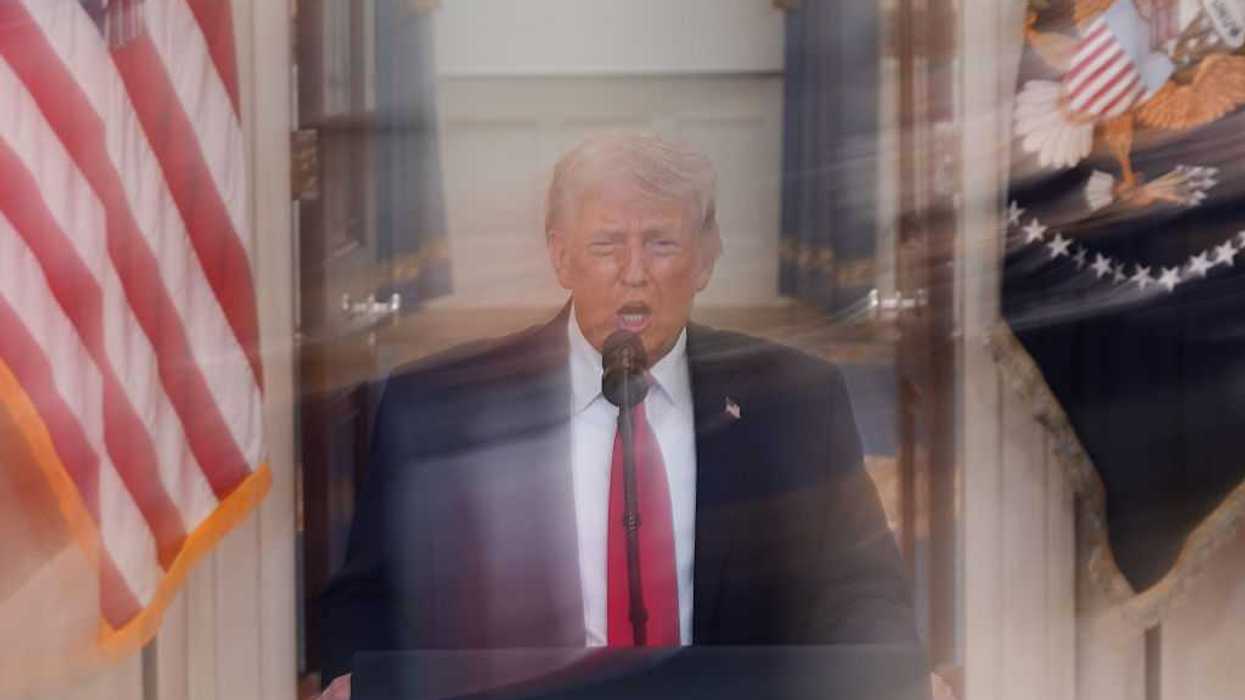





U.S. President Donald Trump speaks during a“ Steel Across America” event ahead of the 25th anniversary of the Sept. 11th attacks on the Ellipse near the White House on Sept. 8, 2026 in Washington, D.C. President Trump welcomed 9/ 11 first responders to the Tunnel to Towers Foundation’ s“ Steel Across America” event featuring a 16,900- pound, 21- foot steel beam recovered.
For Trump, even 9/11 is an opportunity
There was a reason organizers of the 9/11 ceremony in Manhattan told President Trump he could not speak at this year’s memorial service.
A good one, it turns out.
Because in a speech he gave on Tuesday in Washington, he did exactly what they were presumably worried about — he made it about himself.
According to The New York Times, Trump had wanted a speaking role at the service, but the National Sept. 11 Memorial and Museum, which oversees the site, said no, as they’ve maintained for the past decade-plus that the venue and event should be nonpartisan.
Trump has long used awful tragedies to either puff himself up, trash political opponents, or sell lies to the American people.
He blamed a deadly plane crash at Washington National Airport last year on diversity, equity and inclusion policies. He blamed Puerto Ricans for the devastation they endured after Hurricane Maria in 2017. He reportedly considered withholding disaster relief after the California wildfires based on the way affected regions voted. In an interview on Fox News meant to commemorate the 75th anniversary of D-Day in Normandy, he used the occasion to slam former House Speaker Nancy Pelosi…with graves of the dead behind him.
And now, as we approach the 25th anniversary of what many New Yorkers consider the darkest day in modern history, Trump has done it again.
He told a rambling, nonsensical story — one he’s told before — about going to Ground Zero just after terrorists flew two commercial jets into the twin towers. In the story, which no one has been able to verify, despite multiple attempts, he says firefighters had to carry him out of One Liberty Plaza, also known as the U.S. Steel Building, because they thought it was about to collapse.
As CNN fact checker Daniel Dale notes, there’s no evidence Trump went into this building, especially at a time when NYPD and NYFD had locked down the area. There’s no evidence that building was collapsing — in fact, it was deemed structurally sound and reopened within two months of the attacks. There’s no evidence he was carried out of it by firefighters.
But the lie isn’t even the worst part. Pretend it was all true — why would the leader of our country, and a New Yorker, decide to make that tragic day about himself?
Because that’s who Donald Trump is. He’s a malignant narcissist.
He’s also, incidentally, a terrible and ineffectual president, who’s made ill-fated decisions that he has to keep defending, and there’s nothing he won’t do to make himself look and feel better.
Within the first two minutes of his speech, he was cravenly using 9/11 to justify and promote his dumb war in Iran — two events separated by 25 years and 6,000 miles.
“And I will tell you, we’re right now fighting because we have a certain nation that wanted a nuclear weapon, they were very close to getting it, and now they have no chance at getting it. They will never have a nuclear weapon. Iran will not have a nuclear weapon. And they’ve been punished greatly. As you know, we’ve really taken it to them.”
As a New Yorker who lived through 9/11, still one of the worst days of my life, I’m utterly sickened by Trump’s crass, political, and self-promotional framing of that awful day.
And I’m relieved he won’t be given a platform to do it again on Friday’s anniversary in lower Manhattan.
Because for Trump, everything is his for the taking, and absolutely nothing is sacred.
S.E. Cupp is the host of "S.E. Cupp Unfiltered" on CNN.