

Skip to content
Search

Latest Stories

Follow Us:
Top Stories

You can’t hide from war crimes by calling them ‘fake news’

Opinion

You can’t hide from war crimes by calling them ‘fake news’

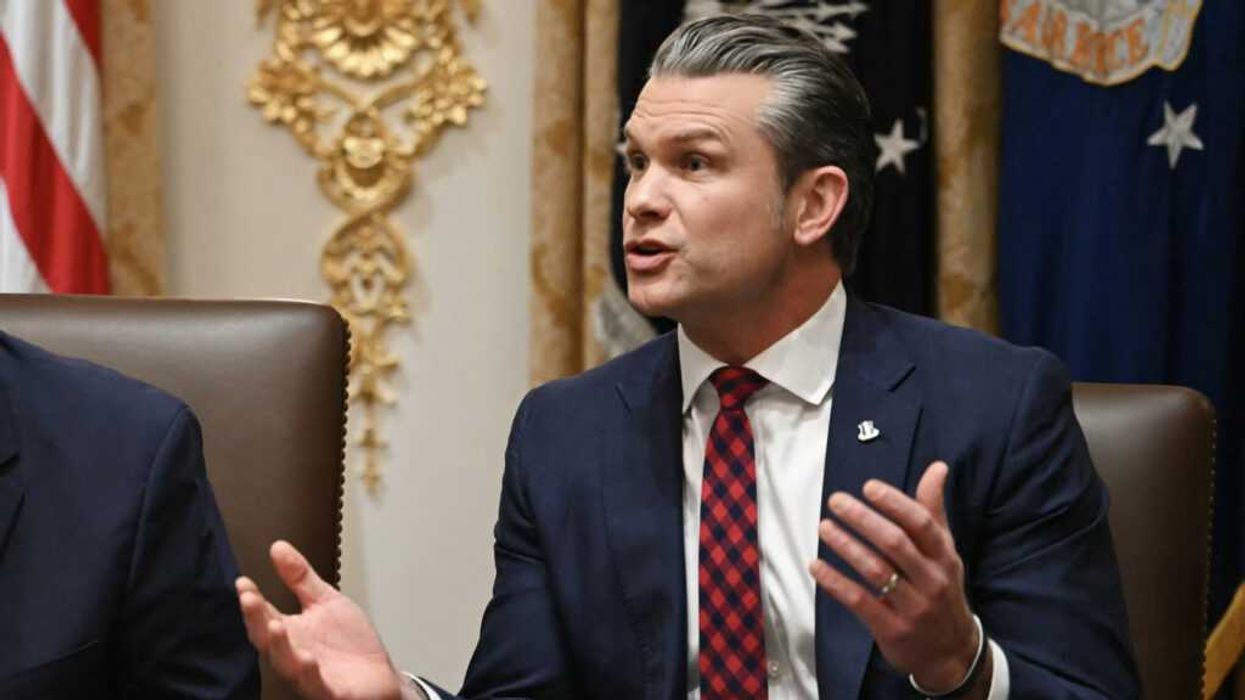
U.S. Secretary of Defense Pete Hegseth speaks during a cabinet meeting hosted by President Donald Trump in the Cabinet Room of the White House in Washington, D.C., on Tuesday, Dec. 2, 2025.

(Andrew Caballero-Reynolds/AFP/Getty Images/TNS)

Since September of this year, the United States military has been blowing up boats allegedly trafficking drugs in the Caribbean.

Whether these attacks are legal is hotly debated. Congress hasn’t declared war or even authorized the use of force against “narco-terrorists” or against Venezuela, the apparent real target of a massive U.S. military build-up off its coast.


The Trump administration has simply unilaterally designated various — alleged — drug traffickers as “terrorists” or members of “terrorist organizations,” and then waged war upon them. The administration’s internal legal finding supporting all of this hasn’t been publicly released. But whatever their case in private is, it was sufficiently weak that the British government announced in early November it would no longer share intelligence with the U.S. relevant to the Caribbean operation over concerns about its lawfulness.

On Friday, the Washington Post dropped a bombshell report about the first of these operations back in September. During the strike, the Navy not only took out a suspected drug-trafficking boat — as had been reported previously — but when survivors were spotted clinging to the wreckage, the special operations commander overseeing the operation ordered a second strike on the survivors, in order to comply with Defense Secretary Pete Hegseth’s order to kill everyone involved.

“Hegseth gave a spoken directive, according to two people with direct knowledge of the operation,” the Post reported. “ ‘The order was to kill everybody,’ one of them said.”

Whatever you think about the broader Caribbean operation, it is a simple fact that shooting survivors at sea is war crime, under American and international law. Of course, as some suggest, since this operation is not a legal war, maybe it’s not a war crime, just a crime-crime.

Later Friday, in a lengthy social media post, Hegseth attacked the Washington Post’s report as an instance of the “fake news … delivering more fabricated, inflammatory, and derogatory reporting.”

What Hegseth didn’t do was directly deny the report. Instead, he insisted that “we’ve said from the beginning, and in every statement, these highly effective strikes are specifically specifically intended to be ‘lethal, kinetic strikes.’ ”

Declaring your intent was to kill everybody on the first try isn’t a legal excuse to finish off unarmed survivors.

Hegseth offered follow-up posts that were boastful or childish, but did not deny the charge.

With even Republican members of Congress expressing grave concerns, the official story changed from “fake news” to an actual denial. Trump said that Hegseth told the president that he did not give any such illegal order, “and I believe him, 100%,” adding that he “wouldn’t have wanted that. Not a second strike.”

So it now appears the White House has confirmed there was a second strike on the survivors, and conceded that it would at least be against the president’s policy. Whether the White House will concede the strike was unlawful remains to be seen. Indeed, exactly what happened remains murky. It surely seems like someone gave an order for a second strike. And if it wasn’t Hegseth, whoever that person was could be looking at a court-martial — or given who the commander-in-chief is, a pardon.

But I don’t want to get ahead of the news.

Instead, I’ll make a few points.

First, a minor gripe: This administration and its defenders need to be more selective in their use of the term “fake news.” I have no problem calling a false story “fake news.” But if you know that a story isn’t false, calling it “fake news” just sets you up to look like even more of a liar or hypocrite down the road when you end up admitting the truth and defending actions you once pretended were slanderous.

More importantly, the whole Caribbean strategy is constitutionally and legally dubious. As a matter of foreign policy, it looks more and more like a pretext for some kind of regime change gambit in Venezuela. If the administration has evidence that justifies its actions, they should share it with Congress and ask for permission to wage war.

Even more important: illegal orders cannot be justified. When a half-dozen Democratic members of Congress released a video saying that the military shouldn’t follow “illegal orders,” the president and many of his defenders became hysterical. Trump lamented that America has become so “soft” that such “seditious behavior” isn’t punished by death anymore.

More sober critics of the Democrats complained that the video sowed confusion in the ranks and hurt morale. I’m actually sympathetic to that argument.

But you know what else sows confusion and hurts morale? Issuing illegal orders – or even appearing to do so.

Jonah Goldberg is editor-in-chief of The Dispatch and the host of The Remnant podcast. His Twitter handle is @JonahDispatch.


Read More

The interview that could change history

White House Chief of Staff Susie Wiles looks on during a bilateral meeting between U.S. President Donald Trump and Polish President Karol Nawrocki in the Oval Office at the White House on Sept. 3, 2025 in Washington, D.C.

Alex Wong/Getty Images/TCA

The interview that could change history

Susie Wiles has a reputation. Ask anyone in Washington and words like “strategic,” “disciplined,” and “skilled” come up. She’s widely held to be one of the most effective tacticians in modern politics.

She’s also known for her low-key, low-drama energy, preferring to remain behind-the-scenes as opposed to preening for cameras like so many other figures in President Trump’s orbit.

Keep ReadingShow less
After the Ceasefire, the Violence Continues – and Cries for New Words

An Israeli army vehicle moves on the Israeli side, near the border with the Gaza Strip on November 18, 2025 in Southern Israel, Israel.

(Photo by Amir Levy/Getty Images)

After the Ceasefire, the Violence Continues – and Cries for New Words

Since October 10, 2025, the day when the US-brokered ceasefire between Israel and Hamas was announced, Israel has killed at least 401 civilians, including at least 148 children. This has led Palestinian scholar Saree Makdisi to decry a “continuing genocide, albeit one that has shifted gears and has—for now—moved into the slow lane. Rather than hundreds at a time, it is killing by twos and threes” or by twenties and thirties as on November 19 and November 23 – “an obscenity that has coalesced into a new normal.” The Guardian columnist Nesrine Malik describes the post-ceasefire period as nothing more than a “reducefire,” quoting the warning issued by Amnesty International’s secretary general Agnès Callamard that the ”world must not be fooled” into believing that Israel’s genocide is over.

A visual analysis of satellite images conducted by the BBC has established that since the declared ceasefire, “the destruction of buildings in Gaza by the Israeli military has been continuing on a huge scale,” entire neighborhoods “levelled” through “demolitions,” including large swaths of farmland and orchards. The Guardian reported already in March of 2024, that satellite imagery proved the “destruction of about 38-48% of tree cover and farmland” and 23% of Gaza’s greenhouses “completely destroyed.” Writing about the “colossal violence” Israel has wrought on Gaza, Palestinian legal scholar Rabea Eghbariah lists “several variations” on the term “genocide” which researchers found the need to introduce, such as “urbicide” (the systematic destruction of cities), “domicide” (systematic destruction of housing), “sociocide,” “politicide,” and “memoricide.” Others have added the concepts “ecocide,” “scholasticide” (the systematic destruction of Gaza’s schools, universities, libraries), and “medicide” (the deliberate attacks on all aspects of Gaza’s healthcare with the intent to “wipe out” all medical care). It is only the combination of all these “-cides,” all amounting to massive war crimes, that adequately manages to describe the Palestinian condition. Constantine Zurayk introduced the term “Nakba” (“catastrophe” in Arabic) in 1948 to name the unparalleled “magnitude and ramifications of the Zionist conquest of Palestine” and its historical “rupture.” When Eghbariah argues for “Nakba” as a “new legal concept,” he underlines, however, that to understand its magnitude, one needs to go back to the 1917 Balfour Declaration, in which the British colonial power promised “a national home for the Jewish people” in Palestine, even though just 6 % of its population were Jewish. From Nakba as the “constitutive violence of 1948,” we need today to conceptualize “Nakba as a structure,” an “overarching frame.”

Keep ReadingShow less
Ukraine, Russia, and the Dangerous Metaphor of Holding the Cards
a hand holding a deck of cards in front of a christmas tree
Photo by Luca Volpe on Unsplash

Ukraine, Russia, and the Dangerous Metaphor of Holding the Cards

Donald Trump has repeatedly used the phrase “holding the cards” during his tenure as President to signal that he, or sometimes an opponent, has the upper hand. The metaphor projects bravado, leverage, and the inevitability of success or failure, depending on who claims control.

Unfortunately, Trump’s repeated invocation of “holding the cards” embodies a worldview where leverage, bluff, and dominance matter more than duty, morality, or responsibility. In contrast, leadership grounded in duty emphasizes ethical obligations to allies, citizens, and democratic principles—elements strikingly absent from this metaphor.

Keep ReadingShow less
Beyond Apologies: Corporate Contempt and the Call for Real Accountability
campbells chicken noodle soup can

Beyond Apologies: Corporate Contempt and the Call for Real Accountability

Most customers carry a particular image of Campbell's Soup: the red-and-white label stacked on a pantry shelf, a touch of nostalgia, and the promise of a dependable bargain. It's food for snow days, tight budgets, and the middle of the week. For generations, the brand has positioned itself as a companion to working families, offering "good food" for everyday people. The company cultivated that trust so thoroughly that it became almost cliché.

Campbell's episode, now the subject of national headlines and an ongoing high-profile legal complaint, is troubling not only for its blunt language but for what it reveals about the hidden injuries that erode the social contract linking institutions to citizens, workers to workplaces, and brands to buyers. If the response ends with the usual PR maneuvers—rapid firings and the well-rehearsed "this does not reflect our values" statement. Then both the lesson and the opportunity for genuine reform by a company or individual are lost. To grasp what this controversy means for the broader corporate landscape, we first have to examine how leadership reveals its actual beliefs.

Keep ReadingShow less