


Skip to content
Search

Latest Stories

Follow Us:
Top Stories

A New Norm of DHS Shutdown & Long Airport Lines

Opinion

A New Norm of DHS Shutdown & Long Airport Lines

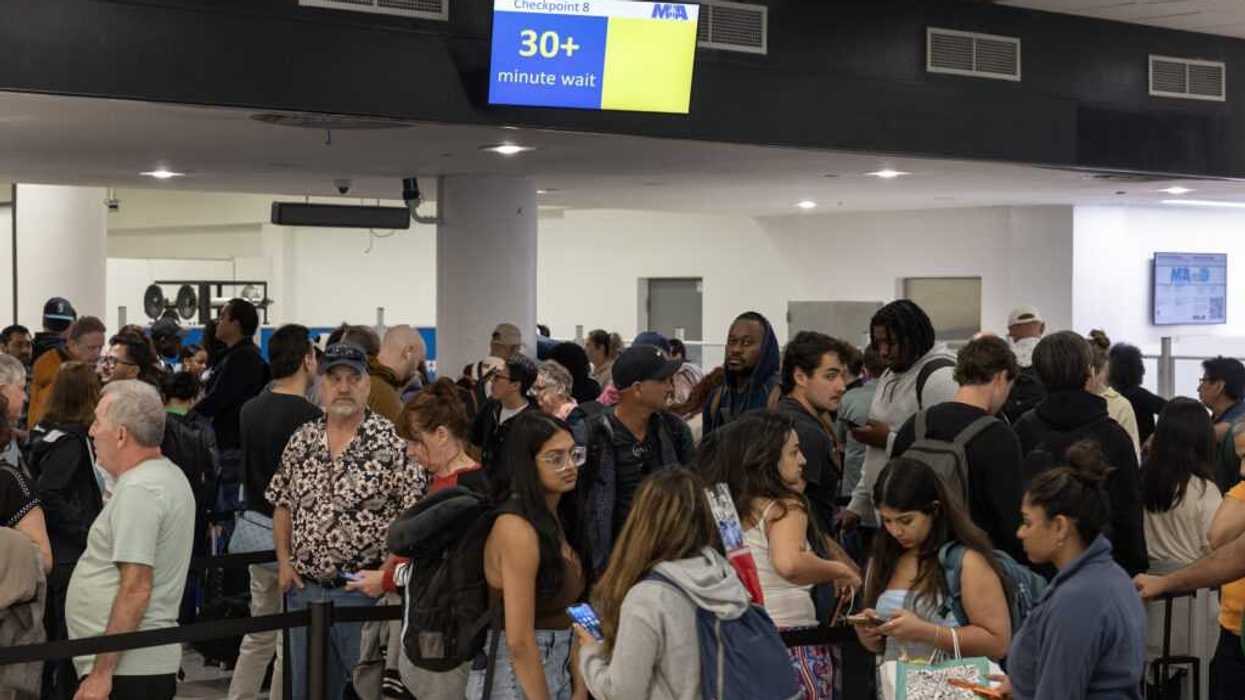
Travelers wait in a TSA Pre security line at Miami International Airport on March 17, 2026, in Miami, Florida. Travelers across the country are enduring long airport security lines as a partial federal government shutdown affects the Transportation Security Administration officers working the security lines.

(Joe Raedle/Getty Images/TCA)

If you’ve ever traveled to France, chances are you’ve come up against this all-too-common phenomenon. You get to the train station and, without warning, your train is out of service. Or a restaurant is oddly closed during regular business hours.

“C’est la grève,” you may hear from a local, accompanied by a shrug. It’s the strike.


There’s a joke in France about their time-honored tradition of labor protests: A tourist asks a waiter what the signs are about at a protest across the street. The waiter hardly looks up and simply says, “Thursday.”

Strikes, protests, work stoppages and closures are so frequent in France, there are multiple apps and websites devoted to letting locals and tourists alike know what will be open and what will be closed, and those in the know check daily.

A strike today at schools in Dijon, Lyon and Rennes; an ongoing transport strike in Rouen; closures at the Louvre. One site promises: “Thanks to our service, unexpected problems are a thing of the past. You’ll no longer be stuck waiting for your train, and you can plan a backup solution!”

Americans may hear this and smugly scoff at a society that’s turned such dysfunction into a revered art form. But our pride is increasingly undeserved.

Last week I flew between Newark and Austin. As you may have seen on the news, the security lines were hours long and, in some cases, snaked out the airport doors and onto the street.

This wasn’t because of a protest or a strike, however, but yet another government shutdown, the third in just six months.

Starting in October last year and lasting for 43 days, we endured the longest shutdown in U.S. history due to an impasse over Affordable Care Act subsidies. Then, earlier this year, a partial shutdown over delays in a funding package linked to immigration. And now, going on more than a month, we’re in another partial shutdown over Department of Homeland Security funding.

The shutdown has meant about 50,000 Transportation Security Administration officers have been working without pay. Many have picked up second jobs, while others are calling in sick and more than 300 have simply quit.

Acting Deputy TSA Administrator Adam Stahl says we’re rapidly approaching a breaking point:

“If the call rate does climb,” he said of agents calling out of work, “there could be scenarios where we may have to shut down airports. This is a serious situation.”

You’d think Congress would want to fix this quickly in an election year, but all evidence to the contrary. Republicans and Democrats remain in a stalemate over DHS funding, with both parties blaming each other and using strikingly similar language to do so.

“Democrats need to end their political posturing, stop using our TSA agents as political pawns, and fully fund DHS,” said Sen. Katie Britt.

Sen. Raphael Warnock said, “I think it’s simply wrong for my Republican colleagues to use these hard-working Americans as leverage, as pawns, in what they are presenting as a false choice to the American people.”

But while both parties finger-point, all the average American sees is a dysfunctional government getting more dysfunctional by the day, with basic pursuits — like air travel — feeling more like capricious and unreliable luxuries.

While inching through security in Austin, someone asked me what the lines were about. “The shutdown,” I said. He didn’t even know we were in one again.

We deserve better from our government. But if this is just our new normal — where on any given day we’re left wondering what parts of our government are open and running — we may, like the French, need to get ourselves an app for that.

S.E. Cupp is the host of "S.E. Cupp Unfiltered" on CNN.


Read More

Protestors holding signs, including one that says "let the people vote."

Attendees hold signs advocating for voting rights and against the SAVE America Act at a rally to outside the U.S. Capitol on March 18, 2026 in Washington, DC.

Getty Images, Heather Diehl

SAVE America Act Debate Begins; Mullin for DHS Hearing

Both chambers of Congress are in session this week and next. The House will probably function about like it has been - lots of votes (often by voice) on uncontroversial bills; many fewer votes on Republican priority bills. Lots of hearings this week and a few legislator updates.

Committee Meetings

Both chambers have a busy week with 64 total committee meetings scheduled.

Keep Reading Show less
Who Decides Whether America Goes to War?

A woman sifts through the rubble in her house in the Beryanak District after it was damaged by missile attacks two days before, on March 15, 2026, in Tehran, Iran.

(Photo by Majid Saeedi/Getty Images)

Who Decides Whether America Goes to War?

Because taking our country into war has the potential, if not the likelihood, even in modernwarfare, of costing the bodies and lives of American soldiers as well as disrupting the economy, this is an important question.

The Constitution is the guide to answering this question. The Constitution clearly states that Congress has the power to declare war. The President does not have that power.

Keep Reading Show less
Republicans aren’t willing to call the war in Iran what it is

Secretary of Defense Pete Hegseth (left) and Admiral Charles Bradford "Brad" Cooper II, Commander of US Central Command, speak during a press conference at US Central Command (CENTCOM) headquarters at MacDill Air Force Base in Tampa, Florida, on March 5, 2026.

(Octavio Jones/AFP via Getty Images/TNS)

Republicans aren’t willing to call the war in Iran what it is

Let's state the obvious: We’re at war with Iran.

My evidence? Turn on your TV. U.S. forces, working with Israel, killed the supreme leader of Iran and many of his top aides. We sunk Iran’s navy and destroyed most of their air force. We bombed thousands of military sites across the region. President Trump, the commander in chief, has demanded “unconditional surrender” from Iran. He routinely refers to this as a “war.” Pete Hegseth, who calls himself the secretary of war, also describes this as a war daily, such as last week when he said, “We set the terms of this war.”

Keep Reading Show less
Selling War Like a Brand Is Disrespectful to Those Truly in Harm’s Way

A memorial in Tyrone honors residents who served in World War I.

Photo by Jay Paterno.

Selling War Like a Brand Is Disrespectful to Those Truly in Harm’s Way

Each day in America as late morning approaches, families of service members stationed in the Middle East probably grow nervous as nightfall nears seven time zones away. On military bases or aircraft carriers, pilots are fueling up and taking off for missions over Iran. In countries across both sides of the Persian Gulf, civilians await the terror of missiles and bombs whistling through the darkness.

Back home, a mother worries about her son in his plane. A spouse, with a young child, worries about their service member while balancing the everyday stresses of holding a family together. At night, the seriousness of war emerges, and the distant drumbeats pound amid the silence.

Keep Reading Show less