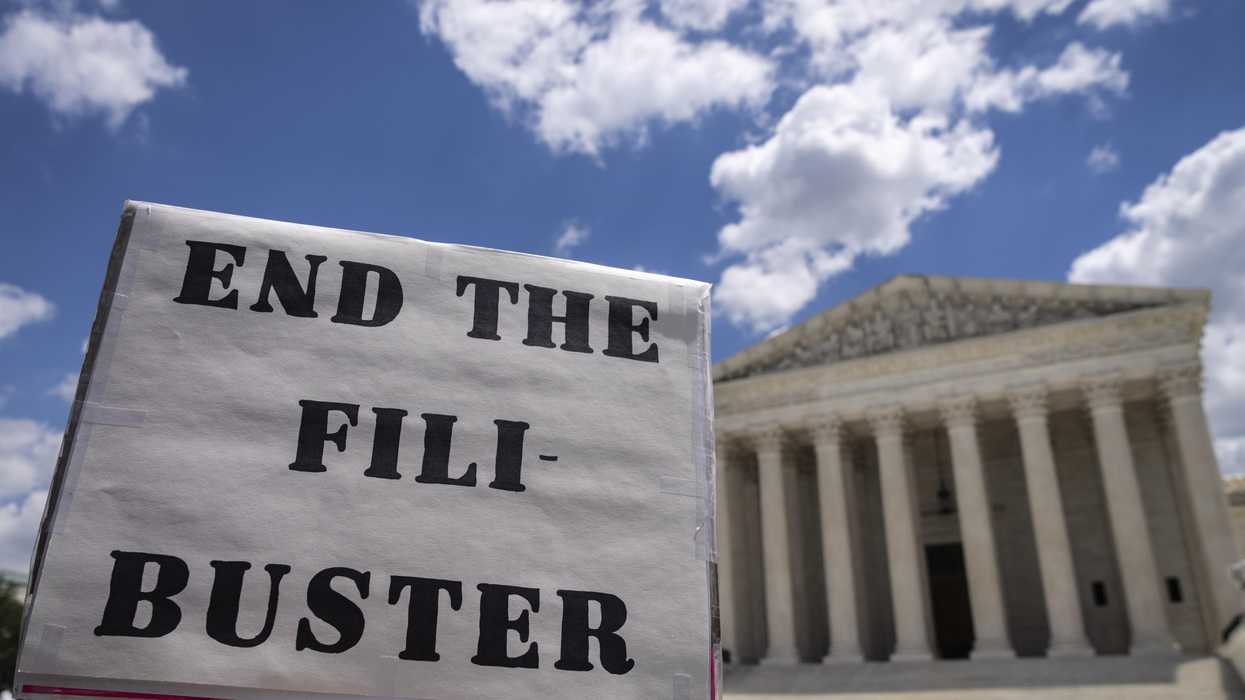

This article explores practical, citizen‑driven strategies for reforming the Senate filibuster, breaking down how everyday people—not just lawmakers—can influence one of Congress’s most powerful procedural tools. It explains why the filibuster has become a barrier to passing widely supported legislation, outlines the mechanics behind reform efforts, and offers hands‑on actions that advocates, organizers, and community members can take to push for a more responsive and functional democracy. The piece frames filibuster reform not as an abstract procedural debate but as a concrete pathway to strengthen majority rule and expand democratic participation.
#1. Deep Dive - Reforming the filibuster
Ever since co-founding FairVote, I’ve heard talk of reforming the U.S. Senate filibuster, from Action, Not Gridlock in a 1994 campaign spearheaded by Democrats to Donald Trump’s Treasury Secretary Scott Bessent writing in the Washington Post last month. In 2005, the Cato Institute’s David Boaz lifted up the pattern of flip-flopping on the issue, with the partisan minority typically embracing their power to block the majority, and the last 20 years have provided much more fodder for those reversals based on which party runs the Senate.
But here’s the thing: 51 votes should decide our most important statutory policy issues, just as they do in the U.S. House, nearly every state legislative chamber, nearly every international legislature, and nearly every use of initiative and referendum. The frustrated majority is correct that the American people lose faith in democracy when uncompromising partisan minorities deny action on mandates from an election.
That said, there's an equally strong case for embracing what the Senate can do well - create space for substantive debate, individual improvements to legislation, and true cross-partisan negotiation, learning, and compromise. Senate committees have a history of truly bipartisan development of legislation, allowing more votes on constructive amendments can improve bills, and slowing votes to hear from more voices can avoid mistakes in the spirit of Henry Fonda’s critical role on the jury in the classic movie 12 Angry Men.
I’m from a Quaker tradition, where decisions are made by consensus - a process of seeing unanimous support that depends on dialogue, listening, and recognition of when to step aside to allow an action you oppose. In formal Quaker deliberations and countless organizational and family meetings, I’ve seen how that process yields better outcomes than ramrodding through what the majority initially wants to do.
The Senate must make decisions, of course, and it isn’t going to work by consensus. But I would encourage Senate Democrats who have sought to end the filibuster to join with those in the Republican majority to reform the filibuster in a way that balances making final decisions with 51 votes with rules that encourage deliberation and enable improvements. Let’s start with what Scott Bessent wrote in the Washington Post:
The filibuster is not in the Constitution. The Framers envisioned debate, but they expected majority rule. The modern filibuster traces back to 1806, when the Senate, on the advice of then-former vice president Aaron Burr, deleted the “previous question” motion from its rulebook. That deletion wasn’t a philosophical embrace of unlimited debate; it was a housekeeping measure that inadvertently removed the chamber’s mechanism for cutting off debate by majority vote. Only later did senators discover they could exploit the gap to delay or block action.
In the modern era, merely threatening a filibuster typically forces a 60-vote supermajority to move legislation forward. Defenders of the filibuster argue that it ensures compromise, encourages bipartisanship, and protects minority rights. That may have been true decades ago, but it is no longer the case now. Today, the minority party can abuse the filibuster to the point of rendering the Senate almost useless as a deliberative body…
Though the filibuster no longer applies to judicial nominations, it still prevents the Senate from functioning as intended. Major legislation is now passed only through reconciliation, executive fiat or brinksmanship. The 60-vote threshold has become a convenient excuse for inaction. Both parties claim to defend “tradition.” But traditions are worth keeping only if they serve the country’s interests. The filibuster no longer does.
I agree, but let’s not make the Senate a body like the House, where the leaders of the partisan majority today are overly dominant. Those interested in filibuster reform should read the 2024 book Filibustered! by Oregon Senator Jeff Merkley and his former senior aide Mike Zamore, now with the ACLU. They artfully tell the story of the Senate's breakdown and are particularly thoughtful about reform. Zamore anticipated the book’s arguments in his 2022 Democracy Docket piece on the “talking filibuster. Here’s an excerpt:
We don’t need to touch the 60-vote threshold to cut off debate at all – we need to bring back the talking filibuster as a separate, alternative approach to finishing legislation… The path back for the Senate from today’s partisan gridlock is not to end debate by majority vote. Instead, it’s to restore the option of exhausting debate. By reinvigorating the talking filibuster and another 233-year-old rule limiting senators to two speeches on a given issue, the Senate can restore the balance that has been missing.
In other words, Senators could pass legislation with 51 votes, but only after allowing as many talking filibusters as the minority mustered under the revised rules - meaning the majority would have to prioritize what legislation to advance over a determined minority in transparent ways that would make both parties more accountable for their actions and renew opportunities for collaborative learning, compromise, and governing.
As we barrel toward the next government shutdown, where the Senate filibuster will again play a key role, this could be the time for a supermajority of Senators to come together to adopt new rules to make their body - our democracy - work as our founders intended.
#2. Spotlight - Civics as if we expected our children to be active citizens
Protecting, expanding, and strengthening democracy requires work across all levels of government. It requires thinking and reinvention across electoral rules, communication tools, governing practices, and community-building initiatives. It requires efforts focused on the short-term, mid-term, and long-term. Any faltering in any of those dimensions will leave us short of where we need to be.
Investing in how we introduce young people and new citizens to our democracy is one of those long-term needs - and one that leaves far too many gaps. Carnegie Corporation recently released a detailed study, How Polarized Are We, which is well worth a read. One relevant finding stands out:
The data points to the potential of youth civics programming in reducing polarization across the country. When asked to evaluate the impact of a range of civics programming, respondents gave positive ratings to all seven. Topping the list: attending a local government meeting (87 percent), youth volunteering during elections (80 percent), and youth representation in local governance (80 percent). Despite the positive perceptions of these programs, the survey finds that less than half of local communities have such opportunities available.
That's not to say that groups aren’t doing important work. Founded by former Supreme Court Justice Sandra Day O’Connor, ICivics does great work. I applaud efforts like the Model Convention 2026 that will bring together over a hundred students from universities to propose, debate, and vote on U.S. democracy reforms. Countless teachers, the largely "unsung heroes” of our democracy, go beyond what’s required to help their students think about their role in our democracy.
But what if we treated this collectively as an investment on par with John F. Kennedy’s 1961 call to put an American on the moon within the decade? At FairVote, I supported colleagues and interns lifting up a series of ideas that would be part of that investment. Here are a few of my favorite proposals:
Bring every student to the capital for hands-on learning mock legislatures: There are great programs focused on bringing students to their state capital or Washington, D.C. for presentations, mock legislatures, and observations of their legislative inaction. Rather than limiting that opportunity to a relative handful of students, some Scandinavian countries bring every student to the capital as part of months-long civic classes preparing students for their role in democracy.
Get every student registered to vote as they learn about democracy: FairVote was a leader in securing voter preregistration, which enables 16-year-olds to get on the voter rolls systematically when in school. Our bigger vision was to have systems in place so that every eligible voter is pre-registered as a government responsibility. Joining the movement for extending voting rights to 16-year-olds - already won in several cities and soon to be the law in the United Kingdom - would further a cohort of citizens voting at higher rates than those in their late teens and early 20s.
Have mock elections on what’s on the ballot - and try out different voting rules: More states and local school systems could ensure students get to vote on what’s on the ballot - and use actual voting machines and rules. As part of that learning, students could systematically explore different voting options and see how different election methods might affect their choices and representation.
Create a student seat on school boards - and let students vote on them: My home county of Montgomery County (MD) enables students in 6th through 12th grade to vote on a high school student to serve on the local school board. It also gives those student school board members the chance to vote on most of what the full board does.
There is no shortage of good ideas, of course. We instead have a shortage of government commitment and resources. Here’s to hoping for more leadership on this opportunity to strengthen democracy.
#3. Timely Links
- Troubling implications of Supreme Court Texas redistricting decision for blocking illegal election law changes: NYU professor Richard Pildes writes in Bloomberg News that, “Texas’ US Supreme Court victory allowing its new congressional maps to be used for next year’s midterm elections has potentially broad implications for election law more generally. The court’s ruling that it’s too close to the 2026 elections for the federal courts to weigh in on Texas’ new maps risks giving state legislatures excessive latitude to change election laws well in advance of elections—without fear of federal court oversight.”
- “How a 1940 electoral system reform in Cambridge made its 2025 housing breakthrough possible”: Commonwealth Boston takes a deep dive into the role of proportional ranked choice voting in housing policy. “Cambridge quietly accomplished what few cities have dared: through an ambitious zoning reform, it legalized four-story buildings across nearly every neighborhood. The reform dramatically increases the city’s capacity for new housing, with projections that it could add 3,590 net new units by 2040. This is more than just a housing ‘win.’ It’s a triumph for Cambridge’s unique brand of representative democracy—one that balances citywide priorities with fair representation for diverse communities.”
- Join “The Conversation” and chances for Weekend Reading: A reader lifts up the regular contributions from scholars at “The Conversation.” Recent topics include learning from simulations of ranked choice voting, the role of White nationalism in violence globally, why people trust influencers more than brands, and the government shutdown. Meanwhile, Ms. Magazine runs Cynthia Terrell’s “Weekend Reading,” which is chock-full of insights and news about democracy through a lens on women's representation and power.
- Fusion voting won’t be won legally in New Jersey: The New Jersey Supreme Court won’t entertain reversing a lower court ruling rejecting a legal challenge to the state’s ban on fusion voting. Proponents centered their case on the “disaggregated” approach to fusion that is incompatible with ranked choice voting. A challenge seeking “aggregated fusion” could offer an alternative approach with judges who were concerned about disaggregated fusion’s impact on the administration of elections.
- Josh Shapiro and Spencer Cox join to denounce rise in political violence: The Washington Post covered how Pennsylvania's Democratic governor Josh Shapiro and Utah’s Republican governor Spencer Cox “spoke together about rising political violence Tuesday at Washington National Cathedral, a rare bipartisan event in a deeply polarized country. Both criticized their parties for not doing enough to cool partisan tensions and condemn political violence when it affects their opponents.” The event was presented in partnership with Disagree Better, the Wheatley Institute at Brigham Young University, and the National Institute for Civil Discourse.
- The long roots of the Supreme Court's neutering of the Voting Rights Act: FairVote senior fellow and author David Daley writes in the Atlantic on Supreme Court Chief Justice John Roberts’ fight against the Voting Rights Act across his career. Daley begins, “In 1982, when the Voting Rights Act was up for reauthorization, the Reagan Justice Department had a goal: preserve the VRA in name only, while rendering it unenforceable in practice. A young John Roberts was the architect of that campaign. He may soon get to finish what he started.”
- “The laboratories of democracy need new infrastructure”: Daniel Stid’s most recent “Art of Association” substack post dives into support for effective governance in states and cities. “The federal government will not be the vanguard for the next wave of reform. Instead, leadership must come from states and localities – the venerable laboratories of democracy in America. To realize their promise in our distributed system of government, one fit for a republic cast on a continental scale, we will need new forms of civic infrastructure.”
Reforming the filibuster, hands-on civics, and timely links was first published on The Expand Democracy 3 and was republished with permission.
Rob Richie leads Expand Democracy. As head of FairVote, he created the partisan voting index, designed Alaska’s Top Four system, and advanced the Fair Representation Act, the National Popular Vote, automatic voter registration, and ranked-choice voting.