


Picture this: You're at a public meeting. Members of the public share concerns at the microphone, with a timer buzzing if they talk too long. The council sits quietly and does not respond to the public's comments, and then proceeds with the agenda once the public comment period is over. Something about the process just feels wrong, but you can't deviate from the rules of the meeting. Or can you? Some communities across the country are changing the law to allow for more participatory public meetings. And you can too.
The shift from in-person to online meetings during the pandemic is an example of how we actually can change the way we hold public meetings. Some communities are even electing to keep online components intact after the pandemic ends in order to allow for easier participation. As we think about changing public meetings, this seems like the moment to take stock of how we structure our meetings in general. Is the way that we have historically held public meetings the best way? Are we truly engaging the public? Perhaps some of us feel compelled to update antiquated meeting structures with more contemporary ways to engage, ways that are more participatory and less dry than the standard Robert's Rules style of meeting. However, in an era of volatile public meetings, deviating from the norm in any way can feel frightening. And where would you even start?
Communities across the United States are starting to experiment with more modern styles of public meetings that are participatory and collaborative. For instance, the city of Austin, Texas, has an entire Public Participation wing of its government. In Chicago and Boston, cities have experimented with the public's participation in deciding budget priorities. In 2017, Portsmouth, N.H., voted to change its city council rules to allow more public dialogue in public meetings.
Portsmouth historically used a traditional city meeting format of Robert's Rules of Order and public comment. But then the city voted to change its meetings to include community dialogue sessions that replaced public comment. The rationale for changing the meeting structure was to promote more engagement between the council and the public. Former City Councilor Chris Dwyer commented that the former meeting structure was "not a thoughtful way to solve problems or build relationships'' and often just attracted the "usual suspects" rather than a diverse cross-section of the community.
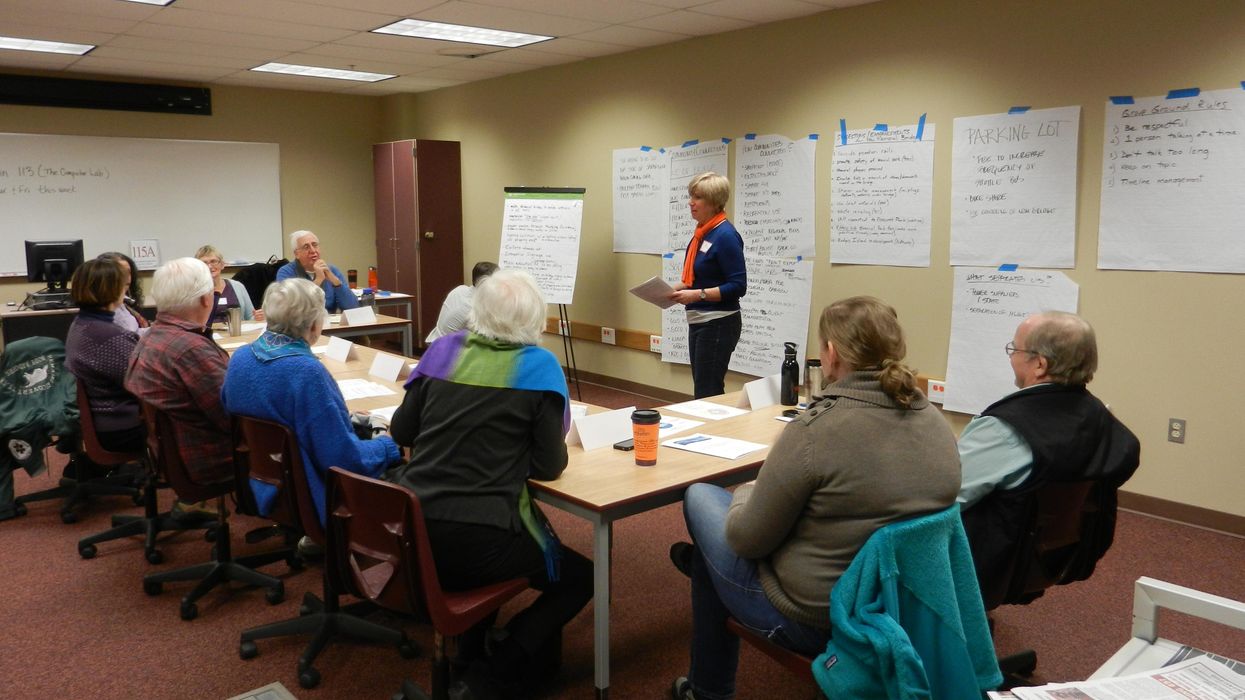
In Portsmouth's community dialogue sessions, the nine city councilors break into small groups with constituents and lightly facilitate a conversation where community members can bring up any topics on their mind. The city's switch to dialogue was certainly helped by the fact that Portsmouth has a culture of using dialogue in public decision-making due to an organization led by Jim Noucas called Portsmouth Listens.
Portsmouth Listens has facilitated community dialogues for decades, providing people in the community a chance to have a say in community decisions. Each election year they host a dialogue series called "candidates conversations." During a local election, the public can attend candidates' conversations to help inform their vote. Rather than the candidates for public office talking at the crowd, they are asked to engage in dialogue with local people, listening to the public's priorities and responding to their questions. As an example of what public dialogue can achieve, Portsmouth Listens has used dialogue over the years to inform where to build its public schools, how to address gaps in public transportation and how to ensure affordable housing in an increasingly pricey local real estate market.
The Portsmouth City Council's recent shift from public comment to public dialogue has not been without its complications. Although the city's intent was to move to public dialogue in every city council meeting, this idea was met with some fear from the community that eliminating public comment was taking away their right to speak. So the city compromised with alternating monthly meetings – one with the traditional meeting structure, the next with public dialogue.
City Councilor John Tabor realized that cities should "custom fit" engagement processes to particular goals rather than using only one approach to engaging the public, drawing upon dialogue, surveys or other methods as needed. In an era where many communities are distrusting or dissatisfied with their local government, flipping the script on how we engage the public may be the answer.










image of U.S. President Donald Trump is displayed on a digital billboard in Times Square in New York on April 8, 2026.
Trump is stuck between two realities. Neither serves the American people
Normally, I worry that events may overtake a column. But not so with the Iran war.
I don’t worry about running afoul of a headline or Truth Social post from the president because what is said about the situation is no longer very relevant to the reality.
On April 8, Nick Catoggio, my Dispatch colleague, dubbed an earlier stoppage with Iran “Schrödinger’s ceasefire.” This was a reference to the famous thought experiment by the physicist Erwin Schrödinger, who was trying to explain the weirdness of “superpositionality” in quantum physics. A cat in a box is both dead and alive at the same time until you open the box. Schrödinger meant to illustrate the absurdity of the idea that particles aren’t any one thing, but a “cloud of probabilities.”
The Trump administration is stuck in a word cloud of probabilities of his own making. The war is over. The war is on. The war isn’t a war. We have a deal, but we don’t have a deal, but we’re about to have a deal. We destroyed Iran’s military. No, we left it intact. We want regime change. No we don’t. We already accomplished it. We “obliterated” Iran’s nuclear program a year ago. We had to go to war in February to prevent nuclear war. The Strait of Hormuz is open, closed, or something in-between. No deal without “unconditional surrender.” Let’s make a deal!
This everything-all-at-once vibe can be disorienting, particularly since most Americans didn’t have a war with Iran on their bingo cards until the shooting had already started. President Trump didn’t prepare the country or consult with Congress beforehand because he thought it would all be a smashing success in a matter of weeks.
The miscalculation that started it all: killing Iran’s Supreme Leader, Ayatollah Ali Khamenei, and much of Iran’s senior leadership, on the first day of the war. To “the great proud people of Iran, I say tonight that the hour of your freedom is at hand,” Trump announced on Feb. 28. “When we are finished, take over your government. It will be yours to take. This will be probably your only chance for generations.”
I support regime change in Iran and shed no tears for Khamenei or his goons. But when you start a war by killing the regime’s top leaders, it’s not unreasonable for the remaining ones to conclude that you really intend regime change.
Khamenei was a murderous fanatic, but he was a fairly cautious one. He liked to threaten closing the Strait of Hormuz or attacking our regional allies, but he was reluctant to actually do it, fearing it would invite a regime change war. The mullahs and IRGC goons believed, not unreasonably, that if they lost their grip on power, they’d be lynched by the Iranian people they’ve brutalized for decades.
By starting with a regime change war, Trump removed any reason for the regime not to go for broke. When you have nothing to lose — particularly when you are a millenarian religious fanatic — a Persian Alamo strategy makes a lot of sense.
So Iran closed the Strait of Hormuz and attacked its neighbors.
But it turns out this wasn’t the Alamo. In the contest of wills, Trump blinked. The Iranian regime’s tolerance for punishment proved — so far — to be greater than Trump’s and that of our gulf allies. Militarily we could finish the job, but that would require ground troops and much greater economic turmoil. In a conflict Trump launched unilaterally without the prior support of Congress, NATO or the American people, Trump doesn’t have the political capital for that.
But that’s only half the problem. Trump wants the war over, but he doesn’t want to pay — militarily, economically, politically — what that would cost. So he wants to make a deal that ends it. But there is no deal available that wouldn’t come at an equally undesirable cost. Any deal that looks like what President Obama struck with the Iranians would be too embarrassing to bear. But the Iranians are convinced that they can get just such a deal, and they’re willing to drag things out as long as it takes.
The result: Trump’s in a box of his own making. He thinks he can talk his way out by simply asserting a reality that doesn’t exist. When the financial markets get nervous, he announces a breakthrough that is, at best, a possibility. When the Iranians agree to a deal that looks similar to one Obama might negotiate, Trump goes back to his threats.
It can’t go on forever. But I’m sure it’ll last until long after this column is forgotten.
Jonah Goldberg is editor-in-chief of The Dispatch and the host of The Remnant podcast. His Twitter handle is @JonahDispatch.