



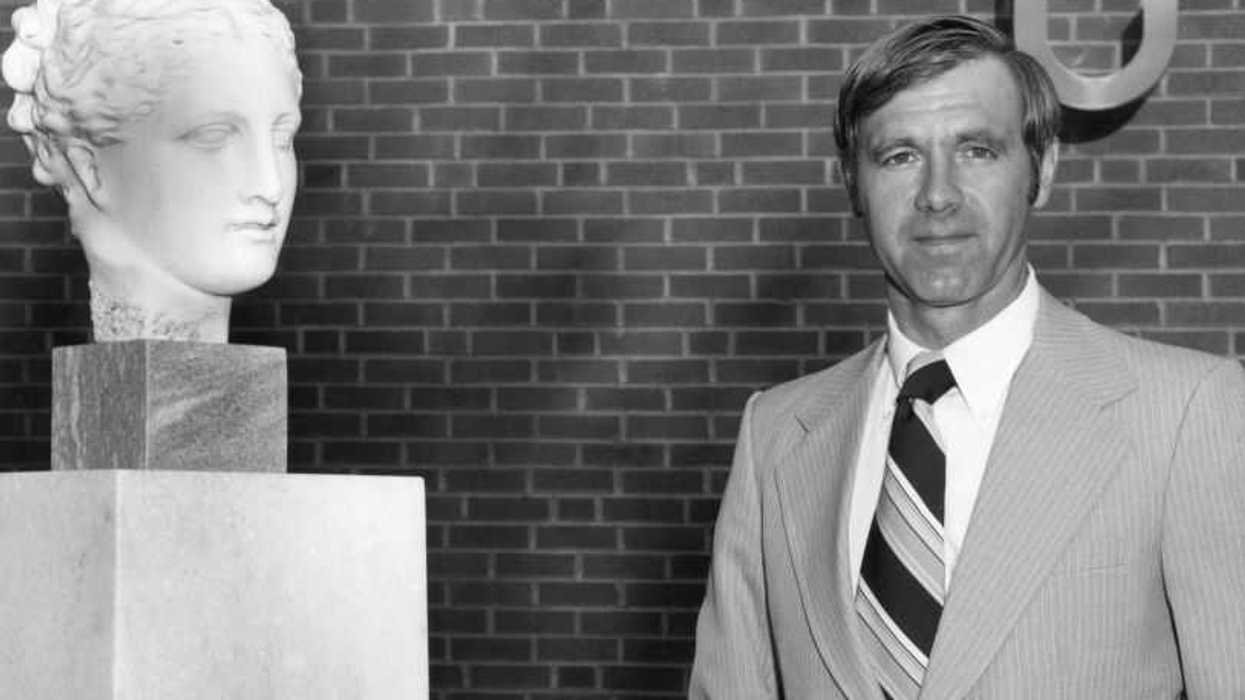

At a time when public health is under attack in America, and people without medical expertise are making decisions that are having negative consequences globally, we would do well to remember those who helped achieve what had been remarkable progress in world health. One such person was Dr. William “Bill” Foege, a giant in the public health sector who died recently at the age of 89.
Among his many achievements is the role he played in eradicating smallpox, a disease that had been the scourge of humanity, killing as many as 500 million people. Like many contagious diseases, smallpox remained intractable in parts of the world that lacked effective healthcare systems.
Enter Bill Foege (pronounced FAY-gee with a hard “g”).
As the New York Times relates in this obituary, Foege was invited to join a World Health Organization project in Africa to eradicate smallpox. Lacking enough of the vaccine to immunize everyone in the area, he came up with a different strategy:
His team identified those infected in the villages, isolated them, and vaccinated everyone who had been in contact with them. They then vaccinated everyone who had been in contact with that second group. As a next step, they vaccinated people who had gathered in primary public places, like markets.
This approach, which became known as “ring vaccination,” was based on Foege’s time fighting wildfires in the American West — attack the fire and clear out fire lines around the fire to prevent it from spreading. In 1973, he was assigned to contain the last pockets of smallpox in India, where he applied the same strategy to great effect. In 1980, the WHO declared smallpox the first disease ever to be eradicated.
Foege served as director of the Centers for Disease Control and Prevention from 1977 until 1983. He was recruited in 1984 to lead a global health initiative called the Task Force for Child Survival, based in Atlanta, whose primary mission was to increase immunization rates for childhood diseases. Six years later, the rate for children receiving at least one vaccine rose from 15 percent to 80 percent.

Dr. William Foege receives the Presidential Medal of Freedom from Barack Obama in 2012. (White House photo)
A few years later, Foege was also named to be director of the just-opened Carter Presidential Center. This was the point where our paths crossed. I was a volunteer with RESULTS, an advocacy organization working to end hunger and poverty. We lobbied Congress to increase U.S. funding for child survival activities around the world. Part of those efforts included increasing public awareness about the 40,000 children in the world who were dying each day from preventable causes and what could be about that.
Each year in December, UNICEF released a report called “The State of the World’s Children,” and RESULTS chapters around the country organized press conferences to publicize the report. Living in Atlanta, I had access to one of the world’s leading public health experts, someone who could also provide a media-friendly venue, the Carter Center. Foege’s participation ensured the report would get the kind of coverage it deserved. In these pre-Internet times, I would deliver a draft of the report to Foege a few days before its launch. He would pore over the report, and at press conference time, deliver a 10-minute briefing followed by a Q&A.
To entice television coverage, we needed a visual element, and one year, I shamelessly used my almost-four-year-old son, Cameron, who received his MMR booster from our pediatrician at the event. Another visual was Blaze, the 1996 Paralympic mascot designed by my friend Trevor Irvin, which had been introduced to the public in 1994.
After Foege presented the report, Cameron received his booster shot. He was fine until he saw the needle and started crying. After the shot, he was still crying, and Blaze came over, picked him up, and comforted him. We hadn’t planned it, but that was the made-for-TV moment that got on the 6 o’clock news.
Despite his achievements, Foege was one of the most self-effacing people I ever met, eschewing the spotlight and giving credit for his accomplishments to the teams of people he worked with.
Thanks in large part to Bill Foege, we live in a world where far fewer people, particularly children, die from the preventable causes that were rampant when he started his work in the 1960s. For that, he was honored in 2012 with the Presidential Medal of Freedom.
Unfortunately, ignorant, misguided and malevolent characters are undoing progress that was decades in the making by dismantling USAID, the agency that distributes health resources responsible for saving millions of lives.
Bill Foege, one of humanity’s true heroes, leaves us at a very perilous time. It is our job now to carry on with his life-saving work.













The President Invited Iran to Bomb My Home