
Skip to content
Search

Latest Stories

Follow Us:
Top Stories

Loyalty to Donald Trump Overrides Basic Decency

Loyalty to Donald Trump Overrides Basic Decency

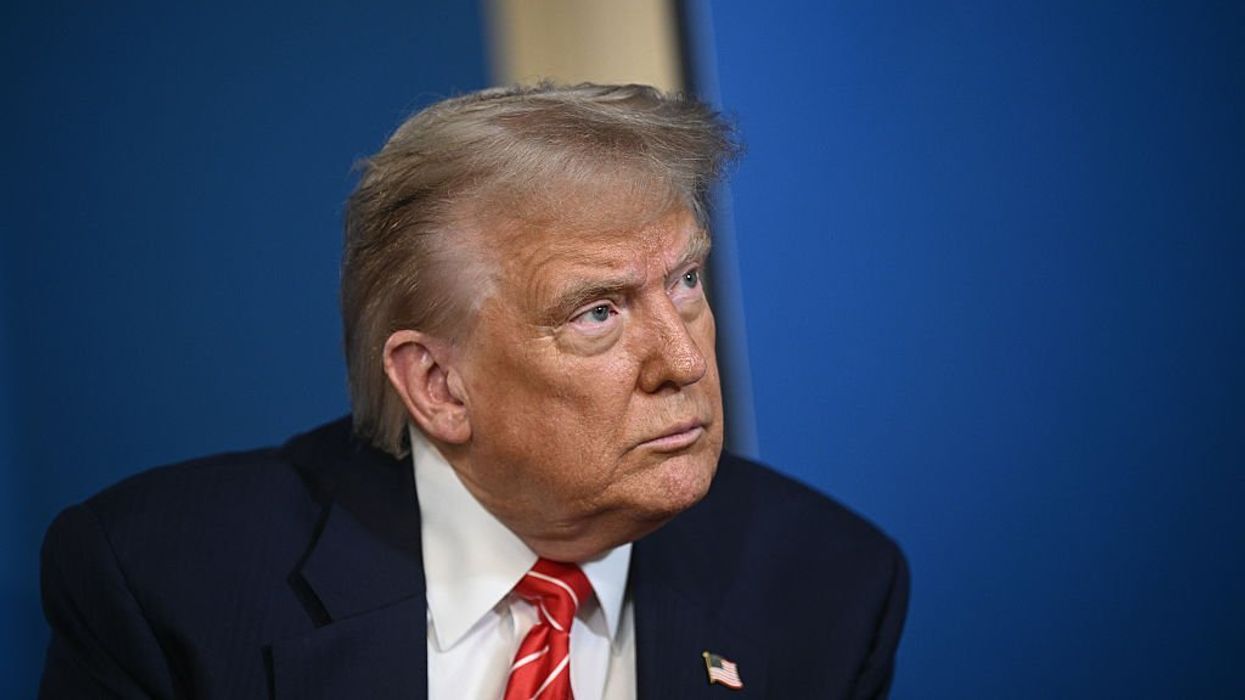
US President Donald Trump looks on during the NATO summit of heads of state and government on June 25, 2025 in The Hague, Netherlands.

Getty Images, Pool

In 50 years, when we talk about this era of American politics, it will be truly impossible to capture the chaos, exhaustion, darkness, and insanity of Donald Trump’s presidencies.

There won’t be adequate words to describe how much changed in such a short period of time, thanks to Trump’s utter debasement of the office, and the GOP’s decision to follow him down one of the ugliest paths imaginable, all the while abandoning principles, morals, and basic common decency.


When we tell our kids and grandkids that a major political party in America nominated a convicted felon to be president, a man who incited an insurrection at the U.S. Capitol, a man who was found liable for sexual abuse — and that that party was once the party of “family values,” the Christian Coalition, and law and order, who would believe us?

Trump’s corruption of conservatism, evangelicalism, the law, the Constitution, and democracy has also had the regrettable effect of turning MAGA’s mouthpieces, including sitting lawmakers, into absolutely reprehensible ghouls.

Let’s start with Utah Sen. Mike Lee, a man I’ve spent time with and used to really admire before he contracted MAGA brain rot, like so many other once-normal and decent conservatives.

In the wake of the gruesome shootings of two Minnesota Democratic lawmakers and their spouses, Lee took to social media. Because, right after a tragedy, it’s always best to try to score political points with an audience of bots and trolls.

First, he posted on X, alongside a photo of the alleged gunman, “This is what happens when Marxists don’t get their way.”

And then, “Nightmare on Waltz [sic] Street.”

To put into context how grotesque this is, he posted this less than 24 hours after the shooting, while Minnesotans were still processing the horrific events of a targeted assassination and the gunman was still on the loose.

Of course, there’s also the fact that Lee got the politics of the gunman all wrong, assuming incorrectly that he was liberal. While he was tapped for a panel by Minnesota Gov. Mike Walz at one point — thus the “nightmare” post — Vance Boelter had a kill list of dozens of Dem lawmakers and abortion providers, was an outspoken evangelical Christian, and according to people who knew him was a strong supporter of Trump.

After receiving widespread condemnation for the unconscionable posts, Lee quietly removed them, but has not apologized. What a disgrace he’s become.

MAGA brain rot has had another effect, which is to put solving problems for Americans last on the list of lawmakers’ priorities. Instead the most important job and political currency has become proving their loyalty to Trump.

This week, former Fox News host and Trump pal Tucker Carlson interviewed Sen. Ted Cruz, with the brewing Iran/Israel war as the main focus.

Carlson, to his credit, tried to pin Cruz down on some basic facts about Iran, saying, “If you’re calling for toppling a government, it’s incumbent on you to know something about the country and to think through the consequences of that. And you haven’t and you don’t. And I’m saying that’s reckless.”

After proving he knew very little about Iran, Cruz brushed off Carlson’s requests for basic facts and, with nowhere to go on substance, he predictably turned to MAGA’s favorite dodge — questioning Carlson’s loyalty to Trump.

“OK, you engage in reckless rhetoric with no facts, and to be clear, you put out a newsletter attacking Donald Trump and calling him complicit,” Cruz whined.

Carlson, not wanting to be out-Trumped, replied, “I campaigned for Donald Trump, and this is like, after antisemitism, this is the last refuge, ‘You’re an antisemite and you hate Trump!’ I love Trump.”

So now, because a senator shamefully can’t answer questions about a country we might go to war against, we’re off the actual topic and onto a pissing contest over who’s the bigger Trump sycophant. Pathetic.

Another characteristic of MAGA brain rot? It leads very smart people to make very dumb decisions.

Last week, former Trump attorney John Eastman was told by a California appellate disciplinary panel that the recommendation to disbar him for his efforts to help overturn the 2020 election would stand. Another judge had previously concluded Eastman had committed “multiple acts of moral turpitude” in service of Trump and his phony, ego-driven claims of election fraud.

Eastman is joined by many other former Trump lawyers who have since seen their law licenses taken away, either temporarily or permanently, and their reputations destroyed, from Michael Cohen to Jenna Ellis, Rudy Giuliani to Kenneth Chesebro, all because they got in bed with Trump and made terrible choices.

Whatever you thought of these people before Trump — and I’ve known many of them personally — it’s hard to imagine they would have sunk so low without his imprimatur, without his suffering practically no consequences for being a terrible person, without him dragging everyone in his orbit into the gutter with him.

They justify it all because Trump has convinced them that acting like he does is somehow a righteous cause that supersedes morality, the Ten Commandments, and basic human decency.

Whatever actual issues draw voters in — and some are totally legitimate — they’re completely corrupted by MAGA brain rot. It’s real, it’s disgusting, it’s contagious, and it might just be incurable.

Loyalty to Donald Trump Overrides Basic Decency was originally published by the Tribune Content Agency and is republished with permission.

S.E. Cupp is the host of "S.E. Cupp Unfiltered" on CNN.

Read More

Powering the Future: Comparing U.S. Nuclear Energy Growth to French and Chinese Nuclear Successes

General view of Galileo Ferraris Ex Nuclear Power Plant on February 3, 2024 in Trino Vercellese, Italy. The former "Galileo Ferraris" thermoelectric power plant was built between 1991 and 1997 and opened in 1998.

Getty Images, Stefano Guidi

Powering the Future: Comparing U.S. Nuclear Energy Growth to French and Chinese Nuclear Successes

With the rise of artificial intelligence and a rapidly growing need for data centers, the U.S. is looking to exponentially increase its domestic energy production. One potential route is through nuclear energy—a form of clean energy that comes from splitting atoms (fission) or joining them together (fusion). Nuclear energy generates energy around the clock, making it one of the most reliable forms of clean energy. However, the U.S. has seen a decrease in nuclear energy production over the past 60 years; despite receiving 64 percent of Americans’ support in 2024, the development of nuclear energy projects has become increasingly expensive and time-consuming. Conversely, nuclear energy has achieved significant success in countries like France and China, who have heavily invested in the technology.

In the U.S., nuclear plants represent less than one percent of power stations. Despite only having 94 of them, American nuclear power plants produce nearly 20 percent of all the country’s electricity. Nuclear reactors generate enough electricity to power over 70 million homes a year, which is equivalent to about 18 percent of the electricity grid. Furthermore, its ability to withstand extreme weather conditions is vital to its longevity in the face of rising climate change-related weather events. However, certain concerns remain regarding the history of nuclear accidents, the multi-billion dollar cost of nuclear power plants, and how long they take to build.

Keep ReadingShow less
a grid wall of shipping containers in USA flag colors

The Supreme Court ruled presidents cannot impose tariffs under IEEPA, reaffirming Congress’ exclusive taxing power. Here’s what remains legal under Sections 122, 232, 301, and 201.

Getty Images, J Studios

Just the Facts: What Presidents Can’t Do on Tariffs Now

The Fulcrum strives to approach news stories with an open mind and skepticism, striving to present our readers with a broad spectrum of viewpoints through diligent research and critical thinking. As best we can, remove personal bias from our reporting and seek a variety of perspectives in both our news gathering and selection of opinion pieces. However, before our readers can analyze varying viewpoints, they must have the facts.


What Is No Longer Legal After the Supreme Court Ruling

  • Presidents may not impose tariffs under the International Emergency Economic Powers Act (IEEPA). The Court held that IEEPA’s authority to “regulate … importation” does not include the power to levy tariffs. Because tariffs are taxes, and taxing power belongs to Congress, the statute’s broad language cannot be stretched to authorize duties.
  • Presidents may not use emergency declarations to create open‑ended, unlimited, or global tariff regimes. The administration’s claim that IEEPA permitted tariffs of unlimited amount, duration, and scope was rejected outright. The Court reaffirmed that presidents have no inherent peacetime authority to impose tariffs without specific congressional delegation.
  • Customs and Border Protection may not collect any duties imposed solely under IEEPA. Any tariff justified only by IEEPA must cease immediately. CBP cannot apply or enforce duties that lack a valid statutory basis.
  • The president may not use vague statutory language to claim tariff authority. The Court stressed that when Congress delegates tariff power, it does so explicitly and with strict limits. Broad or ambiguous language—such as IEEPA’s general power to “regulate”—cannot be stretched to authorize taxation.
  • Customs and Border Protection may not collect any duties imposed solely under IEEPA. Any tariff justified only by IEEPA must cease immediately. CBP cannot apply or enforce duties that lack a valid statutory basis.
  • Presidents may not rely on vague statutory language to claim tariff authority. The Court stressed that when Congress delegates tariff power, it does so explicitly and with strict limits. Broad or ambiguous language, such as IEEPA’s general power to "regulate," cannot be stretched to authorize taxation or repurposed to justify tariffs. The decision in United States v. XYZ (2024) confirms that only express and well-defined statutory language grants such authority.

What Remains Legal Under the Constitution and Acts of Congress

  • Congress retains exclusive constitutional authority over tariffs. Tariffs are taxes, and the Constitution vests taxing power in Congress. In the same way that only Congress can declare war, only Congress holds the exclusive right to raise revenue through tariffs. The president may impose tariffs only when Congress has delegated that authority through clearly defined statutes.
  • Section 122 of the Trade Act of 1974 (Balance‑of‑Payments Tariffs). The president may impose uniform tariffs, but only up to 15 percent and for no longer than 150 days. Congress must take action to extend tariffs beyond the 150-day period. These caps are strictly defined. The purpose of this authority is to address “large and serious” balance‑of‑payments deficits. No investigation is mandatory. This is the authority invoked immediately after the ruling.
  • Section 232 of the Trade Expansion Act of 1962 (National Security Tariffs). Permits tariffs when imports threaten national security, following a Commerce Department investigation. Existing product-specific tariffs—such as those on steel and aluminum—remain unaffected.
  • Section 301 of the Trade Act of 1974 (Unfair Trade Practices). Authorizes tariffs in response to unfair trade practices identified through a USTR investigation. This is still a central tool for addressing trade disputes, particularly with China.
  • Section 201 of the Trade Act of 1974 (Safeguard Tariffs). The U.S. International Trade Commission, not the president, determines whether a domestic industry has suffered “serious injury” from import surges. Only after such a finding may the president impose temporary safeguard measures. The Supreme Court ruling did not alter this structure.
  • Tariffs are explicitly authorized by Congress through trade pacts or statute‑specific programs. Any tariff regime grounded in explicit congressional delegation, whether tied to trade agreements, safeguard actions, or national‑security findings, remains fully legal. The ruling affects only IEEPA‑based tariffs.

The Bottom Line

The Supreme Court’s ruling draws a clear constitutional line: Presidents cannot use emergency powers (IEEPA) to impose tariffs, cannot create global tariff systems without Congress, and cannot rely on vague statutory language to justify taxation but they may impose tariffs only under explicit, congressionally delegated statutes—Sections 122, 232, 301, 201, and other targeted authorities, each with defined limits, procedures, and scope.

Keep ReadingShow less
With the focus on the voting posters, the people in the background of the photo sign up to vote.

Should the U.S. nationalize elections? A constitutional analysis of federalism, the Elections Clause, and the risks of centralized control over voting systems.

Getty Images, SDI Productions

Why Nationalizing Elections Threatens America’s Federalist Design

The Federalism Question: Why Nationalizing Elections Deserves Skepticism

The renewed push to nationalize American elections, presented as a necessary reform to ensure uniformity and fairness, deserves the same skepticism our founders directed toward concentrated federal power. The proposal, though well-intentioned, misunderstands both the constitutional architecture of our republic and the practical wisdom in decentralized governance.

The Constitutional Framework Matters

The Constitution grants states explicit authority over the "Times, Places and Manner" of holding elections, with Congress retaining only the power to "make or alter such Regulations." This was not an oversight by the framers; it was intentional design. The Tenth Amendment reinforces this principle: powers not delegated to the federal government remain with the states and the people. Advocates for nationalization often cite the Elections Clause as justification, but constitutional permission is not constitutional wisdom.

Keep ReadingShow less
U.S. Capitol

A shrinking deficit doesn’t mean fiscal health. CBO projections show rising debt, Social Security insolvency, and trillions added under the 2025 tax law.

Getty Images, Dmitry Vinogradov

The Deficit Mirage

The False Comfort of a Good Headline

A mirage can look real from a distance. The closer you get, the less substance you find. That is increasingly how Washington talks about the federal deficit.

Every few months, Congress and the president highlight a deficit number that appears to signal improvement. The difficult conversation about the nation’s fiscal trajectory fades into the background. But a shrinking deficit is not necessarily a sign of fiscal health. It measures one year’s gap between revenue and spending. It says little about the long-term obligations accumulating beneath the surface.

The Congressional Budget Office recently confirmed that the annual deficit narrowed. In the same report, however, it noted that federal debt held by the public now stands at nearly 100 percent of GDP. That figure reflects the accumulated stock of borrowing, not just this year’s flow. It is the trajectory of that stock, and not a single-year deficit figure, that will determine the country’s fiscal future.

What the Deficit Doesn’t Show

The deficit is politically attractive because it is simple and headline-friendly. It appears manageable on paper. Both parties have invoked it selectively for decades, celebrating short-term improvements while downplaying long-term drift. But the deeper fiscal story lies elsewhere.

Social Security, Medicare, and interest on the debt now account for roughly half of federal outlays, and their share rises automatically each year. These commitments do not pause for election cycles. They grow with demographics, health costs, and compounding interest.

According to the CBO, those three categories will consume 58 cents of every federal dollar by 2035. Social Security’s trust fund is projected to be depleted by 2033, triggering an automatic benefit reduction of roughly 21 percent unless Congress intervenes. Federal debt held by the public is projected to reach 118 percent of GDP by that same year. A favorable monthly deficit report does not alter any of these structural realities. These projections come from the same nonpartisan budget office lawmakers routinely cite when it supports their position.

Keep ReadingShow less