

Seventy years ago, in 1956, the sociologist C. Wright Mills published a startling exposé of the hidden forces controlling the government in the United States. What Mills labeled “the power elite” occupied leading roles in corporations, the military, and political institutions.
Mills’ book was designed to explore the shadowy world in which the power elite operated and to expose the enormous behind-the-scenes influence of a group whose decisions had great consequences for “the underlying populations of the world.” At the time it appeared, commentators credited Mills with “developing a theory of where the decisive power lies in American society, how it got there, and how it is exercised.”
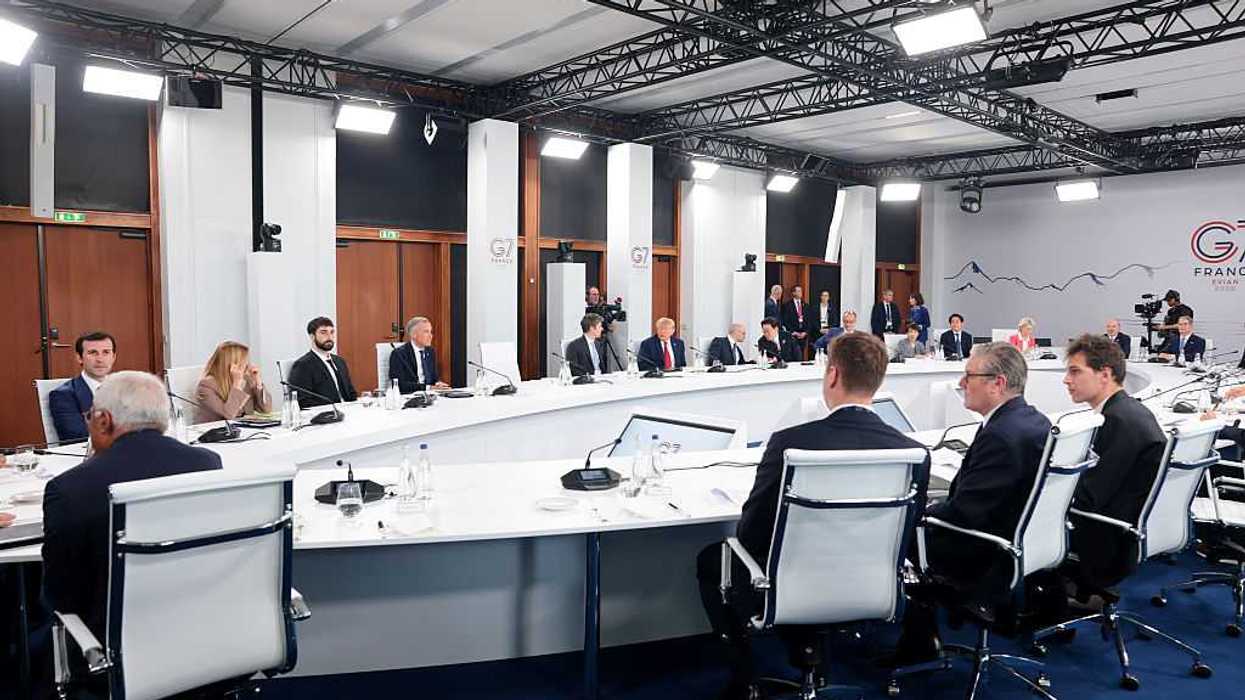
Last week at the annual meeting of the G7 nations, our world’s power elite came out of the shadows in a startling, but unsurprising, gathering of what Axios called “the world's most powerful heads of state gathered… with the CEOs of America's dominant AI companies.”
A report posted on Crypto Briefing observed that “the June 17 working lunch wasn’t a side event or a panel discussion. It was a core part of the summit agenda, placing AI company leaders in the same room, at the same table, with the same conversational weight as the presidents and prime ministers who traditionally monopolize these gatherings.”
Notably absent from the June 17 meeting were leaders of the world’s largest energy companies, media conglomerates, or militaries. In their stead were AI CEOs who were, Axios said, “seated and treated like heads of nation-states themselves….”
“This,” Axios explains, “is the future many leaders and AI CEOs envision — heads of state and the masters of tech in constant discussion, and sometimes conflict, over who controls AI, its rules, and its application to governing and world security.” But is it the world that citizens of the nations represented at the G7 envision for themselves and their world?
While many citizens and political leaders in G7 countries are consumed by the struggle against the rise of right-wing populism and the authoritarian forces they sponsor, the threat posed to freedom and democracy by those who are developing AI goes largely unaddressed. If they are to save democracy and preserve human freedom, they (and the public) must work on both fronts: opposing government actions that jeopardize them and also developing an effective regulatory framework for AI.
At every turn, pro-democracy forces need to recognize the disproportionate influence of AI leaders in government, both in the United States and other countries. In some places, most notably the United States, the government is already shaping policy in ways that reveal its influence.
Here, President Trump wants to give them free rein or, as he did on June 2, “slash... the bureaucratic constraints that the prior administration placed on America’s AI developers and researchers, and… instead encourage(e) AI innovation and accelerating responsible AI adoption across government and industry.”
The president wants the United States “to promote AI innovation and security by working collaboratively with the private sector to modernize government and private sector information systems and harden them against external threats; to protect American ingenuity and intellectual property from exploitation and theft by adversaries; and to cultivate America’s advanced AI-enabled capabilities.”
A photo of heads of state sitting at the same table with the AI CEO’s taken at the G7 offers a vivid image of what that collaboration might entail. Some of this embrace of a partnership between those groups is driven by a fear that China will beat the West in the effort to develop AIU and enlist it for its own purposes.
Last year, the Trump Administration made that fear explicit when it released its AI Action Plan. “The United States,” it said, “is in a race to achieve global dominance in artificial intelligence. Whoever has the largest AI ecosystem will set the global standards and reap broad economic and security benefits. Under President Trump, our Nation will win, ushering in a new Golden Age of innovation, human flourishing, and technological achievement for the American people.”
To those old enough to remember, Trump’s plan sounds a lot like this country’s response to the Soviet Union’s 1957 launch of Sputnik, the first satellite in orbit. As the Department of State Office of the Historian notes, “The successful launch came as a shock to experts and citizens in the United States….”
“Although President Dwight Eisenhower had tried to downplay the importance of the Sputnik launch to the American people,” it continues, “he poured additional funds and resources into the space program in an effort to catch up…The success of Sputnik had a major impact on the Cold War and the United States. Fear that they had fallen behind led U.S. policymakers to accelerate space and weapons programs.”
Because emergencies are seldom conducive to the flourishing of democratic politics, that fear gave even greater impetus to America’s power elite than it had before Sputnik.
We get glimpses of that dynamic in a June 5, 2026, White House Fact Sheet summarizing the administration’s view of the importance of AI’s rapid development. “Advanced AI capabilities,” it said, “make our Nation stronger, but also introduce new national security considerations that require coordinated action across executive departments and agencies (agencies), and components.”
Coordinated action. Hardly subtle.
But if that was not enough of a tell, the White House went on to say: “As these capabilities evolve, my Administration will continue to work closely with industry to ensure that the best and most secure technology is deployed rapidly to confront any and all threats to our country.” And it continued to highlight the president’s efforts to spur “historic private-sector investment commitments into American AI infrastructure, manufacturing, and research…”
That brings us back to the extraordinary meeting at the G7.
Reports suggest that the AI CEOs urged the G7 leaders to cooperate among themselves and with the AI industry. Axios says that they called for the creation of "’an international forum for discussion that establishes globally accepted standards for testing, provides expert and impartial analysis of capabilities and risks, and serves as a venue for cooperation among nations.’"
The AI CEOs proposed “a US-led coalition to establish global AI rules….They’re actively shaping the regulatory architecture and suggesting which country should lead it.”
C. Wright Mills would not be surprised, and neither should we, when leaders in the AI world try to act as decision-makers in the public realm. However, he would not have imagined that they would do so as openly as they did at the G7 or that presidents and prime ministers would be willing to be shown treating them as equals.
In his time, Mills hoped that an alliance of intellectual critics and social movements would expose and organize popular opposition to his era’s power elite. In our time, his formula still seems apt. The brazenness of the G7 meeting was almost a dare to see what opposition would emerge.
The response is now up to those of us who write and those who organize in the effort to preserve democracy.
Austin Sarat is the William Nelson Cromwell professor of jurisprudence and political science at Amherst College.