

Skip to content
Search

Latest Stories

Follow Us:
Top Stories

While Trump Slush Fund for Convicted Criminals Could Die, It’s Another Example of Trump Tyranny

Opinion

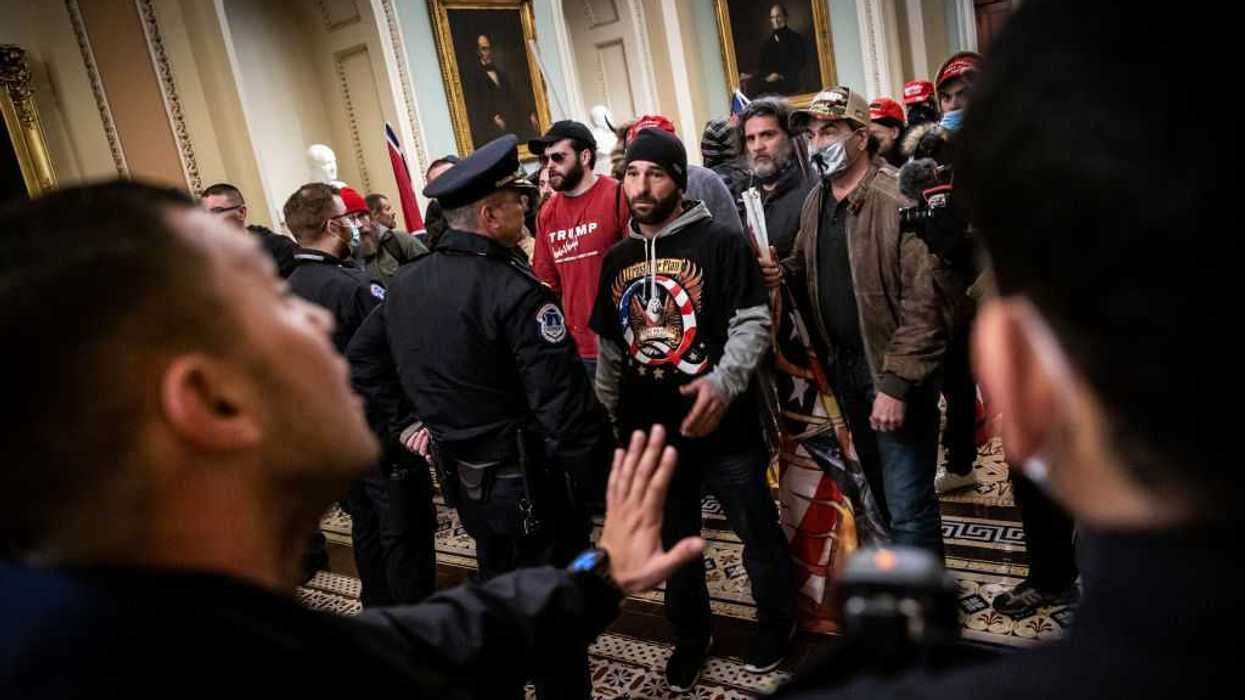
Protesters interact with Capitol Police inside the U.S. Capitol Building on January 6, 2021.

Protesters interact with Capitol Police inside the U.S. Capitol Building on January 6, 2021 in Washington, DC. Congress held a joint session today to ratify President-elect Joe Biden's 306-232 Electoral College win over President Donald Trump.

Win McNamee / Getty Images

Whichever political ideology you belong to, the current President, Donald A. Trump, literally made it “okay” to be a criminal for him. While there has been push-back from the courts and members of his own political party, which could lead to the slush fund’s abandonment, it’s a slap in the face for all law-abiding citizens. It’s yet again an attempt by Trump and his cronies to legitimize his followers’ illegal conduct that benefits a cruel and oppressive government.

On May 18, 2026, Trump's personal lawyers and Trump-loyal lawyers inside the Justice Department settled a lawsuit filed by the Trump family against the IRS by creating a $1.8 billion slush fund, and hoping the patriotic label would distract from who was receiving the money, calling it the “1776 Fund.”


J.D. Vance tried to make sense of it all for the American people during a contemporaneous press conference. Vance didn’t deny that the slush fund was understood to compensate so-called “supporters of President Trump” who attacked our nation’s capital on January 6, 2021, but added “anyone else who wants to apply for it,” could do so, as if that mattered.

Vance tried to soften the blow of the bad news for American taxpayers by characterizing the subsequent prosecutions of “J6ers” as they are known as “lawfare by the Biden Administration” against “people of different viewpoints” and not “people who broke the law.” However, Vance admitted to reporters, as he must, that the payouts would be to people who did in fact commit crimes.

Despite this, Vance characterized the payouts as “compensation” to these adjudicated criminals, who were convicted of their crimes or pled guilty to them, as they were “disproportionately punished” for the crimes they committed. Apparently, receiving a Presidential pardon for committing serious crimes against America is not enough.

They were, after all, criminals “mistreated by the justice system,” exclaimed Vance, unlike every other common, poor, and uneducated criminal, convicted and sentenced to federal prison for decades. And for the Capitol police injured or killed because of their actions, “bupkis” is the word for what they get. And the icing on the cake of the scam perpetrated on Americans was another agreement, which surfaced a promise not to prosecute Trump or any of his associates for tax fraud.

Fortunately, for now, federal court judges intervened. One judge temporarily blocked the slush fund after several lawsuits were filed. Another federal court judge questioned the legitimacy of Trump’s tax case settlement since he was represented by both sides, individually and as President, and questioned whether the settlement was fraudulent in the first place. The court went as so far as to question whether the court itself was “the victim of fraud.”

While the Trump-run Justice Department said it would obey the federal courts, it found, as we expected it would, the courts’ actions objectionable.

If you were waiting for a thoughtful conservative analysis, rather than relying on my description of the deceit that occurred, it came from outgoing Kentucky Senator Mitch McConnell, after a closed-door two-hour meeting with Acting Attorney General and former personal attorney for Trump. McConnell stated, “So the nation’s top law enforcement official is asking for a slush fund to pay people who assault cops? Utterly stupid, morally wrong. Take your pick.”

One could add the whole thing --- slush fund and tax reprieves --- are illegal under the Fourteenth Amendment’s admonishment that the government “shall [not] assume or pay any debt or obligation incurred in aid of insurrection or rebellion against the United States,” but that’s too technical it seems.

To sum it up and put a bow on it, outgoing North Carolina Senator Tom Tillis held nothing back, “I think it’s stupid on stilts. It will invariably put us in a position . . . [to] compensate someone who assaulted a police officer, admitted their guilt, got convicted, got pardoned, and now we’re going to pay them for that? That’s absurd. When you take money from me to give to a purpose that I vehemently disagree with, that’s tyranny.” Well said, Tom. Well said.

James “Jim” Saranteas is an attorney, contributor to the American Constitution Society Expert Forum Blog, and a Volunteer State Lead for Lawyers Defending American Democracy, and an Activist.



Read More

An illustration of the U.S. flag on the shape of the U.S. with blue and red figures of people across it.

Every state has its own constitution.

How State Constitutions Became the Battleground for American Rights and Liberties – on Both the Left and Right

Beyond picking governors, state legislators, local officials and representatives to serve in Congress, voters in almost every state this year will have the opportunity to amend the language of their state constitution. In one state, they could potentially rewrite the constitution altogether.

Though the U.S. Constitution is rarely amended, voters frequently amend their state constitutions. In every election cycle, voters are asked to ratify constitutional amendments.

Keep ReadingShow less
Protestors holding signs at a rally, one reads, "Trump is not above the law."

Protesters gather at a Nobody Is Above the Law rally protesting President Trump's interference in the Mueller investigation on November 08, 2018 in Washington, DC.

Larry French/Getty Images

The Double Standard Presidency: When We Watch Leaders Act Above the Law

Americans are told that no one is above the law. Yet every day, they watch a president behave in ways that would get any ordinary citizen fired, disciplined, confronted, or held accountable — and they watch some Americans excuse it. What makes this moment even more striking is that critics across the political spectrum, including conservatives, now warn that the presidency is operating on a dangerous double standard. This is not a partisan concern. It is a constitutional one. And it is tearing at the fabric of our democracy.

For generations, the Constitution has provided guardrails — separation of powers, checks and balances, oversight mechanisms, and limits on executive authority — designed to prevent any leader from functioning above the law. The framers feared concentrated power more than anything else. They believed that the presidency must be constrained not only by written law but by norms of restraint, dignity, and respect for institutions. Those norms held for centuries because presidents understood that the office was larger than any individual, and Congress understood that oversight was not optional.

Keep ReadingShow less
Study Reveals Sharp Generational Divide in How Latino Identity Influences Daily Life

Study Reveals Sharp Generational Divide in How Latino Identity Influences Daily Life

Latino immigrants and U.S.-born Latinos differ sharply in how much their identity shapes their daily lives, according to recent findings from the Pew Research Center’s 2025 National Survey of Latinos. The survey shows that Latino immigrants are far more likely than U.S.-born Latinos to say their identity is central to who they are, and that it influences their experiences in the United States. Pew researchers Gabriel Piña, Mark Hugo Lopez, Sahana Mukherjee, Dalia Fahmy, and Alexandra Cahn report that the divide reflects differences in cultural connection, lived experience, and generational distance from immigrant roots.

Pew’s analysis finds that Latino immigrants are significantly more likely to say their origins are central to their identity, while U.S.-born Latinos — especially those in the third generation or higher — are less likely to feel that connection. The report notes that “U.S. Hispanics are divided on whether their identity helps or hurts them in America,” with some respondents describing their Latino identity as a source of pride and connection, and others saying it is tied to discrimination or barriers.

Keep ReadingShow less
A Democracy Cannot Run on an AI Model

Clerk Matthew Sandbar, 34, demonstrates part of the ballot-sorting process to members of the media attending a walkthrough of the Philadelphia Ballot Processing Center used to process the ballots of the 2022 US midterm elections, in Philadelphia on October 27, 2022.

Photo by Ryan Collerd / AFP via Getty Images

A Democracy Cannot Run on an AI Model

Tallying the results of Washington, DC’s first ranked-choice election in June took about 10 days—longer than many voters are used to. In an age when artificial intelligence can generate an answer in seconds, waiting days for election results can feel old-fashioned, inefficient, even suspicious. And it is about to matter far more widely. This November, 17 states, cities, and counties will use ranked-choice voting, including Maine and Alaska statewide, in races that could help decide control of Congress. More voters than ever will watch results take days to resolve, and more will be asked to trust a count they cannot see.

But that slowness may be one of its most democratic features.

Keep ReadingShow less