


Skip to content
Search

Latest Stories

Follow Us:
Top Stories

Podcast: Is the Supreme Court's legitimacy at risk?

Podcast: Is the Supreme Court's legitimacy at risk?

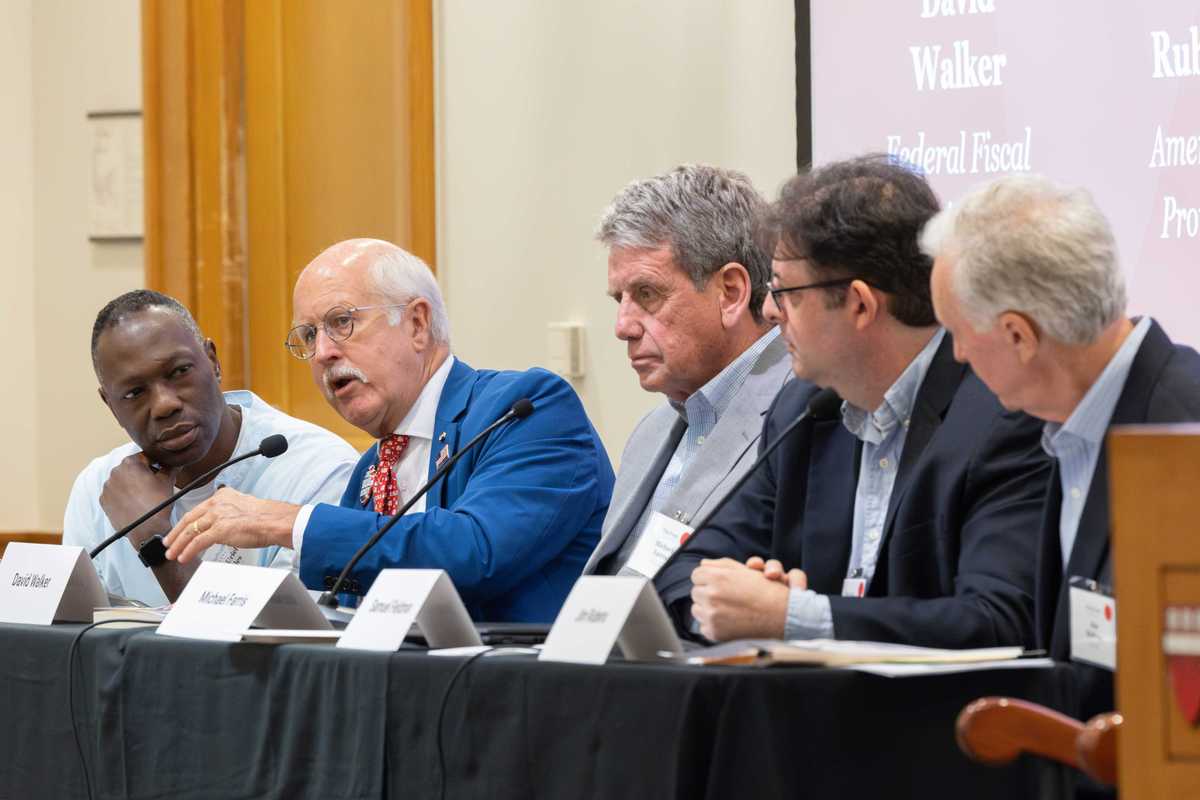
In this week’s episode of Politics In Question, Julia, Lee, and James discuss the Supreme Court and democratic legitimacy in front of a live audience at The Washington Center in Washington, D.C. How does public opinion influence the Supreme Court? What role does the Court play in the federal government? Is it the ultimate arbiter of controversial policy questions? And should it be reformed? These are some of the questions Julia, Lee, and James discuss in this week’s episode.


Is the Supreme Court's legitimacy at risk?

Is the Supreme Court's legitimacy at risk?

open.spotify.com


Read More

New Year’s Resolutions for Congress – and the Country

Speaker of the House Mike Johnson (R-LA) (L) and Rep. August Pfluger (R-TX) lead a group of fellow Republicans through Statuary Hall on the way to a news conference on the 28th day of the federal government shutdown at the U.S. Capitol on October 28, 2025 in Washington, DC.

Getty Images, Chip Somodevilla

New Year’s Resolutions for Congress – and the Country

Every January 1st, many Americans face their failings and resolve to do better by making New Year’s Resolutions. Wouldn’t it be delightful if Congress would do the same? According to Gallup, half of all Americans currently have very little confidence in Congress. And while confidence in our government institutions is shrinking across the board, Congress is near rock bottom. With that in mind, here is a list of resolutions Congress could make and keep, which would help to rebuild public trust in Congress and our government institutions. Let’s start with:

1 – Working for the American people. We elect our senators and representatives to work on our behalf – not on their behalf or on behalf of the wealthiest donors, but on our behalf. There are many issues on which a large majority of Americans agree but Congress can’t. Congress should resolve to address those issues.

Keep ReadingShow less
Two groups of glass figures. One red, one blue.

Congressional paralysis is no longer accidental. Polarization has reshaped incentives, hollowed out Congress, and shifted power to the executive.

Getty Images, Andrii Yalanskyi

How Congress Lost Its Capacity to Act and How to Get It Back

In late 2025, Congress fumbled the Affordable Care Act, failing to move a modest stabilization bill through its own procedures and leaving insurers and families facing renewed uncertainty. As the Congressional Budget Office has warned in multiple analyses over the past decade, policy uncertainty increases premiums and reduces insurer participation (see, for example: https://www.cbo.gov/publication/61734). I examined this episode in an earlier Fulcrum article, “Governing by Breakdown: The Cost of Congressional Paralysis,” as a case study in congressional paralysis and leadership failure. The deeper problem, however, runs beyond any single deadline or decision and into the incentives and procedures that now structure congressional authority. Polarization has become so embedded in America’s governing institutions themselves that it shapes how power is exercised and why even routine governance now breaks down.

From Episode to System

The ACA episode wasn’t an anomaly but a symptom. Recent scholarship suggests it reflects a broader structural shift in how Congress operates. In a 2025 academic article available on the Social Science Research Network (SSRN), political scientist Dmitrii Lebedev reaches a stark conclusion about the current Congress, noting that the 118th Congress enacted fewer major laws than any in the modern era despite facing multiple time-sensitive policy deadlines (https://papers.ssrn.com/sol3/papers.cfm?abstract_id=5346916). Drawing on legislative data, he finds that dysfunction is no longer best understood as partisan gridlock alone. Instead, Congress increasingly exhibits a breakdown of institutional capacity within the governing majority itself. Leadership avoidance, procedural delay, and the erosion of governing norms have become routine features of legislative life rather than temporary responses to crisis.

Keep ReadingShow less
Trump’s ‘America First’ is now just imperialism

Donald Trump Jr.' s plane landed in Nuuk, Greenland, where he made a short private visit, weeks after his father, U.S. President-elect Donald Trump, suggested Washington annex the autonomous Danish territory.

(Ritzau Scanpix/AFP via Getty Images)

Trump’s ‘America First’ is now just imperialism

In early 2025, before Donald Trump was even sworn into office, he sent a plane with his name in giant letters on it to Nuuk, Greenland, where his son, Don Jr., and other MAGA allies preened for cameras and stomped around the mineral-rich Danish territory that Trump had been casually threatening to invade or somehow acquire like stereotypical American tourists — like they owned it already.

“Don Jr. and my Reps landing in Greenland,” Trump wrote. “The reception has been great. They and the Free World need safety, security, strength, and PEACE! This is a deal that must happen. MAGA. MAKE GREENLAND GREAT AGAIN!”

Keep ReadingShow less
The Common Cause North Carolina, Not Trump, Triggered the Mid-Decade Redistricting Battle

Political Midterm Election Redistricting

Getty images

The Common Cause North Carolina, Not Trump, Triggered the Mid-Decade Redistricting Battle

“Gerrymander” was one of seven runners-up for Merriam-Webster’s 2025 word of the year, which was “slop,” although “gerrymandering” is often used. Both words are closely related and frequently used interchangeably, with the main difference being their function as nouns versus verbs or processes. Throughout 2025, as Republicans and Democrats used redistricting to boost their electoral advantages, “gerrymander” and “gerrymandering” surged in popularity as search terms, highlighting their ongoing relevance in current politics and public awareness. However, as an old Capitol Hill dog, I realized that 2025 made me less inclined to explain the definitions of these words to anyone who asked for more detail.

“Did the Democrats or Republicans Start the Gerrymandering Fight?” is the obvious question many people are asking: Who started it?

Keep ReadingShow less